
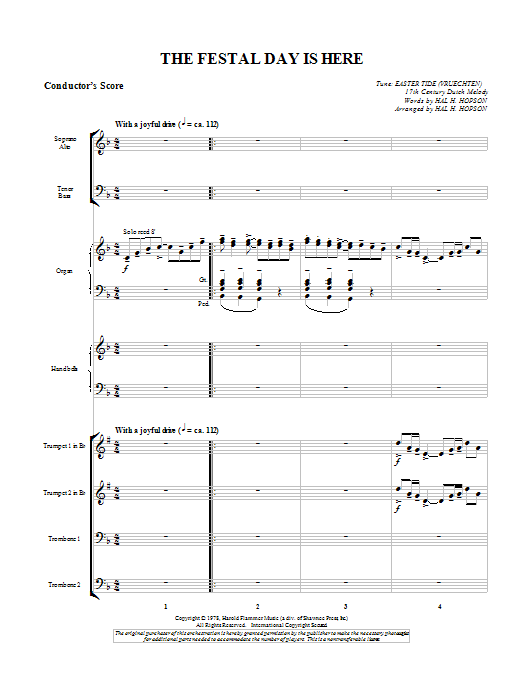

The Festal Day Is Here: Choral Instrumental Pak
Arranged by Hal Hopson
Item: 35-PK00252006
$30.00
Pickup currently not available
Buy Extra Parts (Digital PDF Download)
Parts Added to Cart!
Description
This festive anthem of praise is regal in its scope but not technically difficult for smaller groups. Stellar part-writing and well-conceived handbell and brass parts make this a must-do anthem for Resurrection Sunday. Duration: ca. 3:26.


The Festal Day Is Here: Choral Instrumental Pak isn't in MakeMusic Cloud just yet...but it could be. Let us know you'd like to see it, and you'll help shape what comes next. In the meantime, start a free trial and dive into thousands of interactive titles your students can play along with today.
Request This Title
Tell us you want it.
Start Your Free Trial
Explore everything that's ready to play right now.
Sample Audio
No sample audio found.
Sample Video
No sample videos found.
Additional Details
Publisher:
Hal Leonard
SKU:
35-PK00252006
More about this title
About the Arranger: Hal Hopson

Hal Hopson has established himself as one of the most prolific voices in American church music, with over 1000 published compositions spanning nearly every liturgical and concert genre. Based in Dallas, Texas, he brings both creative ambition and practical accessibility to his work, balancing artistic integrity with the real constraints of church music programs.
Hopson's influence extends across denominational lines and performance contexts. His God with Us was selected for preservation in the American Bicentennial time capsule at the Kennedy Center, a recognition of his significance in twentieth-century choral composition. He remains deeply engaged as a conductor and clinician, leading festivals internationally while maintaining an active focus on congregational song, hymn tune composition, and responsorial psalm settings featured in major hymnals. His service on the national boards of The Presbyterian Association of Musicians and Choristers Guild reflects his commitment to the craft and community of music education.
Why we love this
Hopson understands the realities of church music budgets and volunteer choirs. This anthem delivers genuine festive impact without demanding virtuosic singers or instrumentalists, making it genuinely achievable for congregations ranging from small to mid-sized. The brass and handbell parts feel integral to the sound rather than decorative, which means your instrumentalists get rewarding material while your choir carries the emotional core.
What to expect
Regal and jubilant without being overwrought. The music radiates confidence and joy, with clear harmonic language that feels celebratory rather than complex. The three and a half minute arc builds toward genuine moments of brightness, especially where the full ensemble aligns.
Who it's for
Any choir with access to brass players and bell ringers who wants a strong Easter or Resurrection Sunday anthem without the rehearsal burden of virtuosic writing. This works equally well in traditional worship settings and concert programs celebrating the Easter season.
How to get the most out of it
- Balance the handbell part carefully in rehearsal; it adds sparkle without needing to cut through dense choral textures. Sit your bell players where they can see the director clearly.
- Shape the brass entries as punctuation rather than accompaniment. They should land with purpose and clarity, not blur into the harmonic fabric.
- Build the piece's architecture around the major climactic moments. Resist the urge to sing at full volume throughout; let the festive energy come from dynamic contrast and rhythmic lift.
- Secure the choir's rhythmic precision early. The interaction between voices and brass parts will only sing if ensemble precision is rock solid.
How to use it
Lead with this for a spring choral concert's first half, or place it as the anchor anthem for Easter morning worship when you want something that sounds substantial but rehearses efficiently. It pairs well with lighter, shorter pieces that might precede it, allowing the full instrumental color to register as a special moment.
Skills your students will build
- Blending voices with sustained brass lines
- Responding to instrumental cues and entrances
- Maintaining rhythmic integrity in ensemble contexts
- Reading and performing fanfare-style rhythmic figures