
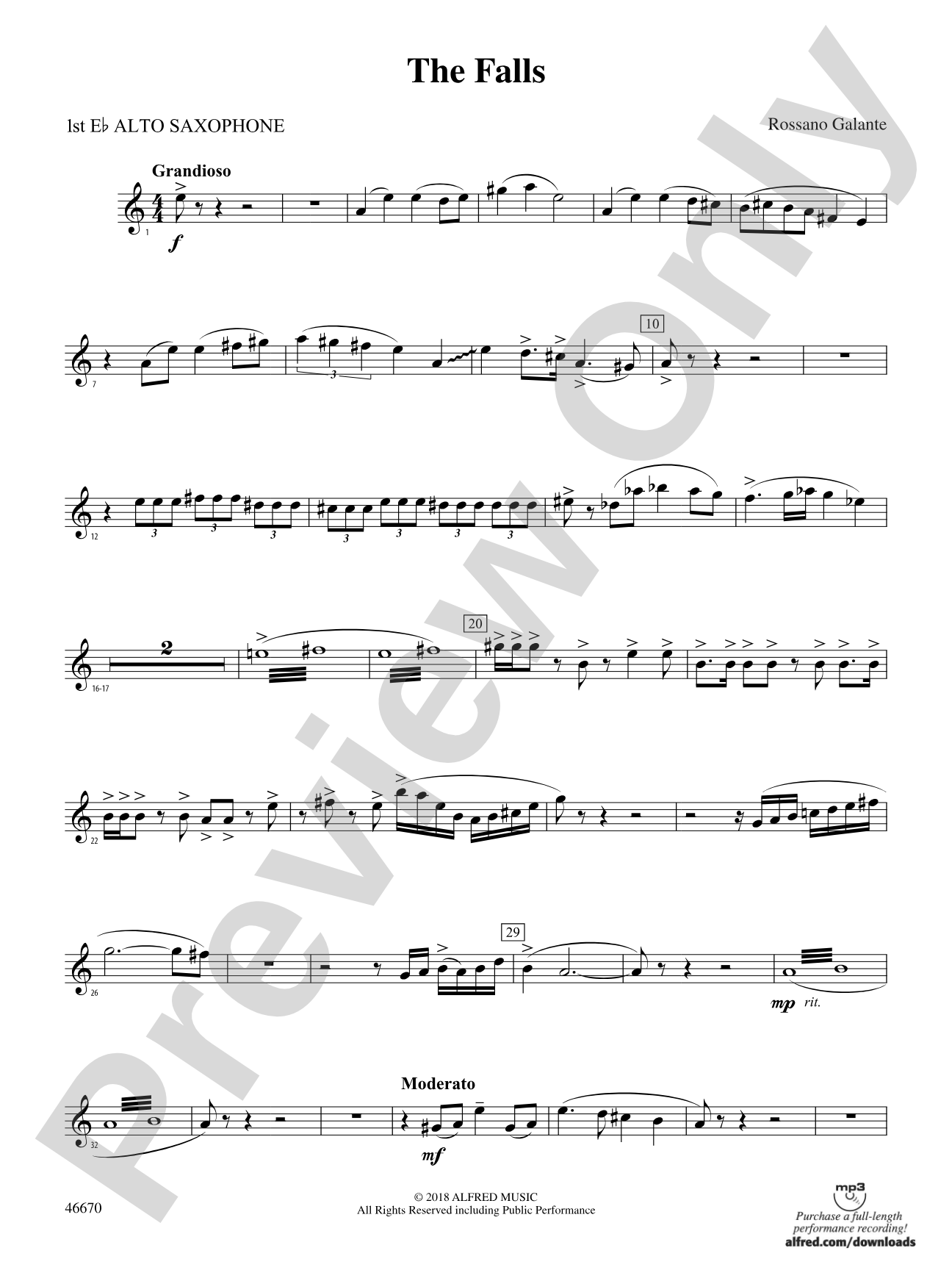

The Falls: E-flat Alto Saxophone
By Rossano Galante
Grade: 4.5 (Medium Difficult)
Item: 00-PC-0017809_AX1
$5.99
Pickup currently not available
Description
Highlighting the falls as it cascades over rocky terrain, sparkling wind and brass fanfares depict the water as it rushes forward before exploding over the edge. Melodic lines transport the audience into the mysterious and rapturous wilderness as this remarkable piece evokes one of nature's must glorious creations. This title is available in MakeMusic Cloud.


Don't just read it, hear it, play along with it, and watch your students grow with it. In MakeMusic Cloud, The Falls: E-flat Alto Saxophone comes alive with professional accompaniment, adjustable tempo, and built-in practice tools that turn solo practice into real progress.
Open in the Player
Jump straight in and assign it today.
Start Your Free Trial
Open this title and explore the full library in minutes.
Sample Audio
1
Audio File
--:--
0:00
0:00
Sample Video
Additional Details
Series:
Alfred Concert Band
Publisher:
Alfred Music
Page Count:
288
SKU:
00-PC-0017809_AX1
More about this title
About the Composer: Rossano Galante

Rossano Galante grew up in Buffalo, New York, and earned his Bachelor of Arts in Trumpet Performance from SUNY Buffalo in 1992. That same year, he was selected as one of nineteen candidates worldwide to enter the University of Southern California's Film Scoring Program, where he studied under the legendary Jerry Goldsmith, Academy Award winner for The Omen. In 1999, Galante relocated to California and began a prolific career in film orchestration, collaborating with Oscar-nominated composers Marco Beltrami, Christophe Beck, Brian Tyler, and Christopher Lennertz on over eighty feature films including the Marvel Cinematic Universe, the A Quiet Place franchise, and recent releases such as Fast X and The Super Mario Brothers Movie.
Beyond his work in film, Galante has become a sought-after composer for concert band and orchestra, with commissions performed worldwide. His catalog includes over 68 published compositions distributed through Alfred, Schirmer, Hafabra, C.L. Barnhouse, Musikverlag Frank, and Dehaske/Curnow, establishing him as both a Hollywood orchestrator and a significant voice in wind band literature.
Why we love this
Galante captures the raw drama of a waterfall with crystalline orchestration that stays grounded in concert band colors. The piece balances visceral brass fanfares and shimmering wind textures against flowing melodic passages, giving performers at the Grade 4.5 level genuinely rewarding material that sounds far more sophisticated than it is to execute. This is the kind of programmatic writing that justifies a full rehearsal block without feeling like students are playing an extended sound effect.
What to expect
The music erupts with crystalline energy as rushing water transforms into explosive sound. You move between moments of turbulent brilliance and passages of mysterious lyricism, as if watching sunlight catch the mist while standing in the spray of the falls.
Who it's for
Directors programming a Grade 4.5 concert band looking for contest or festival material that combines technical polish with genuine musical substance. This piece works equally well for ensembles seeking a striking programmatic centerpiece that stretches musicianship without requiring virtuoso soloists.
How to get the most out of it
- Balance the wind and brass fanfares so the water imagery remains clear; avoid letting the brass overwhelm the delicate shimmer of the woodwinds during cascading passages.
- Shape the melodic lines with long-phrase breathing that moves forward through the wilderness imagery; resist the urge to break at every natural moment.
- Layer the dynamic swells carefully to suggest the water's acceleration toward the edge; coordinate the ensemble so dynamic peaks arrive together and not in ragged waves.
- Lock the rhythm section during the faster rushing passages to create momentum without dragging; the energy builds from turbulence, not from rushing the tempo itself.
How to use it
Program this as a standalone concert feature or as the thematic anchor of a nature-inspired program. The Grade 4.5 difficulty and contest-appropriate length make it ideal for festival circuits in spring, where programmatic pieces with strong visual narratives often capture judges' attention.
Skills your students will build
- Balancing contrasting timbral layers (shimmering woodwinds against brass fanfares)
- Shaping long melodic phrases with ensemble cohesion
- Executing coordinated dynamic swells and crescendos
- Reading and responding to programmatic intent through orchestration
- Sustaining rhythmic precision during fast, textured passage work