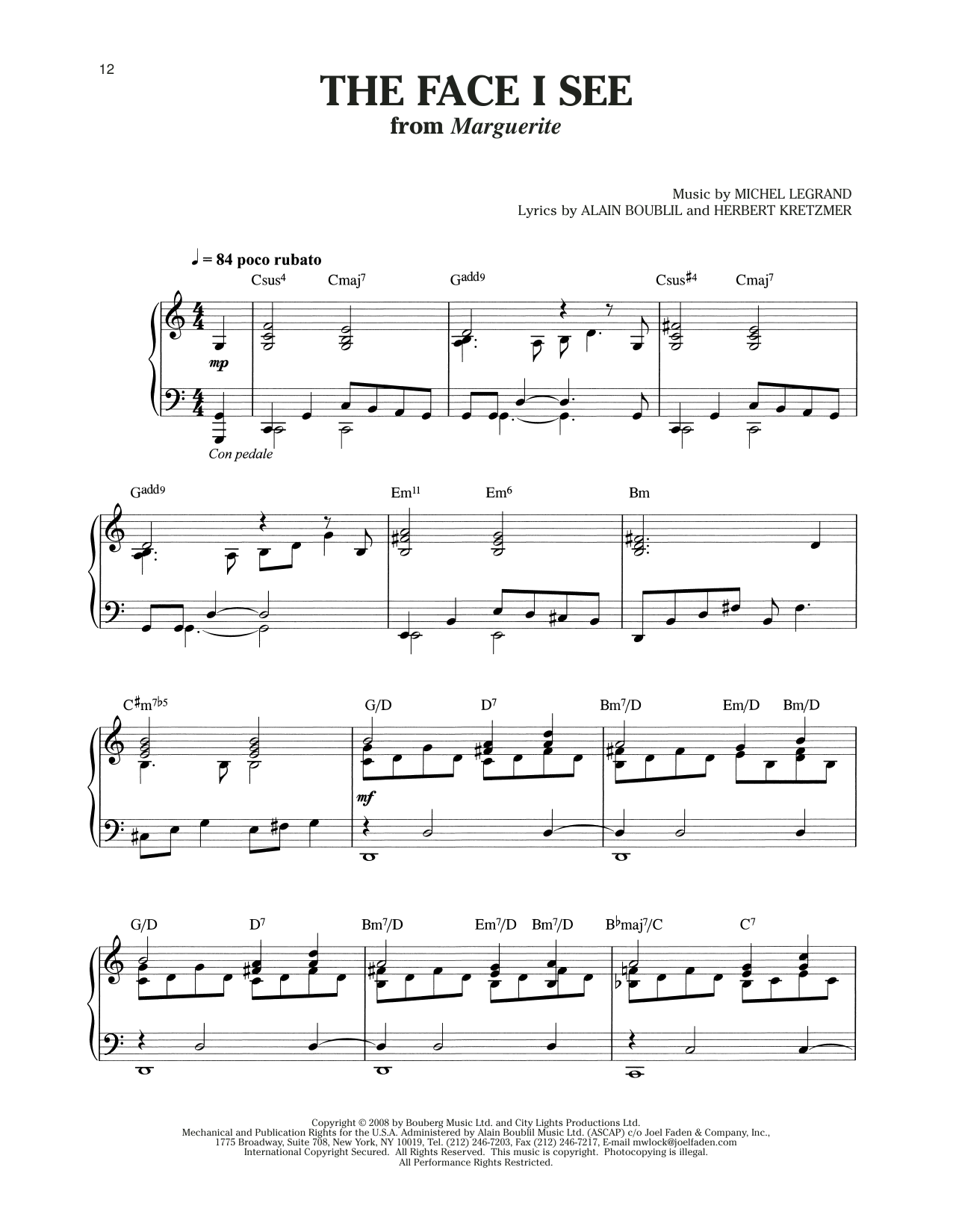
The Face I See (from Marguerite) Sheet Music Preview

The Face I See (from Marguerite): Piano Vocal

By Michel LeGrand / By Claude-Michel Schönberg

Item: 35-DS01735380

Digital Download
$5.99
Description

The Face I See (from Marguerite): Piano Vocal isn't in MakeMusic Cloud just yet...but it could be. Let us know you'd like to see it, and you'll help shape what comes next. In the meantime, start a free trial and dive into thousands of interactive titles your students can play along with today.

Sample Audio
No sample audio found.
Sample Video
Additional Details
Publisher: Hal Leonard
Page Count: 8
SKU: 35-DS01735380

More about this title

About the Composer: Michel LeGrand

Michel LeGrand stands as one of the most prolific film and musical theater composers of the twentieth century, known for his gift for crafting emotionally direct melodies that embed themselves in listeners' memory. His work spans from iconic film scores (The Umbrellas of Cherbourg, The Thomas Crown Affair) to stage musicals, where he collaborated with lyricists and librettists to create songs that blend jazz-inflected harmony with theatrical storytelling.

For musicians and students, LeGrand's output represents a masterclass in how sophisticated harmonic language can serve immediate emotional communication. His Broadway collaborations, particularly those with Claude-Michel Schönberg, showcase how a composer can honor both compositional craft and the human voice's expressive capacity.

Why we love this

This piece carries the harmonic sophistication LeGrand brought to Broadway while remaining singable across different voice types and ranges. The piano part is written with genuine accompaniment artistry, neither overshadowing the vocalist nor reducing itself to mere support; it's a conversation between two musicians. Vocalists consistently connect to the emotional immediacy of the lyric because the music doesn't get in the way of the text.

What to expect

The piece unfolds with the introspection of someone recognizing something profound in another person's presence. LeGrand's harmonic movement creates a gentle forward momentum beneath lyrics that suggest vulnerability and discovery. The eight pages allow the emotional arc to breathe, building from quiet recognition toward something approaching affirmation, all without theatrical excess.

Who it's for

Advanced high school singers and college-level vocalists working on contemporary musical theater repertoire. Pianists preparing to accompany auditions or recitals will find this a worthwhile study in theatrical accompaniment writing. Voice teachers seeking material that combines melodic appeal with harmonic substance will appreciate both the musicality and singability here.

How to get the most out of it

  • Balance the vocal line with the piano introduction by rehearsing separately first; the accompaniment's independence can easily overshadow an insecure singer in the opening phrases.
  • Pay attention to the harmonic rhythm in the piano part. LeGrand's changes move purposefully, and pressing forward through them rather than dwelling on each shift keeps the song moving emotionally.
  • Shape the phrase endpoints with care rather than sustaining to beat four. The song's effectiveness depends on thoughtful breath placement and the pianist responding to those breath moments.

How to use it

This works as a solo recital selection for intermediate and advanced singers, offering a lighter counterpoint to heavier dramatic material while still demonstrating musicianship. It pairs well on a program exploring contemporary musical theater song writing or on a cabaret-style concert where individual songs take center stage. Consider it for voice studio recitals where accompaniment quality matters significantly to the overall impression.

Skills your students will build

  • Navigating a vocal line that sits across chord changes without losing phrasal integrity
  • Collaborative listening between vocalist and pianist in a piece without a strict rhythmic grid
  • Expressing emotional subtext through dynamic restraint rather than vocal projection
  • Reading and executing jazz-influenced harmonic language in a theatrical context
  • Balancing legit vocal technique with the conversational approach required in contemporary musical theater

You May Also Like