
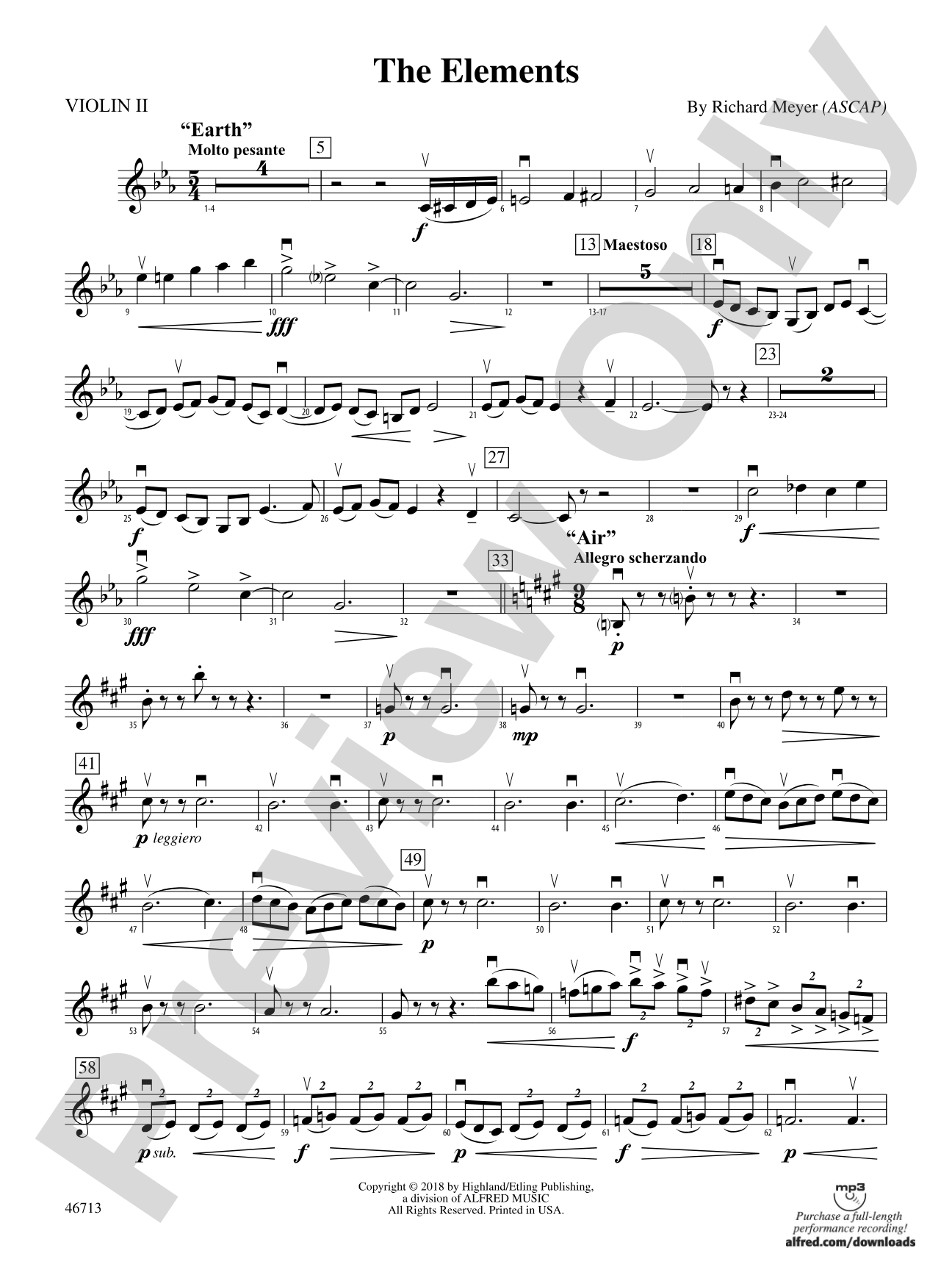

The Elements: 2nd Violin
By Richard Meyer
Grade: 4
Item: 00-PC-0017848_VN2
$5.99
Pickup currently not available
Description
"The Elements" by Richard Meyer is a colorful depiction of the four basic elements---earth, air, water, and fire---and is sure to challenge and delight every member of your advanced string orchestra. Impressionistic harmonies and fascinating rhythmic nuances give this piece an other-worldly feel with each element coming alive as a unique and wondrous tone painting. Technical challenges include 5/4, 9/8, and 7/4 meters and a refreshing variety of diverse key signatures and modes. This title is available in MakeMusic Cloud.


Don't just read it, hear it, play along with it, and watch your students grow with it. In MakeMusic Cloud, The Elements: 2nd Violin comes alive with professional accompaniment, adjustable tempo, and built-in practice tools that turn solo practice into real progress.
Open in the Player
Jump straight in and assign it today.
Start Your Free Trial
Open this title and explore the full library in minutes.
Sample Audio
1
Audio File
--:--
0:00
0:00
Sample Video
Additional Details
Series:
Highland/Etling String Orchestra
Publisher:
Alfred Music
Page Count:
124
SKU:
00-PC-0017848_VN2
More about this title
About the Composer: Richard Meyer

Richard Meyer brings three decades of string instruction experience to his work as a conductor, clinician, and composer. He directed orchestras at Oak Avenue Intermediate School in Temple City, California for 22 years, expanding the program from 29 students to 200, while also overseeing the city's elementary string curriculum. His leadership of the Pasadena Youth Symphony Orchestra for 16 years included performances across North America, Europe, and Australia.
Meyer has established himself as a nationally recognized composer with over 190 published works and arrangements. Beyond the concert hall, he created the "Giving Bach" program in 2009, an initiative that uses interactive concerts to serve special needs and underserved student populations throughout Southern California. His contributions to string pedagogy include co-authoring the String Explorer Series and Sight-read It for Strings, and he served as string editor for Alfred Publishing Company for 16 years.
Why we love this
Meyer writes for what advanced orchestras can actually do, not what they wish they could do. The rhythmic complexity (5/4, 9/8, 7/4) feels earned rather than imposed, and the impressionistic harmonic language gives students something genuinely sophisticated to interpret without relying on virtuosic passage work. This is the kind of piece that makes advanced ensembles sound mature and thoughtful.
What to expect
Meyer's tone painting unfolds like a series of vivid impressionistic watercolors. Each element emerges through shifting meters, modal colors, and harmonic surprise, creating an otherworldly landscape where rhythmic nuance and tonal variety replace traditional melodic narrative. The piece invites listeners into a space where earth, air, water, and fire become palpable sensations rather than abstract concepts.
Who it's for
Advanced high school and college string orchestras seeking repertoire that combines technical challenges with genuine musical substance. Ensembles comfortable reading mixed meters and exploring contemporary harmonic language will find this piece rewarding to perform and audiences equally engaged by its visual and sonic imagery.
How to get the most out of it
- Treat the meter changes as compositional texture, not obstacles. Rather than drilling each meter in isolation, rehearse phrases across the transitions so students hear how Meyer uses shifting meters to paint each element's character.
- Balance the impressionistic harmonies with clear sectional independence. The tone painting requires good intonation and blend, which means checking that each section (especially inner voices) locks onto their harmonic function before adding expressive shaping.
- Conduct the piece to emphasize the rhythmic architecture within each meter. A steady 5/4 pulse feels static; shape the phrases so students understand where the weight falls and how the meter supports the programmatic intent.
How to use it
Open a concert with this work to signal ambition and set a contemporary tone, or use it as a centerpiece to anchor a program around nature or elemental themes. Its 124-page length and technical demands position it well as a mid-season festival contest piece where judges will appreciate both the compositional craft and the ensemble's interpretive maturity.
Skills your students will build
- Reading and maintaining 5/4, 9/8, and 7/4 meters independently within ensemble contexts
- Harmonic listening in modal and impressionistic harmonic language
- Intonation adjustment across diverse key signatures and harmonic centers
- Sustained ensemble blend and sectional independence during complex rhythmic interplay
- Musical interpretation of programmatic content through rhythmic and tonal color choices