
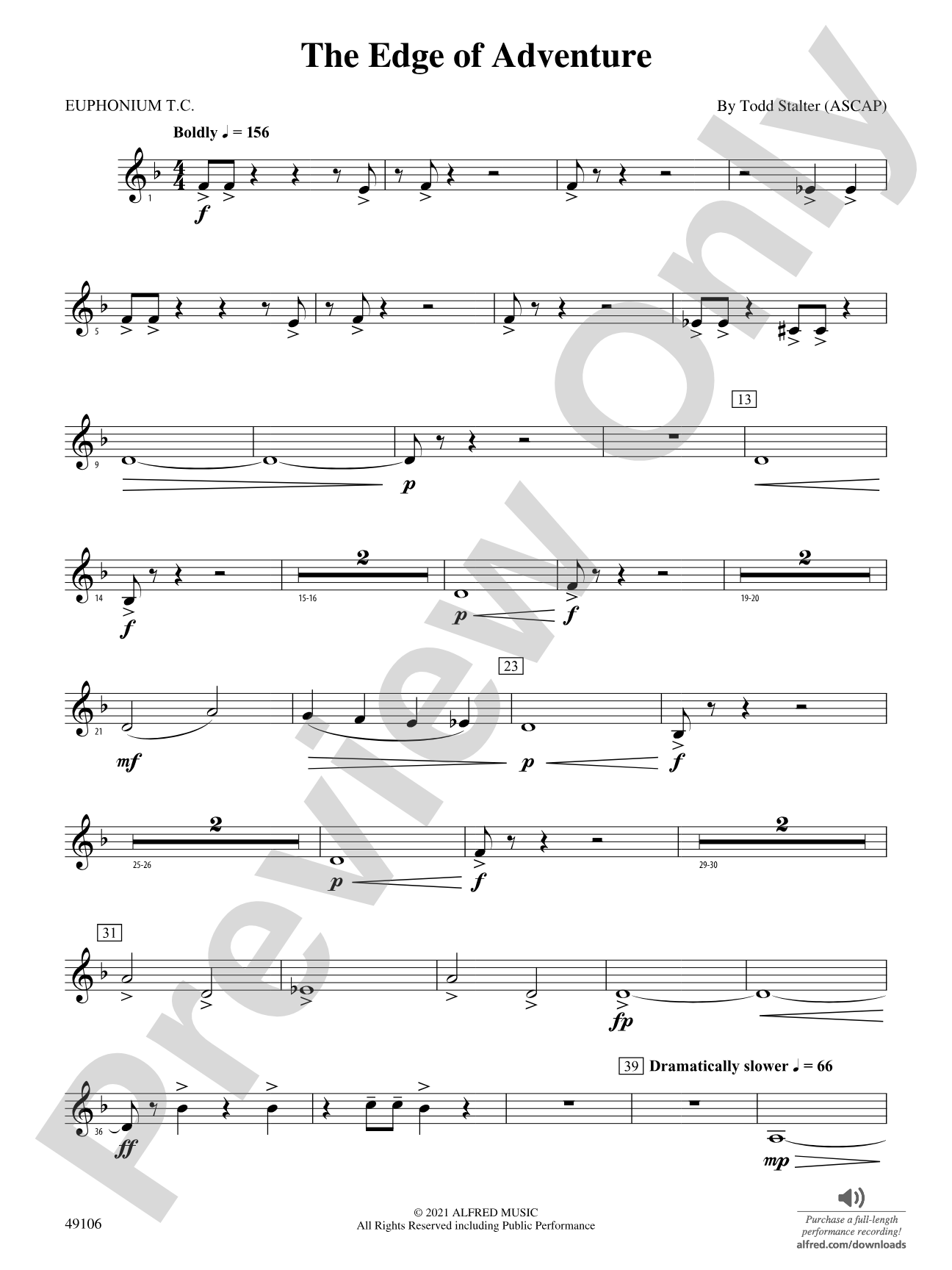

The Edge of Adventure: Baritone T.C.
By Todd Stalter
Grade: 2.5 (Medium Easy)
Item: 00-PC-0018680_BTC1
$3.00
Pickup currently not available
Description
Excitement, anticipation, dread, wonder . . . all of these thrilling aspects of the journey of discovery into the unknown are musically depicted in composer Todd Stalter's work, The Edge of Adventure. Players will love the energetic tempo of the beginning, with its unanticipated rhythmic accents, driving percussion, and foreboding chords, and have an opportunity to play expressively in a middle section that builds to a triumphant, musically satisfying expression of amazement and beauty. Listeners and performers alike are drawn into the piece, constantly sitting on adventure's edge, unaware of what to expect as their quest for discovery unfolds. An ideal young band piece to open or close a concert, The Edge of Adventure lends itself to connections to literature and artwork that can inspire your students to find deeper levels of meaning in the music. (3:10) This title is available in MakeMusic Cloud.


Don't just read it, hear it, play along with it, and watch your students grow with it. In MakeMusic Cloud, The Edge of Adventure: Baritone T.C. comes alive with professional accompaniment, adjustable tempo, and built-in practice tools that turn solo practice into real progress.
Open in the Player
Jump straight in and assign it today.
Start Your Free Trial
Open this title and explore the full library in minutes.
Sample Audio
1
Audio File
--:--
0:00
0:00
Sample Video
Additional Details
Series:
Young Symphonic
Publisher:
Alfred Music
Page Count:
151
SKU:
00-PC-0018680_BTC1
More about this title
About the Composer: Todd Stalter

Todd Stalter spent 34 years as Director of Bands at Eureka High School in Illinois, where he built one of the state's most respected band programs. His marching band won 16 Class 1A state championships, his concert band earned consistent Superior ratings at IHSA contests, and his ensembles performed at Orchestra Hall in Chicago and Walt Disney World. He holds membership in the Illinois State Marching Band Championships Hall of Fame.
As a conductor, Stalter has led All-State bands in Georgia and Delaware, along with numerous honor and district ensembles. He remains active as an adjudicator, clinician, and composer whose works for band and string orchestra are performed across the United States and appear on state festival and contest lists. His compositions are featured in the "Teaching Music Through Performance in Band" series published by GIA. Stalter earned his Bachelor of Music Education and Master of Music in Trumpet Performance from Illinois State University.
Why we love this
The Edge of Adventure captures genuine emotional storytelling within a structure that young bands can execute with real musical impact. Stalter creates kinetic rhythmic energy in the opening, establishes genuine contrast with an expressive middle section, and delivers a satisfying climax that leaves audiences remembering the piece. It works equally well as a concert opener or closer, and the narrative arc gives students concrete imagery to shape their phrasing and dynamics.
What to expect
The opening pulls you into a state of nervous anticipation, with sharp accents and minor-key shadowing creating an almost cinematic sense of stepping into unknown territory. The middle section strips away the frenetic energy, allowing the ensemble to breathe and sing, before building to a moment of genuine wonder and triumph that feels earned rather than imposed.
Who it's for
Young bands at the Grade 2.5 level who are ready to handle rhythmic sophistication and dynamic range. Ensembles with solid fundamentals can access the energetic character and expressive demands of this piece without requiring advanced technical skills.
How to get the most out of it
- Land the rhythmic accents in the opening section with precision; these attacks should feel unpredictable but never sloppy, creating the intended sense of anticipation and unease.
- Shape the middle section with patient crescendos and careful dynamic control, resisting the urge to push the tempo forward as intensity builds.
- Balance the driving percussion throughout so it propels rather than overwhelms; the rhythm section should feel like it's pulling the ensemble forward.
- Work the final statement to a genuine climax; this triumphant section deserves full commitment from every player to land the musical satisfaction the piece promises.
How to use it
Open a concert with this piece to establish energy and grab attention immediately, or close one on a note of triumph and discovery. The vivid narrative arc and moderate technical demands make it an excellent choice for a festival or contest where you want to showcase both musicianship and engagement.
Skills your students will build
- Executing precise rhythmic accents and syncopation in a driving tempo
- Creating contrast between agitated and lyrical musical character
- Balancing forte dynamic sections without sacrificing articulation clarity
- Building extended crescendos with intentional pacing and control
- Responding to melodic and harmonic shifts that signal emotional changes