The Duke: Piano Digital Sheet Music

The Duke: Piano Digital Sheet Music

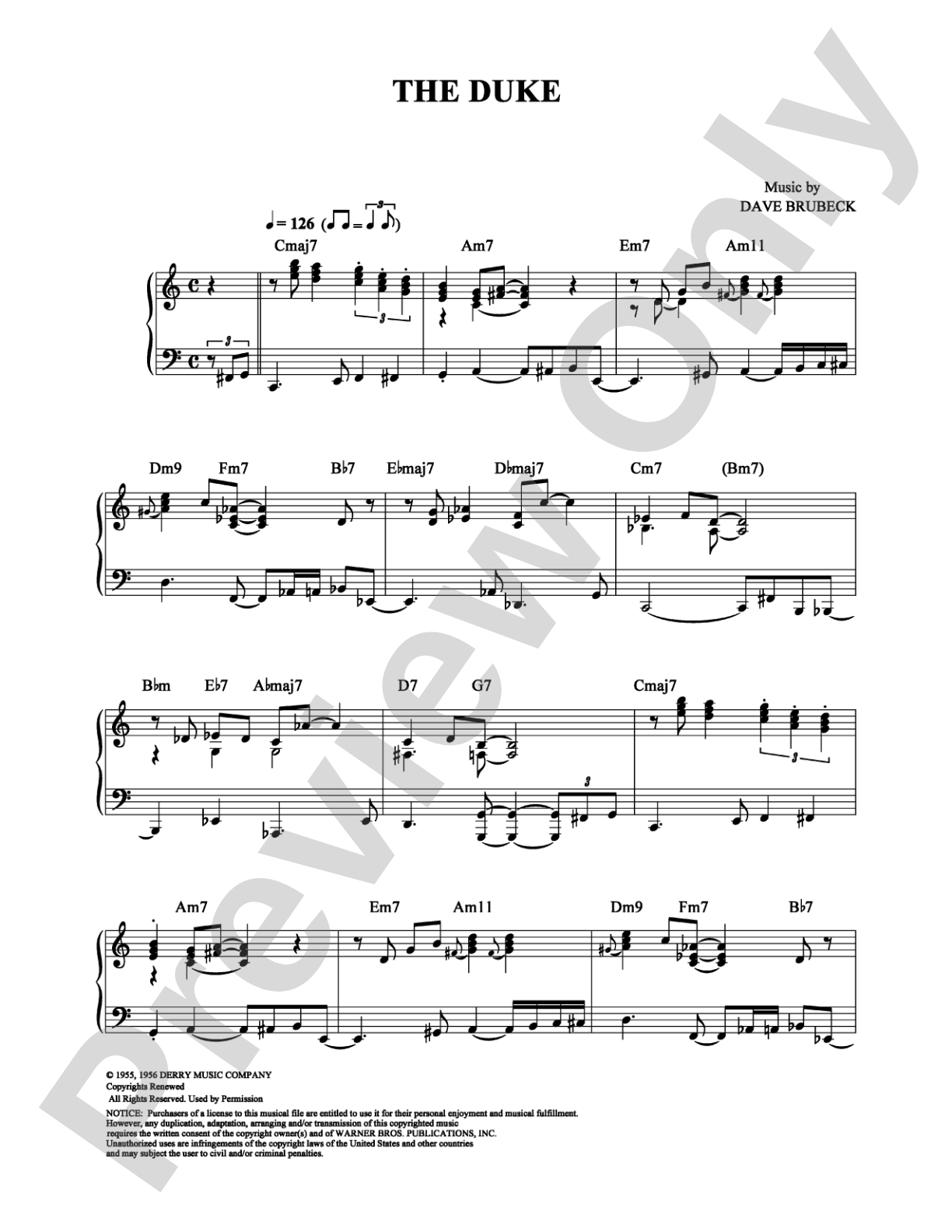
Dave Brubeck, Marian McPartland

Item: 00-PS-0000967

Digital Download
$3.99
Description

The Duke: Piano Digital Sheet Music isn't in MakeMusic Cloud just yet...but it could be. Let us know you'd like to see it, and you'll help shape what comes next. In the meantime, start a free trial and dive into thousands of interactive titles your students can play along with today.

Sample Audio
No sample audio found.
Sample Video
Additional Details
SKU: 00-PS-0000967

More about this title

About the Artist: Marian McPartland

Marian McPartland (1918-2011) was a British-American jazz pianist and composer whose career spanned seven decades. She co-founded the Hickory House jazz club in New York, where she performed regularly for decades, and later became the host of the long-running NPR program "Piano Jazz," through which she interviewed and performed alongside nearly every major jazz artist of the late twentieth century.

Why we love this

McPartland's compositions combine swing-era sensibility with sophisticated harmonic language, making them approachable for jazz pianists developing their improvisational voice. "The Duke" has the melodic clarity and rhythmic directness that made her work so effective in live performance, yet leaves room for genuine personal interpretation.

What to expect

The piece carries the warmth and directness of the bebop era, with a melody that feels both polished and conversational. There's a relaxed confidence in the phrasing that reflects decades of live performance and genuine connection with the jazz tradition.

Who it's for

Jazz pianists working toward fluency in swing standards and learning to balance composed melody with improvisation. This piece works well for intermediate to advanced students who have solid chord knowledge and want to study how a master composer crafted accessible yet musically substantial material.

How to get the most out of it

  • Let the melody sing through the early phrases before adding comping texture; McPartland wrote these lines to be heard clearly.
  • Explore the harmonic changes during your solo sections—the progression supports both straight-ahead swing phrasing and chromatic approach notes.
  • Listen for the natural swing feel in the original recording to internalize the groove before laying down your own interpretation.

How to use it

Feature this in a jazz recital or informal concert setting where you want to showcase your comping and improvisational skills. It also pairs naturally with other mid-century jazz standards in a program that traces the swing-to-bebop era.

Skills your students will build

  • Swing comping in the style of 1940s-50s jazz piano
  • Improvising over jazz changes while maintaining melodic coherence
  • Balancing written melody with rhythmic reinterpretation
  • Listening and learning from recorded performances

You May Also Like