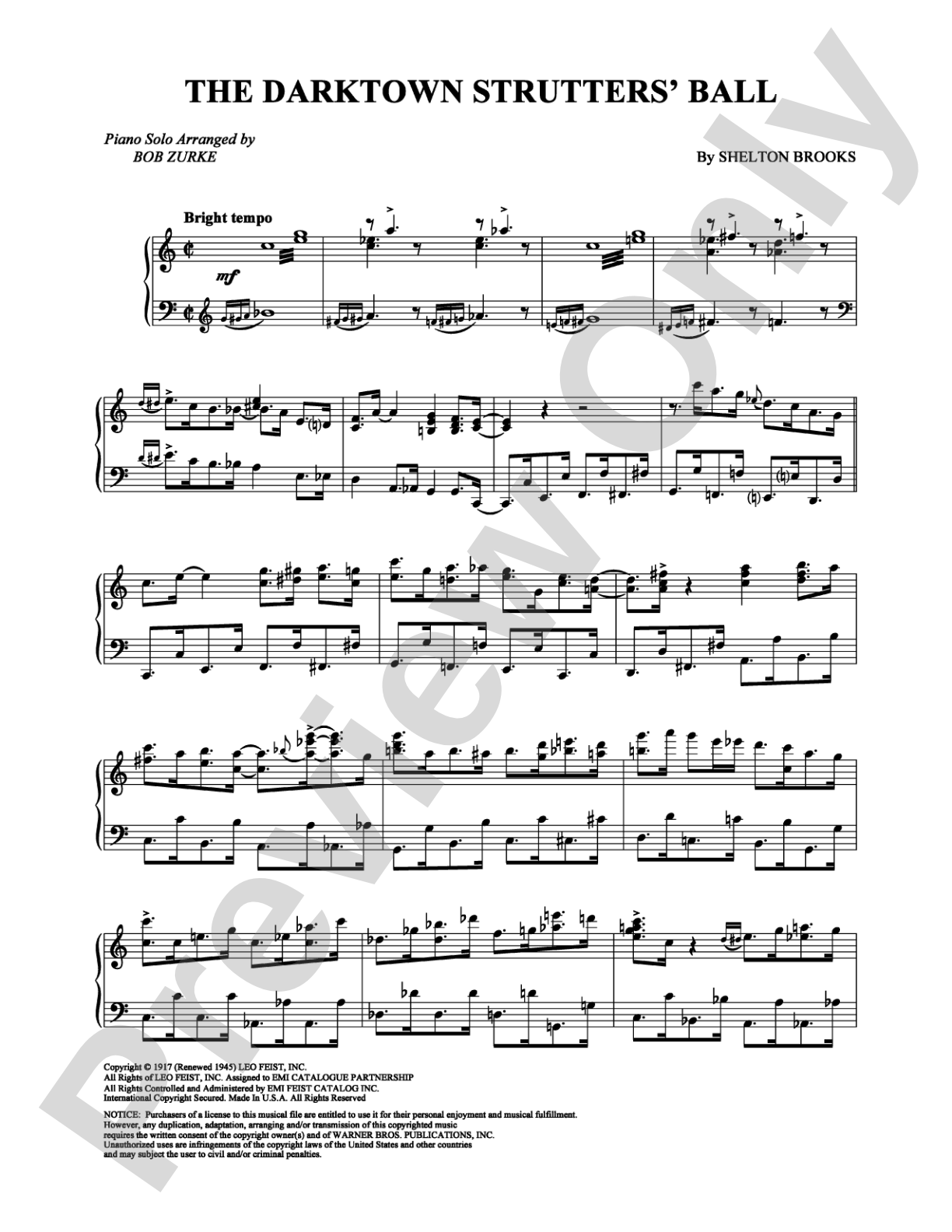
The Darktown Strutter's Ball: Piano Digital Sheet Music

The Darktown Strutter's Ball: Piano Digital Sheet Music

Shelton Brooks, Original Dixieland Jazz Band

Item: 00-PS-0007421

Digital Download
$3.99
Description

The Darktown Strutter's Ball: Piano Digital Sheet Music isn't in MakeMusic Cloud just yet...but it could be. Let us know you'd like to see it, and you'll help shape what comes next. In the meantime, start a free trial and dive into thousands of interactive titles your students can play along with today.

Sample Audio
No sample audio found.
Sample Video
Additional Details
SKU: 00-PS-0007421

More about this title

About the Artist: Original Dixieland Jazz Band

The Original Dixieland Jazz Band made history as the first group to record jazz music, releasing their landmark 1917 recordings that introduced this revolutionary American art form to the world. Their early New Orleans sound captured the raw energy, collective improvisation, and rhythmic sophistication that defined jazz's emergence from blues, ragtime, and brass band traditions.

Why we love this

This tune sits at the crossroads of jazz history and genuine fun. It's an ideal entry point for pianists exploring early jazz idioms without requiring advanced improvisation skills, and its infectious energy makes it a natural fit for concert programs exploring American popular music or the Jazz Age.

What to expect

Jaunty and irreverent, with the confident swagger of a New Orleans parade filtered through a piano. The piece practically dances on the page, full of syncopated surprises and the kind of rhythmic playfulness that makes you want to move.

Who it's for

Pianists intermediate and above who want to experience authentic early jazz repertoire firsthand and understand how jazz idioms translate to the keyboard. Students studying American music history, jazz history, or the evolution of popular music will find this both musically rewarding and educationally grounded.

How to get the most out of it

  • Lean into the swing feel and syncopated rhythms rather than playing mechanically. Let the off-beat accents breathe.
  • Balance clarity in the left hand with the melodic line so the stride or walking bass supports rather than overwhelms.
  • Capture the playful, strut-like character in your tempo choices. Too slow loses the spirit; too fast muddies the articulation.
  • Pay attention to dynamics and articulation markings as signposts for phrasing. This piece communicates through rhythmic punctuation as much as melody.

How to use it

Pair this with other early jazz standards or Tin Pan Alley classics to create a program segment celebrating American vernacular music. It works equally well as a standalone recital piece or as part of a thematic concert exploring jazz's roots and influence on twentieth-century piano literature.

Skills your students will build

  • Syncopation and swing rhythms in early jazz idioms
  • Stride piano and jazz left-hand techniques
  • Articulation and phrasing in jazz contexts
  • Reading and interpreting jazz notation conventions from the 1910s

You May Also Like