
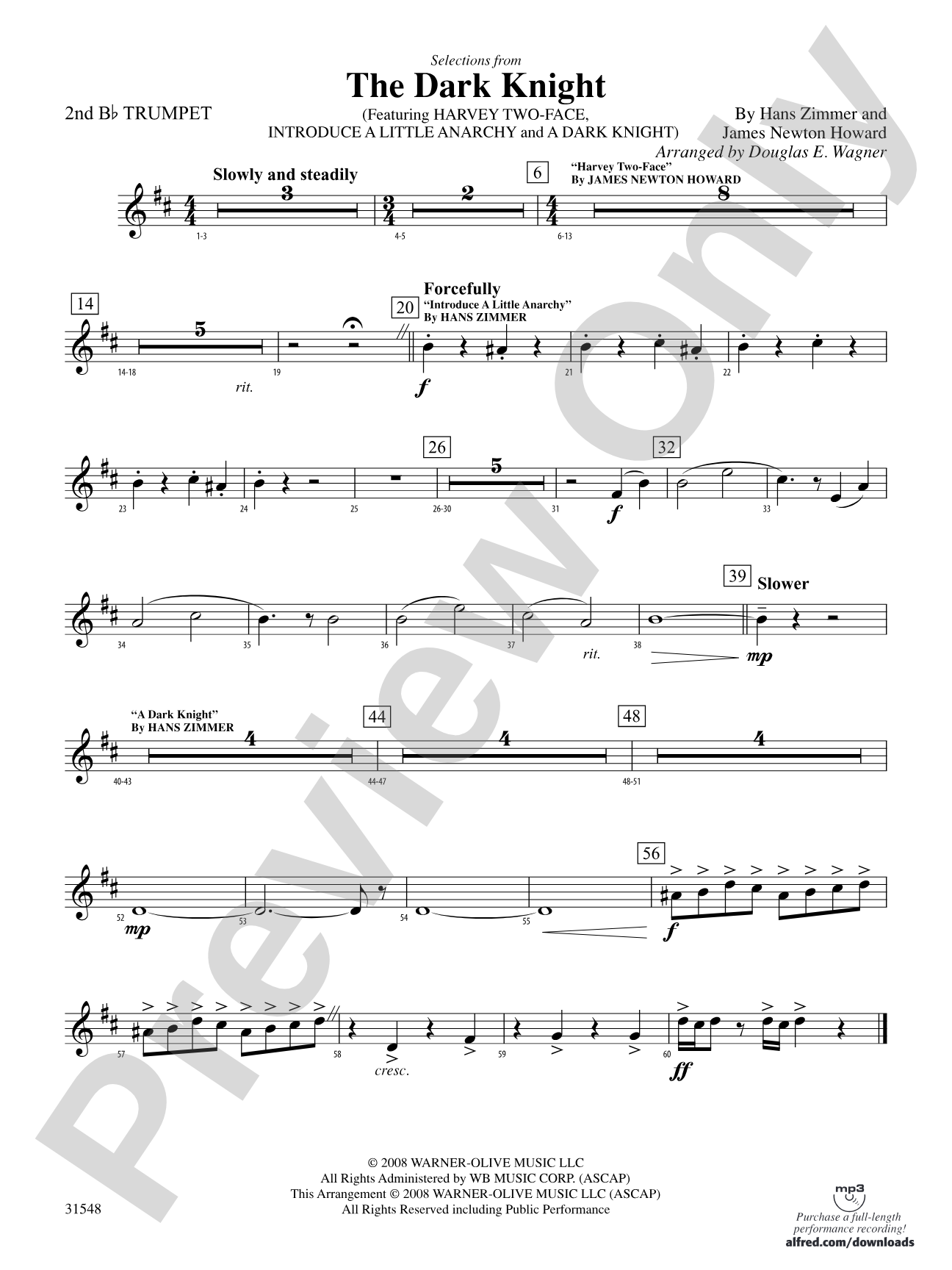

The Dark Knight, Selections from: 2nd B-flat Trumpet
Featuring: Harvey Two-Face / Introduce a Little Anarchy / A Dark Knight
By Hans Zimmer and James Newton Howard / arr. Douglas E. Wagner
Grade: 2.5
Item: 00-PC-0015738_T2
$5.99
Pickup currently not available
Description
Although scored at the perfect level for intermediate players, the drama and musical impact of the original score remain uncompromised in this medley including Harvey Two-Face, Introduce a Little Anarchy and A Dark Knight. Players and audiences alike will thrill in experiencing the music of this brilliant cinematic spectacle again and again. This arrangement is designed to work well with strings alone or with the addition of winds.


Don't just read it, hear it, play along with it, and watch your students grow with it. In MakeMusic Cloud, The Dark Knight, Selections from: 2nd B-flat Trumpet comes alive with professional accompaniment, adjustable tempo, and built-in practice tools that turn solo practice into real progress.
Open in the Player
Jump straight in and assign it today.
Start Your Free Trial
Open this title and explore the full library in minutes.
Sample Audio
1
Audio File
--:--
0:00
0:00
Sample Video
No sample videos found.
Additional Details
Series:
Pop Intermediate String/Full Orchestra
Publisher:
Alfred Music
Page Count:
248
SKU:
00-PC-0015738_T2
More about this title
About the Composer: Hans Zimmer
Hans Zimmer stands among film's most prolific and innovative composers, creating scores that have defined cinematic sound across genres from action blockbusters to intimate character studies. His orchestral thinking combines classical training with electronic layering and rhythmic sophistication, making his work immediately recognizable while remaining deeply musical when extracted from film.
Zimmer's scores have shaped how orchestras approach contemporary music in education. His compositional approach—building emotional intensity through harmonic movement and layered orchestration rather than melodic gesture alone—gives students insight into how modern concert music functions.
Why we love this
This arrangement succeeds because it honors the original's cinematic intensity while remaining fully playable at the intermediate level. The scoring for strings alone (with winds optional) solves a real programming challenge for orchestras building toward full ensemble instrumentation, and the three-movement structure gives directors natural pacing options for concert placement without overstaying welcome.
What to expect
Propulsive and ominous. The three movements unfold like a psychological arc, moving from the unsettling introduction of Harvey Two-Face through anarchic chaos to the final dark resolution. Players experience the satisfaction of executing music designed for dramatic effect at a scale that feels genuinely theatrical without requiring virtuosic technique.
Who it's for
Intermediate orchestras ready to tackle film music with genuine dramatic weight. This works for groups comfortable with sustained ensemble balance and rhythmic independence across sections, whether you field a full orchestra or predominantly strings-based ensemble.
How to get the most out of it
- Balance the low string foundation against upper voice momentum, especially in 'A Dark Knight,' where the bass line drives harmonic progression. Students often want to rush when energy builds; lock tempo through the sustain.
- Treat the electronic-influenced rhythmic figures (particularly in 'Introduce a Little Anarchy') as compositional backbone rather than accompaniment. These aren't auxiliary lines; they shape the piece's identity and need precision and clarity from the section.
- Use dynamics strategically in 'Harvey Two-Face' to sculpt the ominous character. Zimmer relies on orchestration and register changes more than melodic contrast, so dynamic control at the section level becomes your primary interpretive tool.
- Record a rehearsal early and listen back as an ensemble. Students often don't hear how their individual lines stack until they step back from playing. This builds ownership of the arrangement's architecture.
How to use it
Program this as a centerpiece for a film music concert or as the dramatic anchor of a mixed concert that needs contemporary bite. The 2.5 grade level makes it an ideal bridge between youth orchestra foundations and advanced repertoire, particularly effective when programmed before or after classical standards to show students how orchestration principles transcend era and genre.
Skills your students will build
- Reading and executing contemporary rhythmic figures across multiple simultaneous patterns
- Sustaining ensemble balance in sections carrying harmonic movement rather than melody
- Responding to dynamic and orchestration changes as interpretive storytelling tools
- Coordinating sectional independence while maintaining unified ensemble pulse
- Understanding how film score orchestration differs from concert tradition in harmonic language and structural pacing