The Dark Knight, Concert Suite from: 3rd B-flat Trumpet Sheet Music Preview

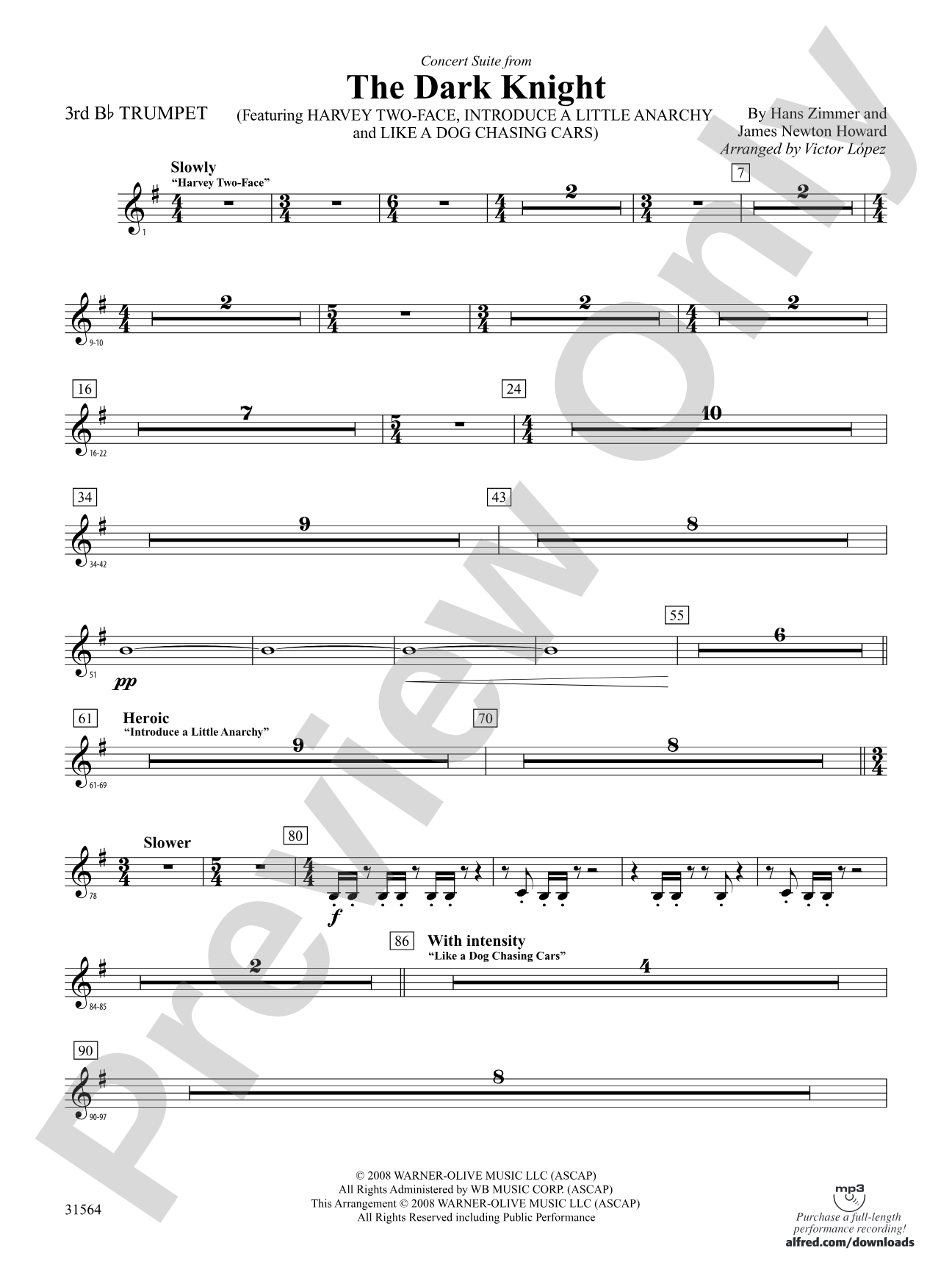
The Dark Knight, Concert Suite from: 3rd B-flat Trumpet

Featuring: Harvey Two-Face / Introduce a Little Anarchy / Like a Dog Chasing Cars

By Hans Zimmer and James Newton Howard / arr. Victor López

Grade: 3.5

Item: 00-PC-0015743_T3

Digital Download
$3.00
Description
Live the drama of the blockbuster Batman thriller with this medley featuring "Harvey Two-Face," "Introduce a Little Anarchy," and "Like a Dog Chasing Cars." Perfectly arranged for the advanced orchestra or the community orchestra! (7:39)

Don't just read it, hear it, play along with it, and watch your students grow with it. In MakeMusic Cloud, The Dark Knight, Concert Suite from: 3rd B-flat Trumpet comes alive with professional accompaniment, adjustable tempo, and built-in practice tools that turn solo practice into real progress.

Sample Audio
0:00
0:00
Sample Video
Additional Details
Series: Pop Concert Full Orchestra
Publisher: Alfred Music
Page Count: 252
SKU: 00-PC-0015743_T3

More about this title

About the Composer: Hans Zimmer

Hans Zimmer stands among the most prolific film composers of the past four decades, with a catalog spanning from intimate character studies to epic blockbuster scores. His approach to orchestration and thematic development has fundamentally shaped how contemporary composers think about scoring drama, tension, and emotional complexity for large ensembles.

Why we love this

Victor López's arrangement captures the psychological intensity and propulsive energy of Zimmer's original score while remaining fully playable at the 3.5 grade level. The medley structure lets orchestras tackle recognizable, dramatically potent material without requiring the extended rehearsal time a full-length film score demands. This is accessible modern concert music that still feels substantial and rewarding to perform.

What to expect

Tense, darkly propulsive, and psychologically complex. The suite moves between moments of stark menace and barely controlled chaos, with rich harmonic colors and sudden dynamic shifts that keep both players and listeners on edge. There's theatrical sophistication here, but not at the expense of visceral impact.

Who it's for

Advanced high school orchestras, college community orchestras, and select middle school ensembles with strong section leaders will find this suite both musically engaging and technically achievable. Directors seeking contemporary concert fare that resonates with student musicians and audiences will appreciate how recognizable these themes are while remaining genuinely orchestral in scope.

How to get the most out of it

  • Lean into the dramatic contrasts between sections. The shift from 'Harvey Two-Face' to 'Introduce a Little Anarchy' should feel like a genuine shift in psychological stakes, not just a tempo change.
  • Balance clarity of line with the weight of the full ensemble. Zimmer's harmonies often carry as much weight as the melody, so ensure middle voices and accompaniment figures don't disappear under the sound.
  • Manage the sustained tension in longer passages by keeping the pulse steady but never mechanical. These cues thrive on controlled intensity rather than raw volume.
  • Pay attention to the role of unpitched percussion. Zimmer's original orchestration uses metallic and pitched percussion for both color and narrative punctuation; treat these moments as structural signposts.

How to use it

Program this as a centerpiece for a film music or contemporary concert, pairing it with other accessible modern scores or lighter classical works to balance the psychological weight. It also works well as a season opener that signals you're programming bold, current material alongside traditional repertoire. The 7:39 duration gives it enough presence to anchor a concert without dominating an entire program.

Skills your students will build

  • Balance of harmonic density with melodic clarity in modern orchestration
  • Sustaining tension through dynamic control and rhythmic precision
  • Reading and executing rapid section changes and tempo shifts
  • Ensemble coordination across divided string and brass sections
  • Stylistic awareness of film scoring conventions applied to concert performance

You May Also Like