
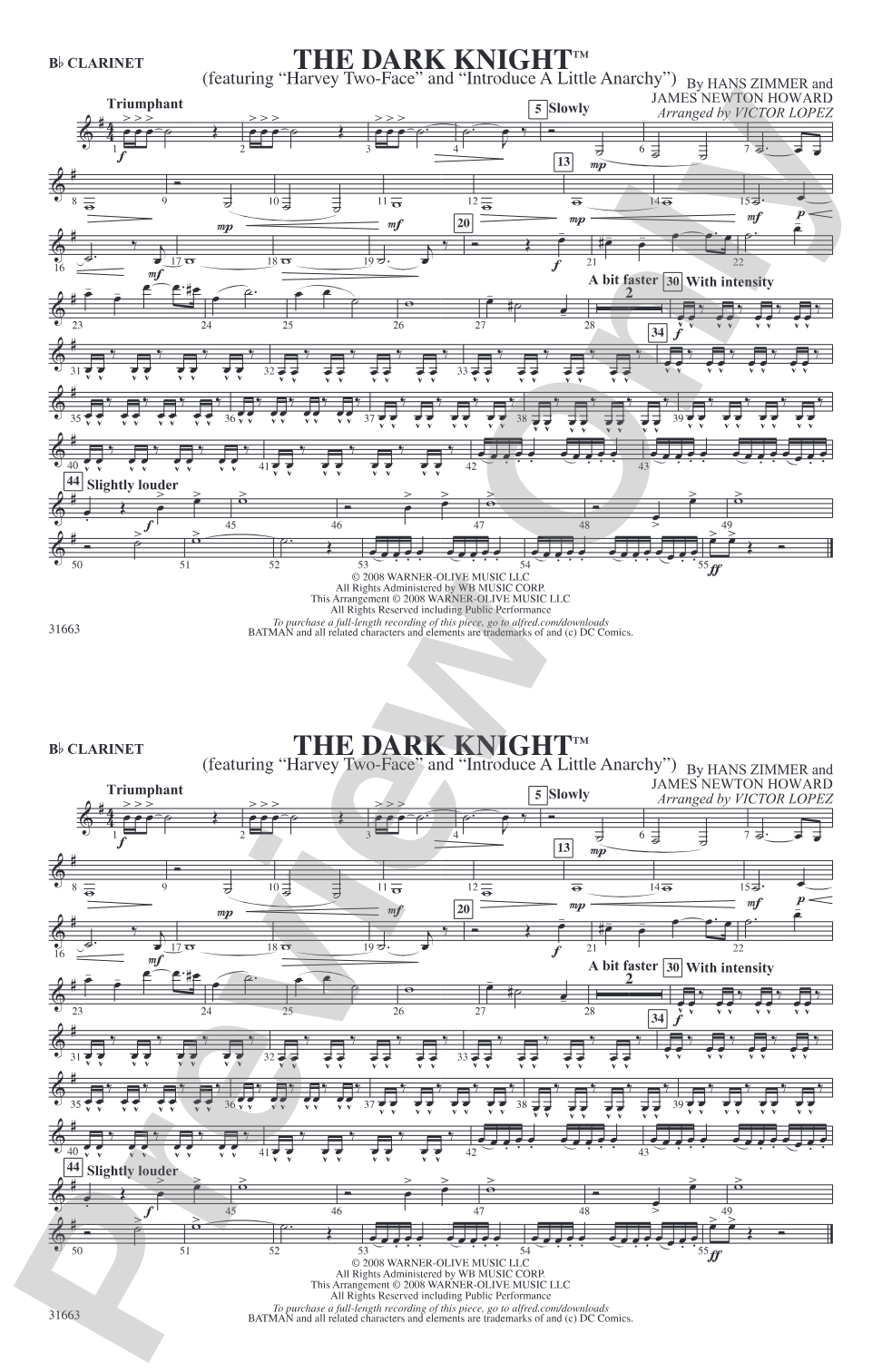

The Dark Knight: 1st B-flat Clarinet
Featuring: Harvey Two-Face / Introduce a Little Anarchy
By Hans Zimmer and James Newton Howard / arr. Victor López
Grade: 3 (Medium)
Item: 00-PC-0018191_C1
$3.00
Pickup currently not available
Description
The spectacular score by Hans Zimmer and James Newton Howard from the biggest movie of the summer features many memorable themes. Victor López combines two of the best ("Harvey Two-Face" and "Introduce a Little Anarchy") into a stunning arrangement for your marching band!


Don't just read it, hear it, play along with it, and watch your students grow with it. In MakeMusic Cloud, The Dark Knight: 1st B-flat Clarinet comes alive with professional accompaniment, adjustable tempo, and built-in practice tools that turn solo practice into real progress.
Open in the Player
Jump straight in and assign it today.
Start Your Free Trial
Open this title and explore the full library in minutes.
Sample Audio
1
Audio File
--:--
0:00
0:00
Sample Video
No sample videos found.
Additional Details
Series:
Mega Sounds for Marching Band
Publisher:
Alfred Music
Page Count:
118
SKU:
00-PC-0018191_C1
More about this title
About the Composer: Hans Zimmer
Hans Zimmer stands as one of the most prolific and influential film composers of the past four decades. His work across action blockbusters, psychological thrillers, and intimate dramas demonstrates a rare ability to craft themes that are both cinematically powerful and musically sophisticated. Zimmer's approach to orchestration and harmonic language has fundamentally shaped how contemporary audiences experience scored media, and his willingness to collaborate with other composers on large-scale projects reflects his confidence in collective artistry.
In the classroom and rehearsal hall, Zimmer's music offers students direct access to professional-level compositional technique. His themes are memorable enough to engage young musicians while remaining complex enough to reward careful study. Marching band arrangements of his work provide conductors with high-engagement repertoire that connects to students' broader musical lives and demonstrates how serious compositional craft serves entertainment and storytelling.
Why we love this
Victor López's arrangement captures the cinematic intensity of Zimmer and Howard's original work while building it into something that lives and breathes on the field. The combination of two thematically rich cues gives you enough musical material to sustain interest across the full arc of a competitive run or field show, and at Grade 3, the technical demands don't overshadow the emotional payoff that makes this music compelling in the first place.
What to expect
Dark, propulsive, and unapologetically cinematic. The Harvey Two-Face theme carries a sinister undercurrent with sharp rhythmic edges, while the anarchic energy of the second cue feels chaotic and menacing. Together, they create a psychological tension that's rare in marching band repertoire, pulling the audience into a morally complex, high-stakes world without relying on simple heroic gestures.
Who it's for
Directors programming competitive marching bands or field show ensembles looking for contemporary, high-engagement music that connects to students' film and pop culture experience. This works for intermediate programs that have solid fundamentals in place and want material with genuine dramatic arc and memorable themes.
How to get the most out of it
- Balance the melodic themes across your sections. These two cues are built on strong principal voice writing; make sure your lead players (trumpets, trombones, mellophone) have the confidence and air support to shape long phrases without losing energy.
- Pay attention to the harmonic movement underneath the main themes. The accompaniment voices carry color and momentum; even when they're not playing the melody, they need precision and clarity to support the overall architecture.
- Tempo consistency matters here. These themes rely on forward motion and structural integrity. Lock your percussion section early and trust that stability will let your brass soar.
- Use the dynamic range. Zimmer's writing has both intimate and explosive moments. Resist the urge to play everything at concert volume; the contrast is what makes the powerful moments actually land.
How to use it
This works best as a competitive or exhibition show centerpiece, or as a striking closer that shifts the emotional temperature of your program sharply. If you're building a themed set around tension, conflict, or contemporary storytelling, this arrangement sits naturally alongside other modern scores while standing out for its specificity and compositional depth.
Skills your students will build
- Sustaining long melodic phrases with dynamic control and consistent air support
- Balancing principal voice writing against harmonic accompaniment
- Maintaining ensemble precision in syncopated rhythmic figures
- Executing tempo-based musical storytelling and dramatic pacing
- Reading and executing rapid dynamic shifts and contrast-based phrasing