
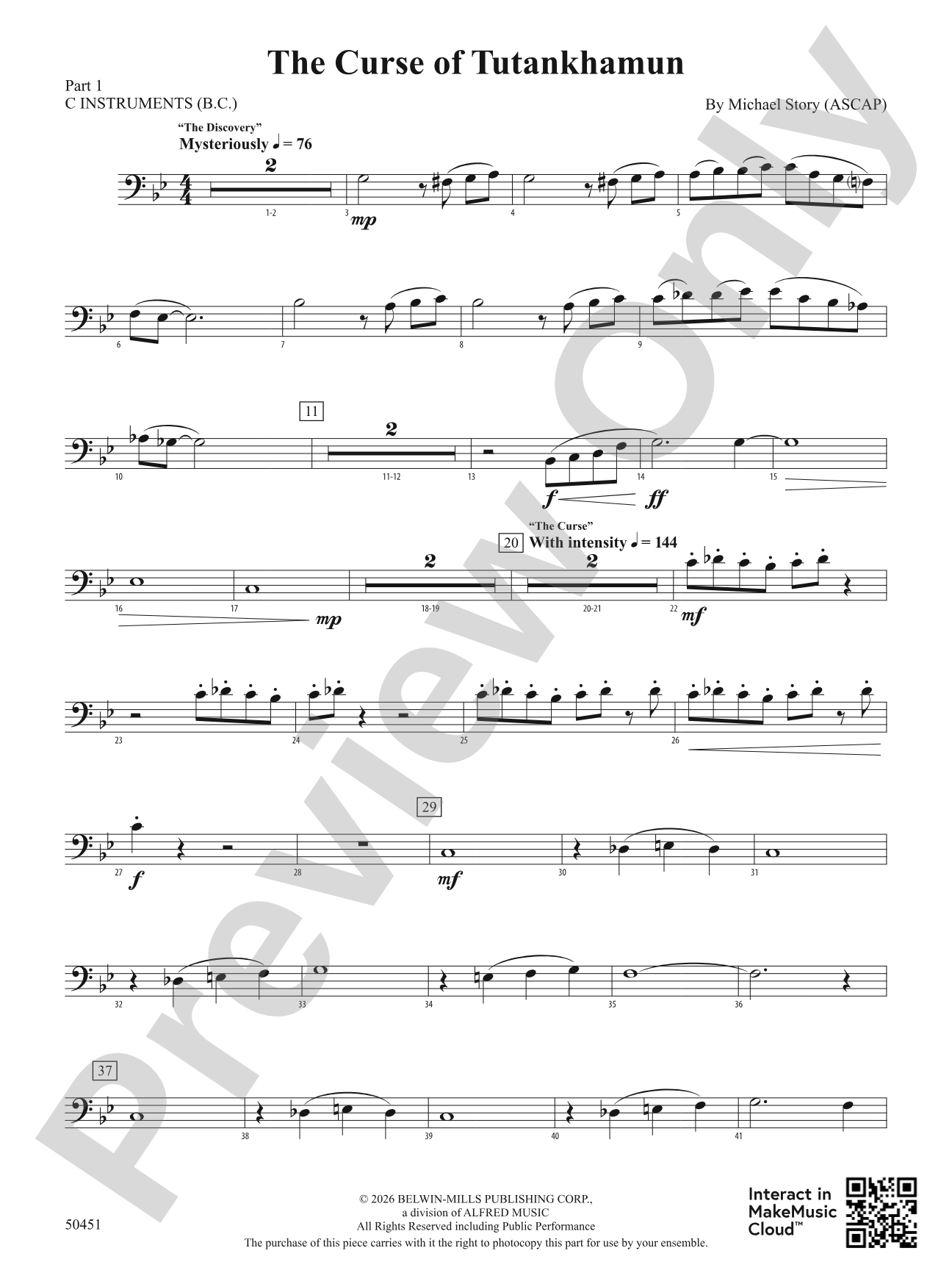

The Curse of Tutankhamun: Part 1 - C Instruments (B.C.)
By Michael Story
Grade: 2
Item: 00-PC-0019657_PART1_CBC
$3.00
Pickup currently not available
Description
This version of The Curse of Tutankhamun by Michael Story is part of our Belwin FLEX offerings and is designed with maximum flexibility for use by any mix of instruments---wind, strings, and percussion, including like- or mixed-ensembles with as few as 5 players. The suggested instrumentation and a customizable Teacher Map will help you plan out how to best assign parts to suit your ensemble's needs. It also comes with supplemental parts for maximum flexibility. With the purchase of this piece, permission is granted to photocopy the parts as needed for your ensemble. A percussion accompaniment track is also available as a free download. String parts have been carefully edited with extra fingerings and appropriate bowings to support students in mixed ensembles playing in less familiar keys.
Inspired by the illness experienced in the 1920s by scientists exploring the tomb of the boy-pharaoh Tutankhamun, Michael Story's work musically traces the history from the discovery of the tomb through the mysterious curse. In Belwin's FLEX format, this delightful work will capture your students' imagination. Both intense and enjoyable, this work is highly recommended.(2:45)
Percussion Accompaniment Track Downloads:
with click
without click


Inspired by the illness experienced in the 1920s by scientists exploring the tomb of the boy-pharaoh Tutankhamun, Michael Story's work musically traces the history from the discovery of the tomb through the mysterious curse. In Belwin's FLEX format, this delightful work will capture your students' imagination. Both intense and enjoyable, this work is highly recommended.(2:45)
Percussion Accompaniment Track Downloads:
with click
without click
The Curse of Tutankhamun: Part 1 - C Instruments (B.C.) isn't in MakeMusic Cloud just yet...but it could be. Let us know you'd like to see it, and you'll help shape what comes next. In the meantime, start a free trial and dive into thousands of interactive titles your students can play along with today.
Request This Title
Tell us you want it.
Start Your Free Trial
Explore everything that's ready to play right now.
Sample Audio
1
Audio File
--:--
0:00
0:00
Sample Video
No sample videos found.
Additional Details
Series:
Belwin Young Band
Publisher:
Alfred Music
SKU:
00-PC-0019657_PART1_CBC
More about this title
About the Composer: Michael Story
Michael Story has established himself as a prolific composer for young and developing ensembles, with a catalog that ranges from concert band to flexible instrumentation works. His compositions are rooted in strong melodic writing and orchestration that speaks directly to student musicians, making technically accessible music that never talks down to its players.
Why we love this
Story delivers genuine narrative arc in a Grade 2 piece without sacrificing musical substance. The historical inspiration (the discovery of Tutankhamun's tomb and the associated curse of the 1920s) gives your students a real story to interpret and perform, transforming what could be a routine rehearsal into an imaginative journey. The flexible instrumentation means you're not limited by who shows up on any given day; you conduct the ensemble you have, not the one you wish for.
What to expect
Mysterious and energetic by turns, with moments of genuine drama. The piece captures both the thrill of archaeological discovery and the creeping dread of the curse, moving through distinct emotional territories without ever losing the thread of Story's clean, singable melodic voice. Students will feel like they're telling a story, not just playing notes.
Who it's for
Directors managing flexible instrumentation ensembles, mixed groups with unpredictable instrumentation from rehearsal to rehearsal, and programs where string and wind players learn together. This works equally well for all-wind or all-string versions and scales from a small chamber group up to a full concert ensemble.
How to get the most out of it
- Map your parts carefully before the first rehearsal using the Teacher Map provided. A few minutes of strategic assignment based on your roster prevents confusion and keeps momentum forward.
- Balance the string and wind sections deliberately. In mixed ensembles, strings often sit too far back dynamically; work for a true blend where both colors register equally in the ensemble sound.
- Let the percussion accompaniment track anchor your early rehearsals, then gradually release students' dependence on it as confidence builds. This is particularly helpful when parts sit in unfamiliar keys.
- Trust the story arc. The piece moves from discovery through mounting tension toward resolution. Shape phrase endings and tempo rubato in service of that narrative rather than playing every measure at the same energy level.
How to use it
Program this as a centerpiece for a concert exploring historical or literary themes, or as the opening number of a festival performance where you want something engaging that demonstrates your ensemble's flexibility. At 2 minutes 45 seconds, it pairs efficiently with a longer classical selection or a contrasting lyrical piece in the same concert.
Skills your students will build
- Reading music in less familiar keys (careful fingerings and bowings provided)
- Blending string and wind timbres in a mixed ensemble setting
- Responding to narrative structure in performance
- Dynamic contrast and dramatic pacing
- Following a flexible instrumentation score and parts system