
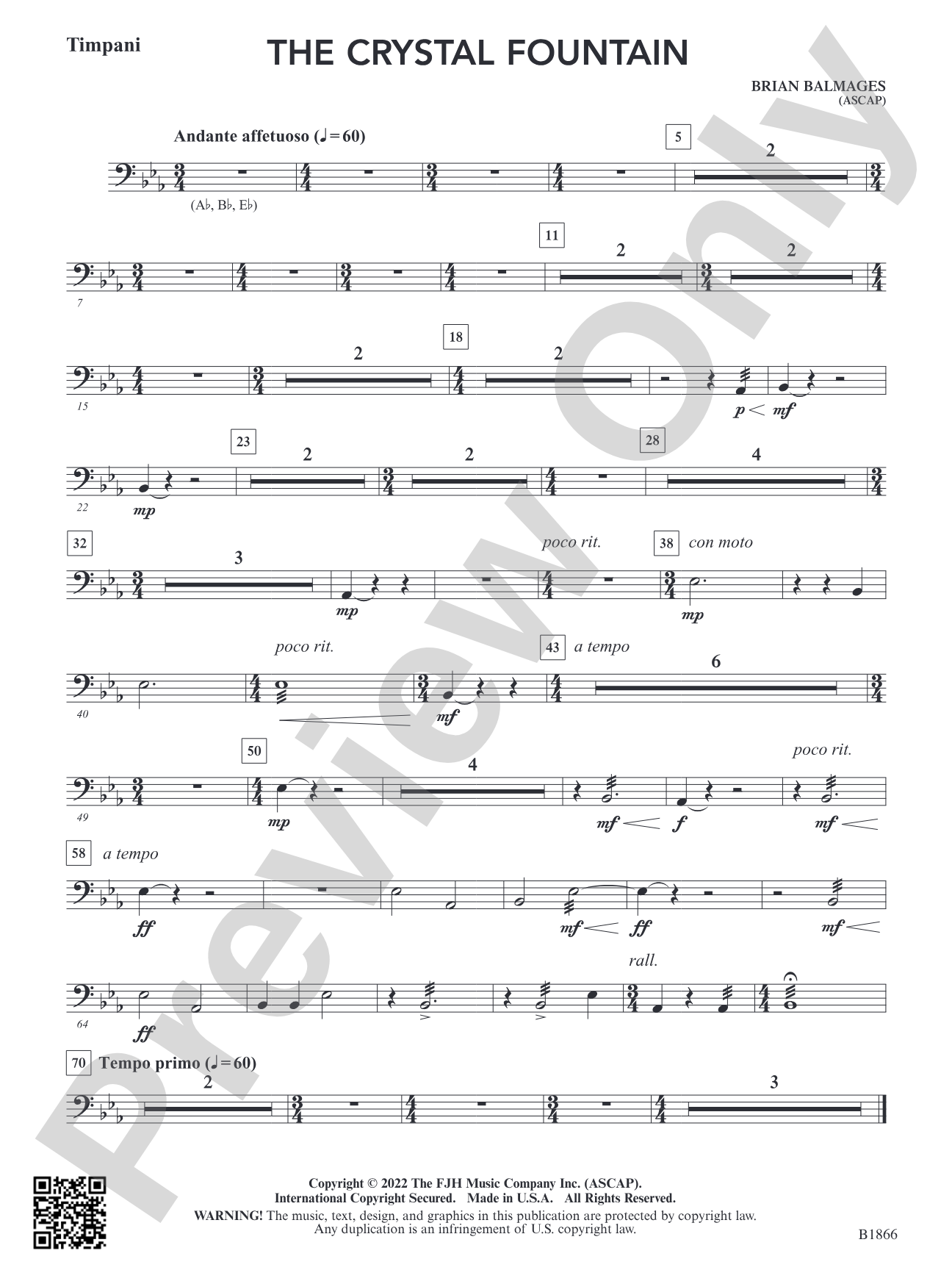

The Crystal Fountain: Timpani
By Brian Balmages
Grade: 2.5
Item: 98-PC-DB1866_TMP
$7.00
Pickup currently not available
Description
Based on the hymn Guide Me, O Thou Great Redeemer, this heartfelt work begins delicately, relying on fragments of the hymn. Overlapping entrances establish a sense of timelessness as the music develops, ultimately reaching a powerful climax where the piece’s original melody and the full hymn tune are presented simultaneously. As the music fades, the listener is left with a sense of peace and closure. Simply magical.


Don't just read it, hear it, play along with it, and watch your students grow with it. In MakeMusic Cloud, The Crystal Fountain: Timpani comes alive with professional accompaniment, adjustable tempo, and built-in practice tools that turn solo practice into real progress.
Open in the Player
Jump straight in and assign it today.
Start Your Free Trial
Open this title and explore the full library in minutes.
Sample Audio
1
Audio File
--:--
0:00
0:00
Sample Video
No sample videos found.
Additional Details
Series:
FJH Young Band
Publisher:
The FJH Music Company, Inc.
SKU:
98-PC-DB1866_TMP
More about this title
About the Composer: Brian Balmages

Brian Balmages has established himself as a versatile composer and conductor whose works traverse orchestral, band, and chamber music repertoires. His compositions have been performed by ensembles spanning from professional orchestras to school bands in prestigious venues including Carnegie Hall, the Kennedy Center, and the Sydney Opera House. He holds membership in the American Bandmasters Association and received the A. Austin Harding Award from the American School Band Directors Association, along with winning the 2020 NBA William D. Revelli Composition Contest for Love and Light.
Beyond composing, Balmages maintains an active conducting schedule with all-state ensembles, university groups, and professional orchestras worldwide. His music was performed at the 2013 Presidential Inaugural Prayer Service, and he has received commissions from major institutions including the University of Miami. Currently serving as Director of MakeMusic Publications and Digital Education for Alfred and MakeMusic, he continues to influence music education through both his creative output and administrative leadership.
Why we love this
The Crystal Fountain transforms a familiar hymn into something that feels entirely new through careful orchestration and developmental technique. Rather than presenting the melody straightforwardly, Balmages builds texture from fragmentary material, allowing the full tune to emerge with stunning impact at the climax. This approach rewards careful ensemble listening and gives young musicians a genuine sense of architectural design in concert music.
What to expect
The piece unfolds like watching light refract through moving water. It begins with quiet, almost uncertain fragments before gradually revealing its underlying hymn tune through layered textures and building intensity. The final descent leaves listeners in a state of quiet reflection, having experienced both stirring climax and genuine spiritual calm.
Who it's for
Young concert bands at the 2.5 grade level seeking meaningful contest and festival repertoire that combines accessibility with genuine musicianship. Directors will find this piece approachable in terms of technical demands while offering real interpretive challenges and emotional depth.
How to get the most out of it
- Shape the opening delicately by maintaining consistent vibrato in the sustained notes; the fragmented hymn phrases depend on subtle dynamic control to establish intimacy before the overlapping entrances begin.
- Conduct the overlapping entrances with clear subdivision to help the band hear how each voice contributes to the layered texture; this section establishes the piece's meditative character.
- Build toward the climax gradually, resisting the urge to jump ahead in tempo; the power comes from accumulated momentum, not speed.
- Lead the final fade with intention, allowing the ensemble to diminish without losing focus or pitch center; the sense of peace depends on controlled, deliberate release.
How to use it
Program this as a contest or festival selection where its Grade 2.5 difficulty allows students to focus on musicianship rather than technical survival. Its meditative opening and powerful climax also make it an excellent centerpiece for a concert program exploring sacred music or hymn-based compositions.
Skills your students will build
- Listening to and balancing layered textures with overlapping entrances
- Sustaining even tone and intonation during extended soft passages
- Building dynamic intensity across a long musical arc
- Understanding how fragmented material develops into complete melody
- Interpreting expressive control in both climactic and diminuendo sections