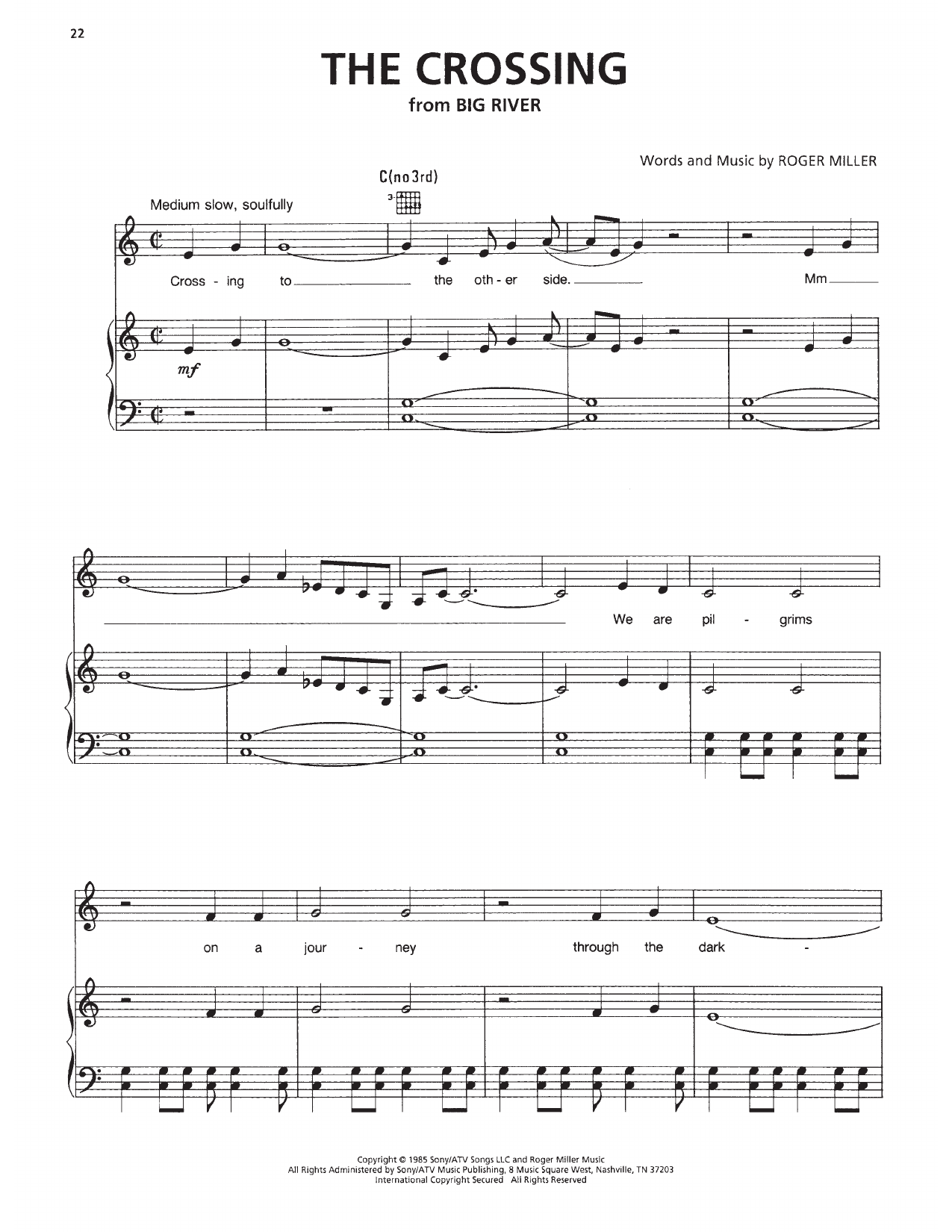
The Crossing (from Big River: The Adventures Of Huckleberry Finn) Sheet Music Preview

The Crossing (from Big River: The Adventures Of Huckleberry Finn): Piano Vocal

As performed by Roger Miller / Edited by Joan Frey Boytim

Item: 35-DS01927169

Digital Download
$5.99
Description

The Crossing (from Big River: The Adventures Of Huckleberry Finn): Piano Vocal isn't in MakeMusic Cloud just yet...but it could be. Let us know you'd like to see it, and you'll help shape what comes next. In the meantime, start a free trial and dive into thousands of interactive titles your students can play along with today.

Sample Audio
No sample audio found.
Sample Video
Additional Details
Publisher: Hal Leonard
Page Count: 4
SKU: 35-DS01927169

More about this title

About the Artist: Roger Miller

Roger Miller was a singer, songwriter, and actor who earned four Grammy Awards and a Tony Award for his work in musical theater. His distinctive conversational style and rhythmic storytelling made him a bridge between country music and Broadway, bringing authenticity to both idioms throughout his career.

Why we love this

Miller's songwriting for Big River captures the American frontier vernacular with genuine warmth, avoiding pastiche. The songs work equally well in concert as they do in the full theatrical context, giving singers and pianists a chance to explore character-driven material that rewards genuine connection to the text.

What to expect

The crossing itself is both literal and metaphorical. The music evokes the Mississippi River with gentle forward motion, but underneath runs an undercurrent of apprehension, escape, and the weight of moral choice. Miller's melody is deceptively simple, yet it carries the gravity of a defining moment.

Who it's for

Vocalists preparing musical theater auditions or concert selections will find this piece effective for showcasing legit belt technique and acting range. It suits singers with contemporary classical training as well as those rooted in musical theater tradition.

How to get the most out of it

  • Let the conversational rhythm breathe naturally. The vocal line follows speech patterns rather than strict metering, so resist over-conducting the piano and allow the singer space to shape phrases.
  • Notice how the accompaniment supports storytelling rather than overwhelming it. Keep the piano texture clean and listen underneath the vocal line to catch harmonic turns that underscore emotional shifts.
  • Work the dynamic arc across the full four pages. What might seem like a gentle folk arrangement builds cumulative power through repetition and lyrical development.

How to use it

Include this in an American songwriting showcase alongside other musical theater selections that value character and lyrical content. It pairs well with concert programs exploring vernacular narrative song or with a broader Big River suite if you're mounting the full musical.

Skills your students will build

  • Sustaining conversational phrasing over longer melodic lines
  • Coordinating vocal expression with harmonic accompaniment
  • Managing soft dynamic control in intimate theatrical moments
  • Interpreting character motivation through musical choices

You May Also Like