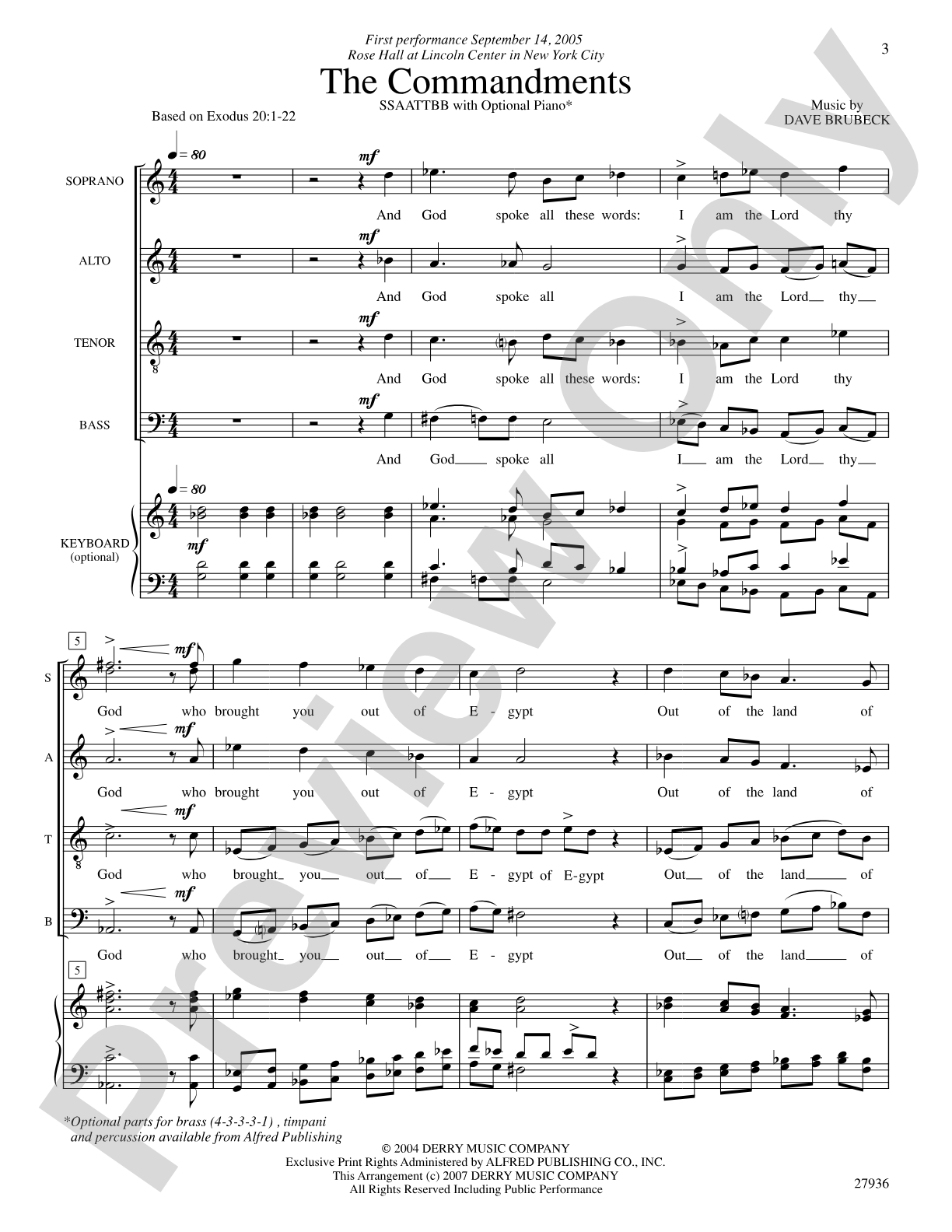
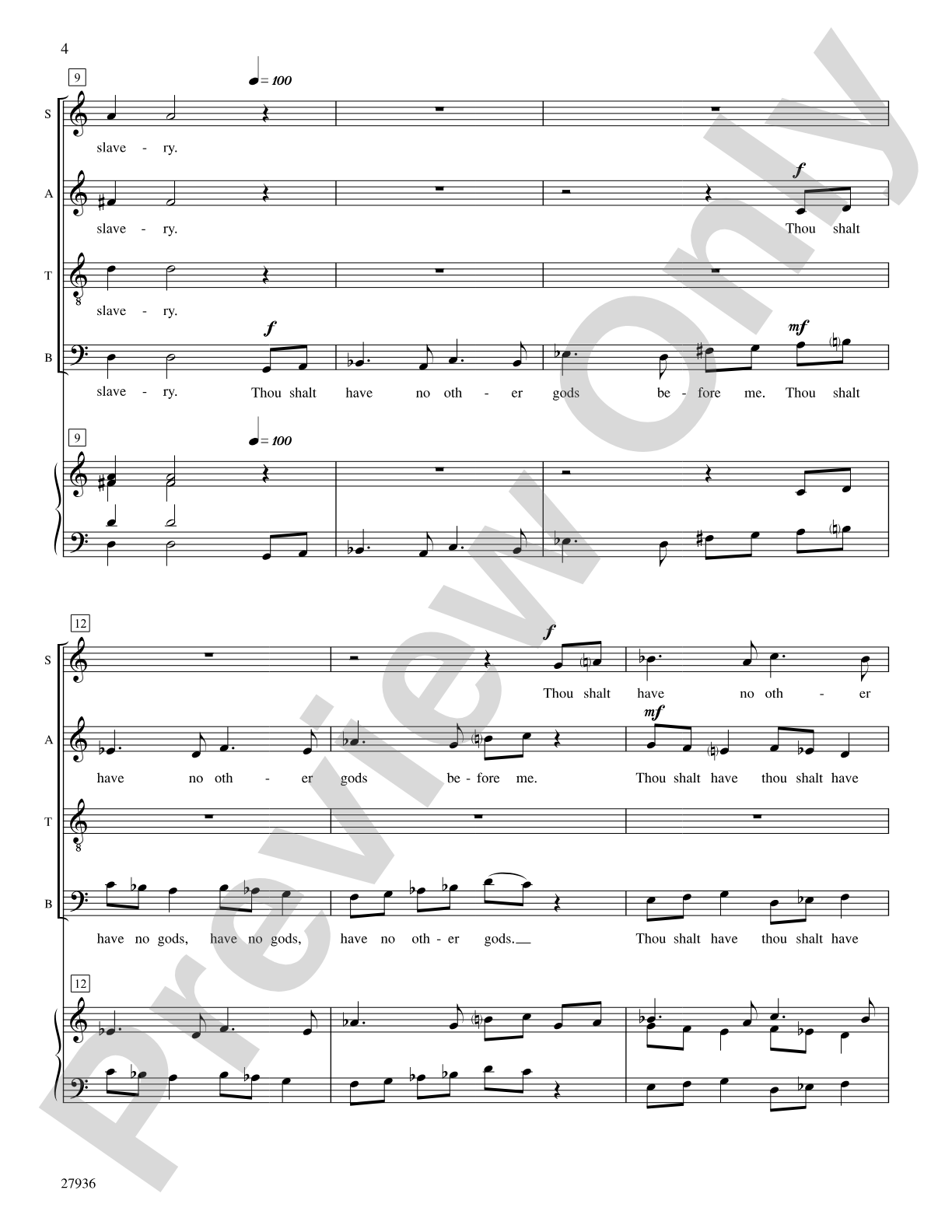
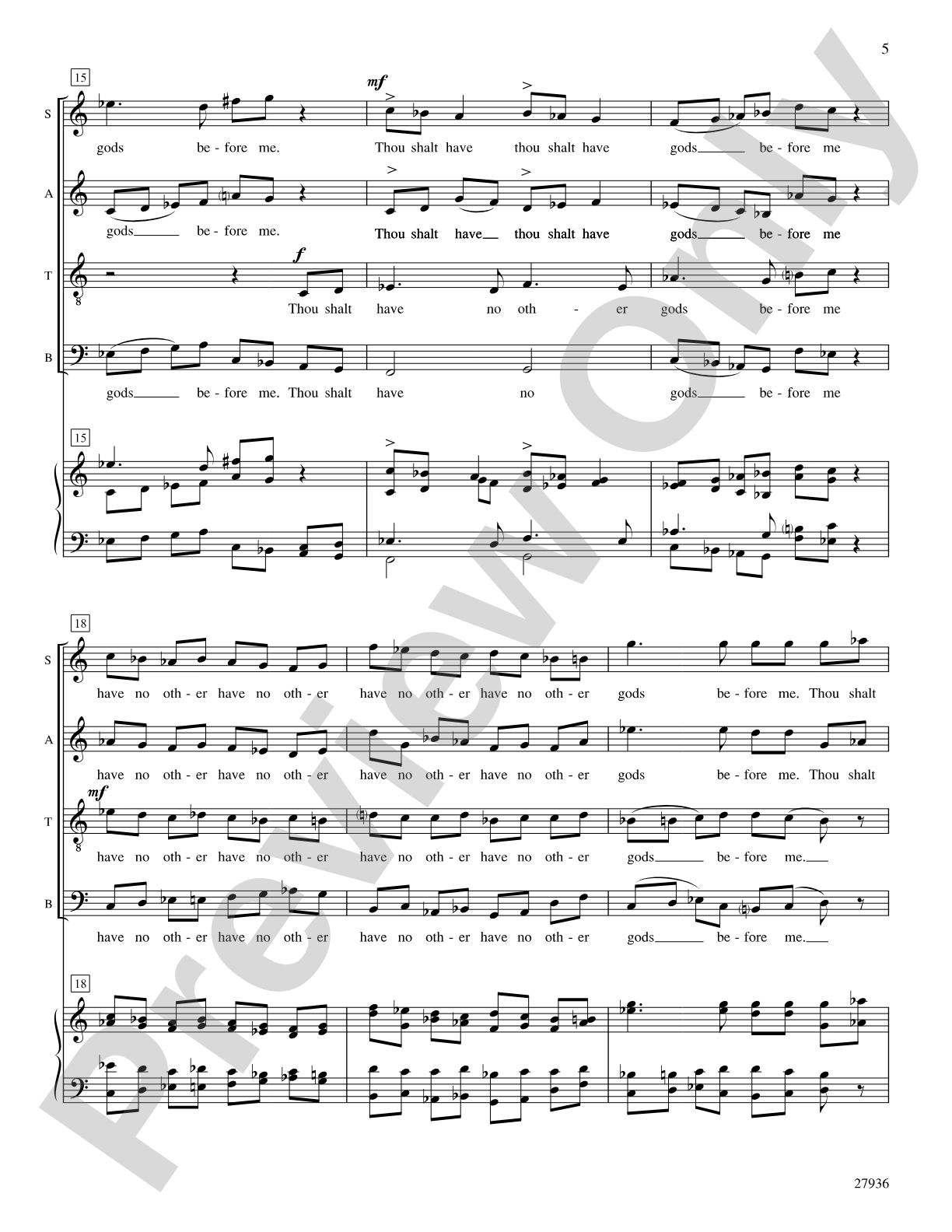
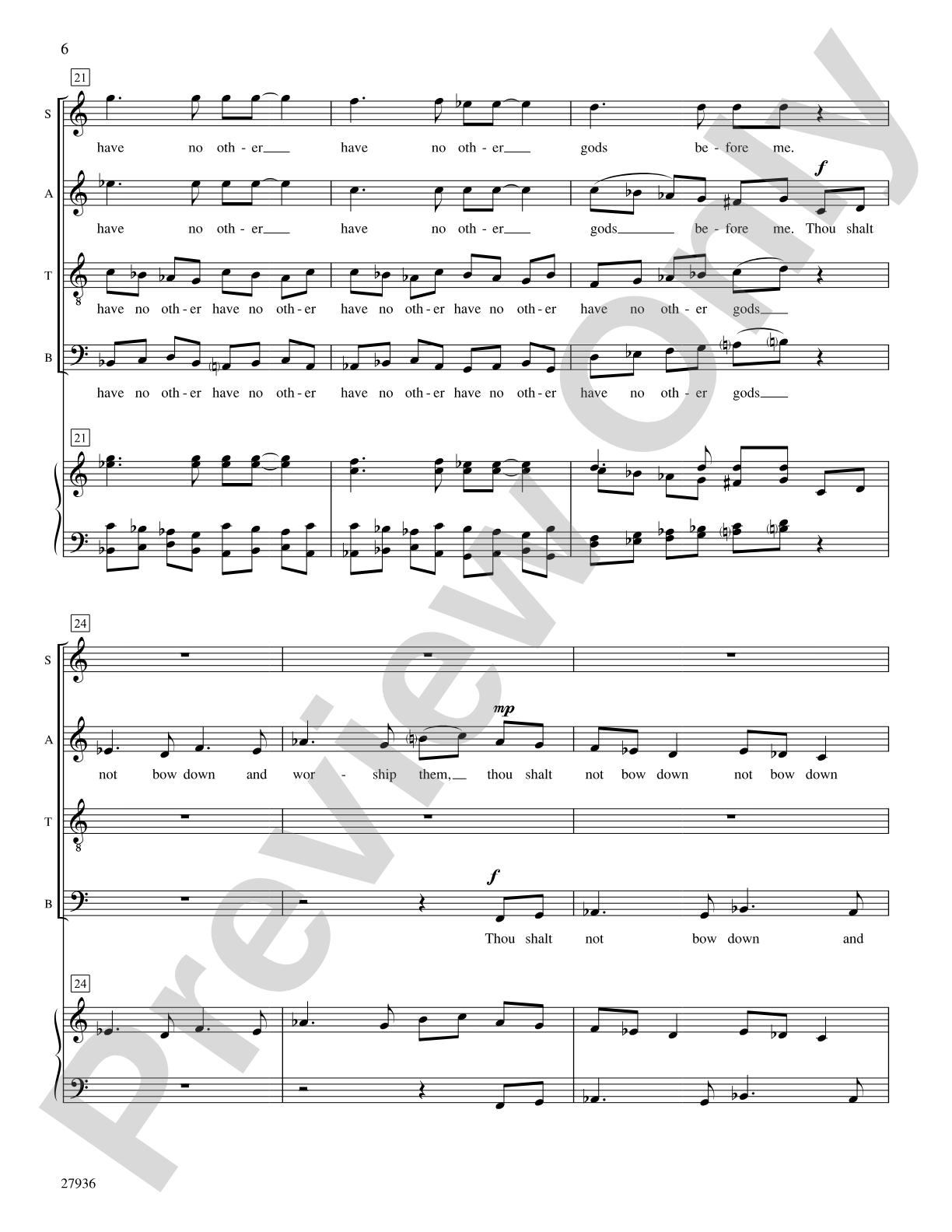
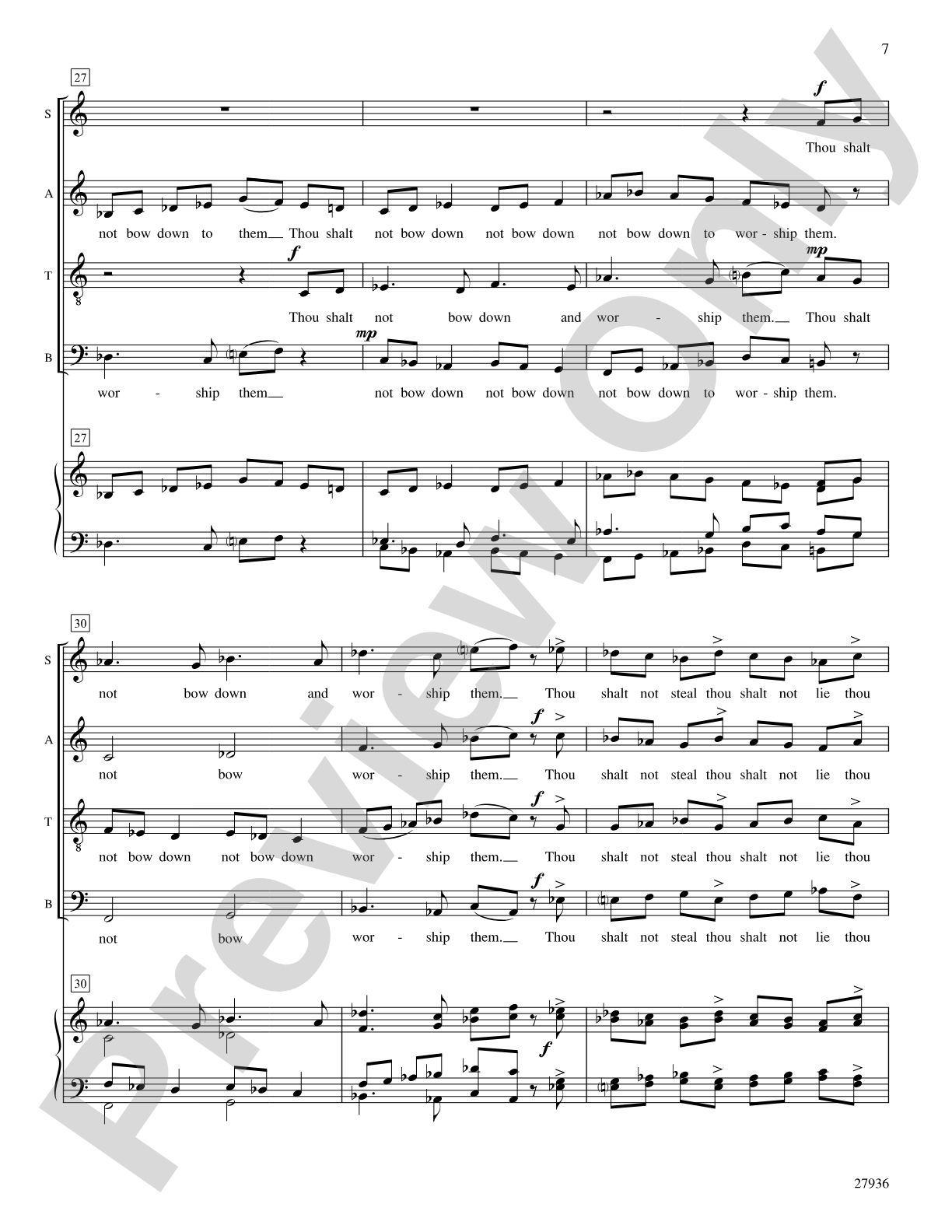
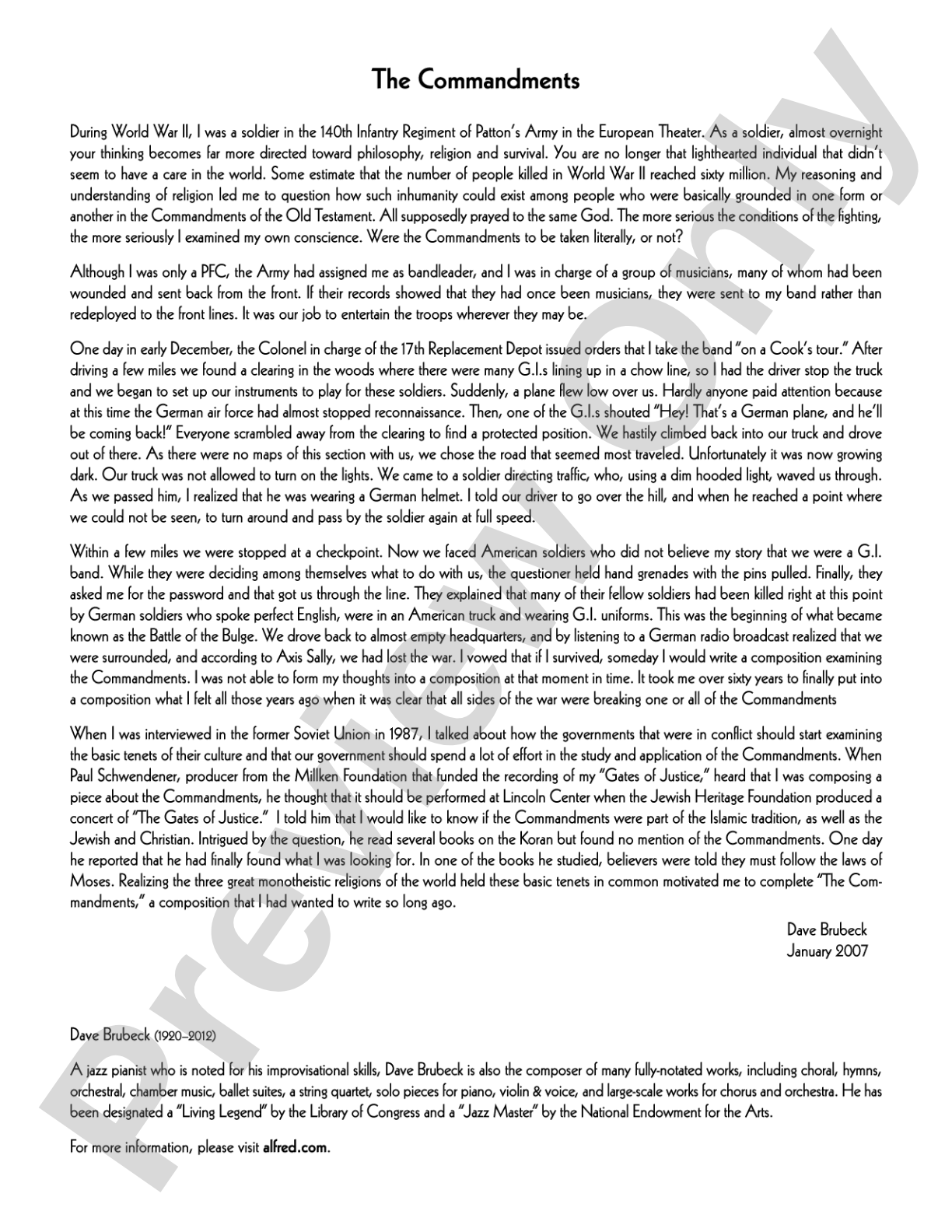
The Commandments Sheet Music Preview

The Commandments: SSAATTBB Choral Octavo

By Dave Brubeck

Item: 00-PO-0004370

Digital Download
$4.25

Minimum order quantity: 20 copies

Description

The Commandments: SSAATTBB Choral Octavo isn't in MakeMusic Cloud just yet...but it could be. Let us know you'd like to see it, and you'll help shape what comes next. In the meantime, start a free trial and dive into thousands of interactive titles your students can play along with today.

Sample Audio
No sample audio found.
Sample Video
Additional Details
Series: Lawson-Gould: The Dave Brubeck Series
Publisher: Alfred Music
Page Count: 28
SKU: 00-PO-0004370

More about this title

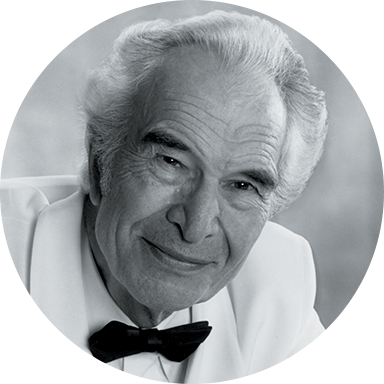
About the Composer: Dave Brubeck

Dave Brubeck

Dave Brubeck was a jazz pianist whose improvisational brilliance extended far beyond the concert stage into composition. He created an extensive catalog that spans choral works, hymns, orchestral pieces, chamber music, and large-scale compositions for chorus and orchestra, all while maintaining the harmonic sophistication and rhythmic innovation that defined his jazz recordings. His album "Time Out" became the first jazz record to sell over a million copies, and his composition "Take Five" remains an American cultural touchstone.

Beyond music, Brubeck was a pioneering force in breaking racial barriers during the mid-20th century. His sacred works, including the mass "To Hope!" and oratorios such as "The Voice of the Holy Spirit" and "Beloved Son," have been performed and recorded internationally by major orchestras and ensembles. He studied composition with Darius Milhaud at Mills College following World War II, an experience that shaped his lifelong commitment to blending jazz language with classical forms. Throughout his career, Brubeck received the Grammy Lifetime Achievement Award, the Presidential Medal of the Arts, and induction into the American Classical Music Hall of Fame in 2003.

Why we love this

Brubeck's sacred choral writing brings the harmonic richness and rhythmic vitality of his jazz language into liturgical and devotional contexts. The eight-part voicing allows for genuine divisi writing that creates textural depth rather than simply doubling; singers experience the craftsmanship of a composer who understood how voices move and blend. This piece gives choirs access to sacred music that feels contemporary and spiritually compelling without abandoning the structural clarity that makes it teachable.

What to expect

The music unfolds with a contemplative intelligence, moving through harmonic territories that feel both grounded in sacred tradition and gently forward-looking. Brubeck's voice-leading creates moments of luminous texture where the eight parts align in unexpected consonance, followed by passages of gentle dissonance that never feel harsh or unsettled.

Who it's for

This octavo suits choirs with strong sight-reading skills and the vocal depth to fill eight parts with confidence. It works equally well for concert choirs, church choirs with significant membership, and college ensembles seeking sacred literature with jazz-inflected harmony and modernist sensibility.

How to get the most out of it

  • Treat each voice part as a distinct line rather than harmony filler; Brubeck's jazz background means counterpoint carries melodic weight throughout.
  • Balance the divide sopranos and altos carefully in divisi sections so the upper voices maintain clarity while supporting the harmonic foundation.
  • Let the rhythm breathe; resist over-conducting in passages where the voices establish their own internal pulse independent of strict metered time.
  • Record sectional rehearsals of the divisi voicings so singers can hear how their line sits within the harmonic context and locate their entry points accurately.

How to use it

Pair this with other mid-century American sacred choral works to build a program that reflects how composers beyond the traditional church music establishment engaged with spiritual themes. It also serves well as a concert centerpiece for ensembles highlighting their interpretive depth and harmonic sophistication.

Skills your students will build

  • Reading and balancing eight-part divisi voicings
  • Understanding jazz-inflected harmony in notated form
  • Maintaining independent melodic lines within dense harmonic textures
  • Navigating rhythmic flexibility while preserving ensemble cohesion

You May Also Like