
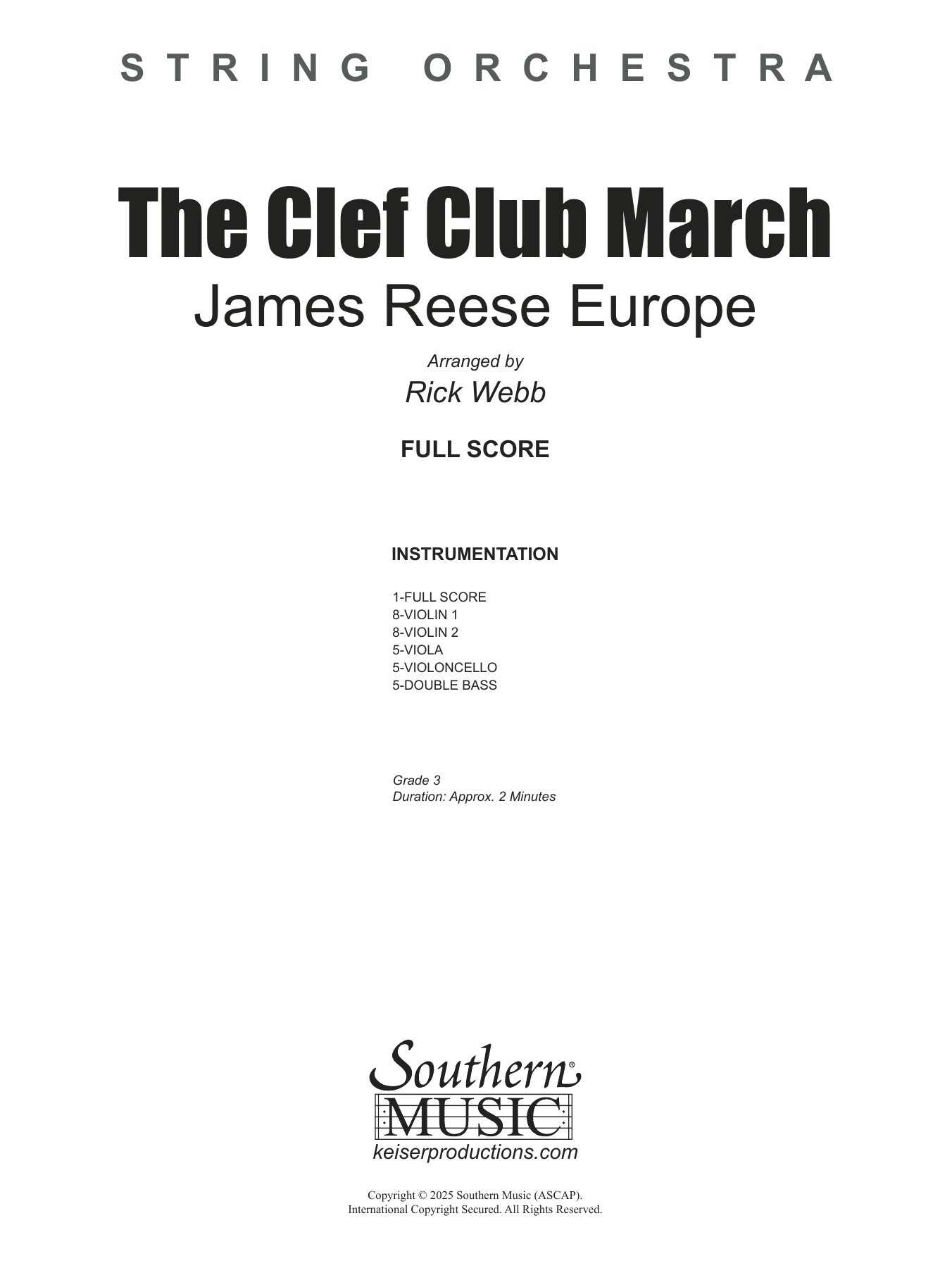

The Clef Club March (arr. Richard Webb): String Orchestra Conductor Score & Parts
By James Reese Europe / Arranged by Richard Webb
Grade: 3
Item: 35-PK01724450
$50.00
Pickup currently not available
Buy Extra Parts (Digital PDF Download)
Parts Added to Cart!
Description
James Reese Europe (1881-1919) was an influential New York bandleader and composer during the first two decades of the 20th century. He first came to prominence as one of the founders of The Clef Club, an organization that provided musical support and performance opportunities for the city's Black musicians. Europe later commanded the U.S. Army regiment during World War I, and was decorated for bravery for his service on the Western Front. While Clef Club March was originally published in several different arrangements, all but a handful of orchestral parts have been lost to history. This arrangement provides the rare opportunity for string players to perform an outstanding march by this historically important American composer.


The Clef Club March (arr. Richard Webb): String Orchestra Conductor Score & Parts isn't in MakeMusic Cloud just yet...but it could be. Let us know you'd like to see it, and you'll help shape what comes next. In the meantime, start a free trial and dive into thousands of interactive titles your students can play along with today.
Request This Title
Tell us you want it.
Start Your Free Trial
Explore everything that's ready to play right now.
Sample Audio
No sample audio found.
Sample Video
No sample videos found.
Additional Details
Publisher:
Hal Leonard
SKU:
35-PK01724450
More about this title
About the Composer: James Reese Europe
James Reese Europe (1881-1919) was a bandleader, composer, and cultural organizer who fundamentally shaped Black musical life in early 20th century New York. He co-founded The Clef Club in 1910, an institution that secured performance venues and recording opportunities for African American musicians during a period of severe racial exclusion from mainstream concert halls and orchestras. Europe's leadership extended into military service when he led the 369th Infantry Regiment's band during World War I, earning distinction for his contributions to the war effort and international recognition for American jazz and concert music.
Europe's compositional output includes marches, dances, and other concert works that reflect the vibrant hybrid of European classical forms and African American musical traditions. While many of his orchestral arrangements have been lost, the works that survive reveal a sophisticated understanding of instrumentation and a gift for memorable melody. The Clef Club March exemplifies his craftsmanship and remains a vital link to a crucial but often overlooked chapter of American music history.
Why we love this
This march brings an important American composer into the repertoire when so many works from this era have vanished. Webb's string orchestration captures the character of Europe's original while honoring what the historical record allows us to know, giving students a direct connection to a pivotal figure in African American musical leadership.
What to expect
Energetic and purposeful, with the forward momentum you expect from a march but animated by rhythmic vitality and harmonic warmth. The string textures give the piece a lyrical character distinct from band marches, creating brightness without stridency.
Who it's for
String orchestras at the upper-intermediate level looking to expand beyond the standard march repertoire. Directors seeking works that combine technical accessibility with historical substance and cultural significance.
How to get the most out of it
- Shape each phrase with clear arrival points; marches thrive on intentional phrasing rather than driving mechanically through the sections.
- Balance the melodic voices so that secondary lines in the violas and cellos remain audible without overwhelming the first violins.
- Establish a tempo that allows the rhythmic figures to spring naturally without rushing the accompaniment patterns.
- Use the score to identify moments where the arrangement shifts harmonic color or introduces countermelodies, cueing players to listen across sections.
How to use it
Position this in a concert celebrating American composers or as a way to honor Black History Month programming with substantive musical content rather than tokenistic gestures. It pairs naturally with other marches and character pieces and serves as an excellent opener that establishes energy and ensemble cohesion.
Skills your students will build
- Clarity in march rhythmic figures and accompaniment patterns
- Balance between melody and inner voices in string textures
- Style awareness in early 20th-century American concert music
- Recognition of culturally significant composers and their contributions to concert music history