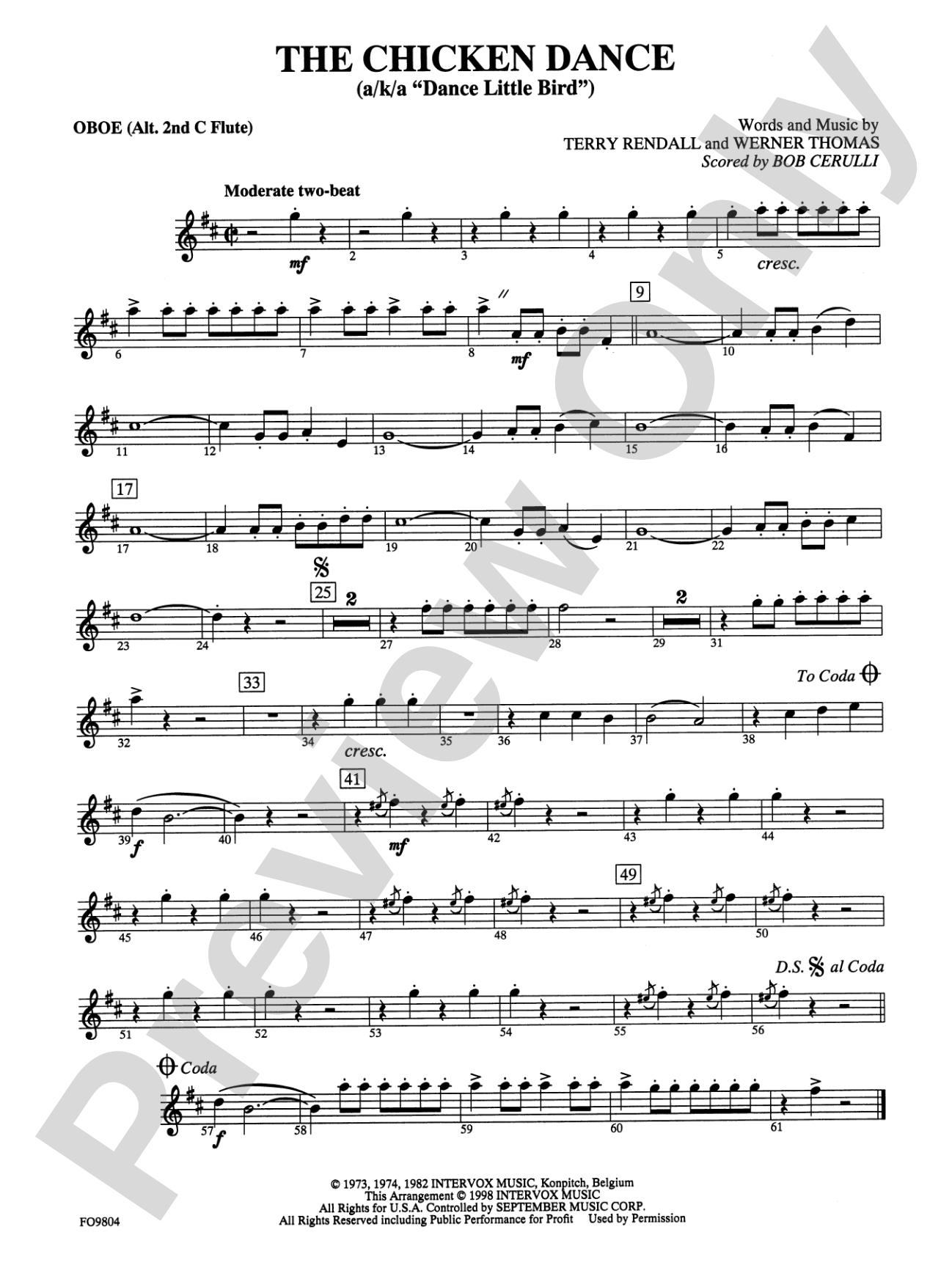
The Chicken Dance: Oboe Sheet Music Preview

The Chicken Dance: Oboe

Arr. Bob Cerulli

Grade: 2.5

Item: 00-PC-0016620_O1

Digital Download
$3.00
Description
Hold on to your hats for this one! You'll play only a few notes before everyone (and we mean everyone) in your audience gets the message. The grins will go from ear to ear, and chances are there will be more than a few who will be doing a bit of moving. It's all good fun and one heck of a way to bond your musicians with their audiences. With this wonderful Bob Cerulli arrangement, you'll hit solid home runs . . . never 'fowl' balls!

Don't just read it, hear it, play along with it, and watch your students grow with it. In MakeMusic Cloud, The Chicken Dance: Oboe comes alive with professional accompaniment, adjustable tempo, and built-in practice tools that turn solo practice into real progress.

Sample Audio
No sample audio found.
Sample Video
Additional Details
Series: Pop Intermediate Full Orchestra
Publisher: Alfred Music
Page Count: 62
SKU: 00-PC-0016620_O1

More about this title

About the Arranger: Bob Cerulli

Bob Cerulli

Bob Cerulli studied double bass at the Curtis Institute of Music under Roger Scott and later earned degrees in music education from the University of the Arts and conducting from the College of New Jersey. He performed as Principal Bass with several regional orchestras including the Greater Trenton Symphony and Delaware Valley Philharmonic, and freelanced extensively in Philadelphia and Atlantic City with Broadway performers and film composers including Henry Mancini, Bill Conte, and Michel LeGrand.

Cerulli's own compositions have been performed by regional orchestras, and his Romance in D Major for cello and piano was written for Philadelphia Orchestra Principal Cellist William Stokking. After 29 years teaching music in public schools, he now serves as a Senior Adjunct Professor at Rowan College at Burlington County and regularly conducts orchestral performances and reading sessions at regional music festivals.

Why we love this

Cerulli's arrangement cuts right to the chase with a melody that registers instantly, making this an ideal crowd-pleaser without sacrificing musicianship. The Grade 2.5 scoring keeps all sections engaged and in the action, so no one is left waiting for their moment. Best of all, the piece does exactly what great light music should do: it creates a shared moment of joy between your ensemble and the audience that lingers long after the final note.

What to expect

From the first few notes, the energy is unmistakable and infectious. The orchestration sparkles with clarity and bounce, inviting both musicians and listeners into the joke without a wink or explanation. This is the kind of music that breaks the formality of a concert hall and reminds everyone why they love live performance.

Who it's for

Conductors programming full orchestra concerts who want to include a moment of genuine audience engagement and levity without compromising musicianship. This arrangement works for mixed-ability orchestras at the intermediate level, where younger players and experienced musicians alike can contribute meaningfully to a piece that's both accessible and fun to perform.

How to get the most out of it

  • Keep the tempo brisk and consistent so the comedic timing lands. The humor comes from the melody's familiarity and directness, not from dragging it out.
  • Balance the melodic lines so the main theme cuts through the accompaniment. Even in a full orchestra setting, clarity wins over volume.
  • Encourage your brass and reeds to embrace the playful character without overblowing. This piece thrives on precision and restraint, not bombast.
  • Watch for ensemble unity during the rhythmic hits that punctuate the melody. Clean, synchronized attacks make the fun moments even sharper.

How to use it

Reserve this for a moment when you want to shift the concert's mood and reconnect with your audience after a series of heavier works. It lands best early in a second half or as an encore, where it can stand alone as a palate cleanser and genuine highlight rather than feeling tacked on. The piece is short enough to fit into a diverse program and substantial enough to warrant its own place on the page.

Skills your students will build

  • Playing with character and style appropriate to light, novelty repertoire
  • Maintaining consistent ensemble tempo and rhythmic precision across all sections
  • Balancing melody and accompaniment in a full orchestral texture
  • Responding to conductor direction for comedic pacing and ensemble clarity

You May Also Like