
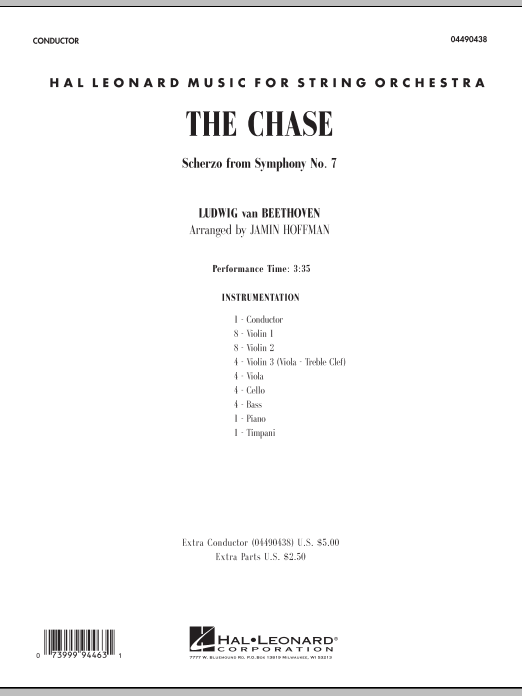

The Chase (Scherzo from Symphony No. 7): String Orchestra Conductor Score & Parts
By Ludwig Van Beethoven / Arranged by Jamin Hoffman
Grade: 3-4
Item: 35-PK00144150
$45.00
Pickup currently not available
Buy Extra Parts (Digital PDF Download)
Parts Added to Cart!
Description
This skilled arrangement of the Scherzo from Beethoven's 7th Symphony combines the hunting-horn theme from the beginning of the movement with the more stately waltz-like theme from the trio, providing your students access to one of Beethoven's most well-known and loved pieces. Dur: 3:35


The Chase (Scherzo from Symphony No. 7): String Orchestra Conductor Score & Parts isn't in MakeMusic Cloud just yet...but it could be. Let us know you'd like to see it, and you'll help shape what comes next. In the meantime, start a free trial and dive into thousands of interactive titles your students can play along with today.
Request This Title
Tell us you want it.
Start Your Free Trial
Explore everything that's ready to play right now.
Sample Audio
No sample audio found.
Sample Video
No sample videos found.
Additional Details
Publisher:
Hal Leonard
SKU:
35-PK00144150
More about this title
About the Composer: Ludwig Van Beethoven
Beethoven composed his Symphony No. 7 in A Major during 1811 and 1812, a period of remarkable creative output that also produced the Eighth Symphony. The work premiered in Vienna in December 1813 as part of a benefit concert, and audiences responded with immediate enthusiasm to its rhythmic vitality and orchestral brilliance. This symphony stands as a bridge in his career, written after the transformative "Waldstein" and "Appassionata" sonatas but before the Ninth Symphony would reshape symphonic possibilities entirely.
The Scherzo movement exemplifies Beethoven's genius for rhythmic propulsion and thematic transformation. Rather than the minuet form of Classical predecessors, he crafted a movement built on kinetic energy and sharp contrasts between hunting-horn fanfares and a graceful waltz-like section, creating one of his most immediately engaging and performable movements. For student orchestras, this movement offers direct access to Beethoven's orchestral language without the technical demands of the full symphony.
Why we love this
String orchestras at the intermediate level rarely encounter Beethoven, and this arrangement changes that. The hunting-horn theme grabs listeners instantly, while the trio provides breathing room and textural variety that young musicians can actually shape with their developing musicality. Hoffman's arrangement respects the original while making it achievable for Grade 3-4 ensembles.
What to expect
The opening brims with the energy of a hunt, all forward momentum and bright fanfares that crackle with life. The trio shifts gears entirely, inviting dancers onto a grand ballroom floor where melodies flow with elegance and restraint. The return of the hunting theme feels like a triumphant conclusion to a perfectly matched pairing of contrasts.
Who it's for
String orchestras at the Grade 3-4 level looking to program a recognized masterwork without overwhelming technical demands. Directors who want students to experience authentic Beethoven orchestration and rhythm rather than simplified or heavily adapted versions.
How to get the most out of it
- Balance the rhythmic drive of the opening theme with clarity of articulation; young string players often rush when excited, so establish a steady tempo in rehearsal before adding dynamic contrast.
- Shape the trio section's melodic line with careful attention to phrase direction, treating it as a genuine waltz rather than a slower interlude.
- Layer the parts gradually during rehearsals, letting students hear how the hunting-horn figure threads through different sections of the orchestra.
- Consider the overall arc across the full 3:35 duration; this piece rewards patience and allows time for the familiar themes to resonate with the audience.
How to use it
Program this as an opener on a mixed concert to energize the audience immediately, or place it strategically in the second half after a slower work to restore momentum. Its 3:35 duration makes it an ideal companion piece when building a program around a longer contemporary or Romantic-era work.
Skills your students will build
- Articulation and rhythmic precision in rapid eighth-note passages
- Melodic shaping and phrasing across longer lines
- Texture and balance when multiple thematic ideas occur simultaneously
- Interpretation of Classical orchestration conventions and voice leading
- Tempo stability and ensemble cohesion across contrasting sections