The Chase: Piano Digital Sheet Music

The Chase: Piano Digital Sheet Music

Friedrich Burgmüller

Item: 00-PS-0000224

Digital Download
$2.95
Description

The Chase: Piano Digital Sheet Music isn't in MakeMusic Cloud just yet...but it could be. Let us know you'd like to see it, and you'll help shape what comes next. In the meantime, start a free trial and dive into thousands of interactive titles your students can play along with today.

Sample Audio
No sample audio found.
Sample Video
Additional Details
SKU: 00-PS-0000224

More about this title

About the Composer: Friedrich Burgmüller

Friedrich Burgmüller (1806, 1874) was a German pianist and composer whose pedagogical works became foundational to piano instruction throughout the 19th century. His 25 Progressive Studies, Op. 100, remain standard repertoire in conservatories worldwide, prized for their musicality and carefully calibrated technical demands.

Burgmüller had a gift for embedding genuine musical substance into teaching pieces. Rather than write empty exercises, he created short character pieces that rewarded expressive playing while introducing specific technical challenges. His work bridges the gap between mechanical drill and concert-quality music, making him an essential figure in piano pedagogy.

Why we love this

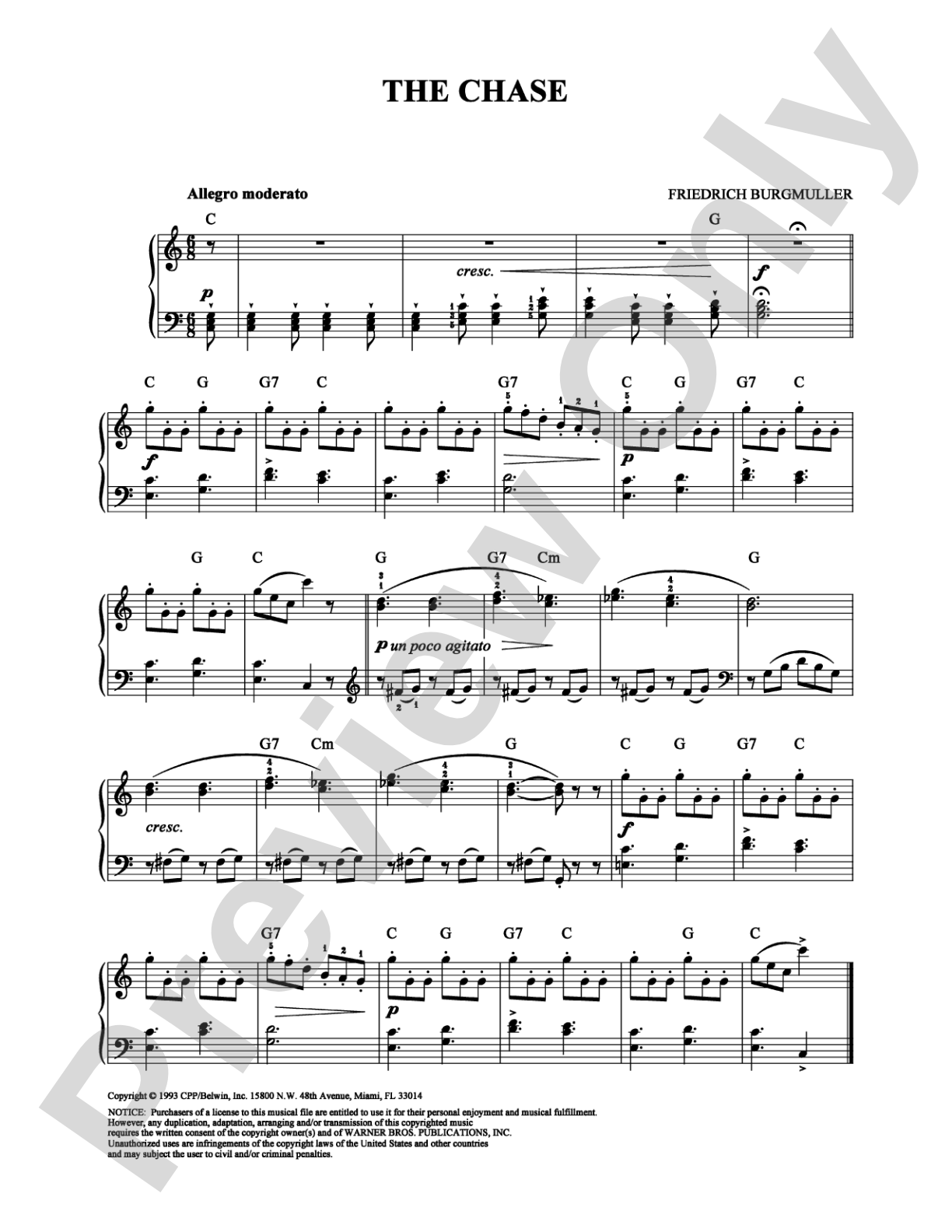
The Chase captures everything that makes Burgmüller's writing endure: a narrative that unfolds through music, figuration that serves a purpose, and the kind of rhythmic propulsion that keeps students engaged without resorting to empty virtuosity. It's the piece students actually want to practice.

What to expect

Energetic and playful, with a sense of chase and pursuit woven into its melodic dialogue. The piece bounds forward with rhythmic vitality, creating a narrative arc that feels both whimsical and purposeful.

Who it's for

Intermediate piano students working through early Romantic pedagogical repertoire, typically around grades 3, 4 (ABRSM) or levels 5, 6 (RCM). Teachers seeking a piece that develops hand independence and rhythmic precision while maintaining genuine musical appeal.

How to get the most out of it

  • Shape the left-hand figuration as a continuous conversation rather than mere accompaniment; the pattern should breathe and respond to the melody's phrasing.
  • Manage the tempo with flexibility, allowing slight breathing room at phrase ends while maintaining the sense of forward momentum that defines the character.
  • Distinguish between the pursuer and the pursued through subtle dynamic shaping; let voicing clarity reveal which line is the subject and which is the countersubject.

How to use it

Program this as a recital opener to establish energy and audience engagement, or pair it with slower works to create dynamic contrast. Its character and length make it ideal for student recitals, competitions, or concert programming that showcases Romantic-era pedagogy.

Skills your students will build

  • Sustained rhythmic precision in pieces with perpetual motion figurations
  • Dynamic shaping of accompanimental patterns to support rather than obscure melody
  • Balance between legato melodic playing and articulate technical passagework
  • Narrative phrasing that uses tempo and dynamics to tell a musical story

You May Also Like