
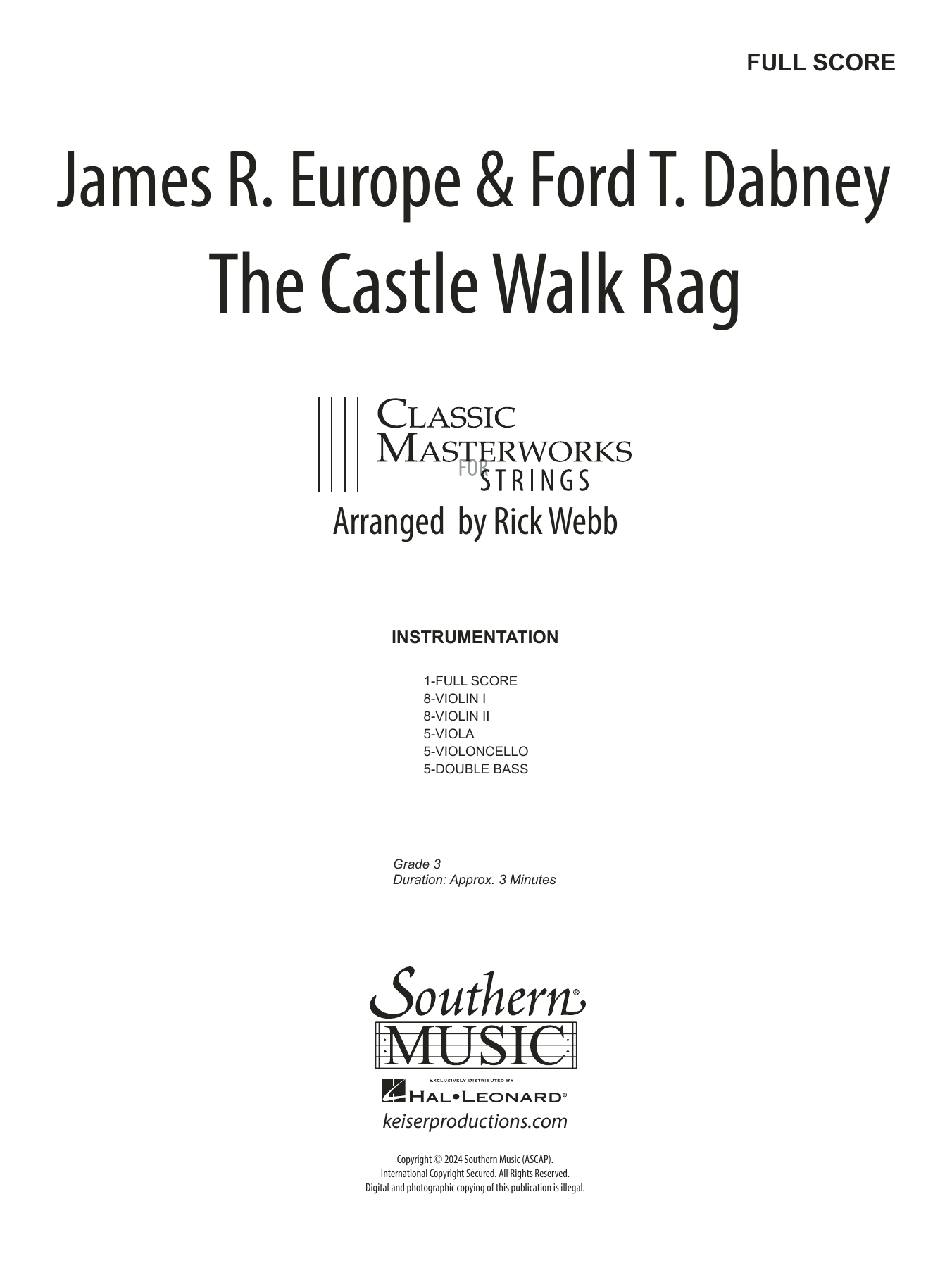

The Castle Walk Rag (arr. Richard Webb): String Orchestra Conductor Score & Parts
By James Reese Europe / Arranged by Richard Webb
Grade: 3
Item: 35-PK01512525
$55.00
Pickup currently not available
Buy Extra Parts (Digital PDF Download)
Parts Added to Cart!
Description
THE CASTLE WALK was commissioned by the famous husband-and-wife dance team Irene and Vernon Castle, who appeared on Broadway and in silent films in the early 20th century. CASTLE WALK was first recorded in 1914 to provide music for the Castles' social dance programs. This delightful string version is entitled THE CASTLE WALK RAG to reflect the works contagious ragtime style.


The Castle Walk Rag (arr. Richard Webb): String Orchestra Conductor Score & Parts isn't in MakeMusic Cloud just yet...but it could be. Let us know you'd like to see it, and you'll help shape what comes next. In the meantime, start a free trial and dive into thousands of interactive titles your students can play along with today.
Request This Title
Tell us you want it.
Start Your Free Trial
Explore everything that's ready to play right now.
Sample Audio
No sample audio found.
Sample Video
No sample videos found.
Additional Details
Publisher:
Hal Leonard
SKU:
35-PK01512525
More about this title
About the Composer: James Reese Europe
James Reese Europe stands as one of the most significant figures in early twentieth century American music. A bandleader, composer, and violinist, Europe was instrumental in bringing African American musicians into prominence during an era of severe racial segregation. He led the 369th Infantry Regiment Band during World War I, a groundbreaking ensemble that introduced European audiences to jazz and syncopated American music.
Europe's compositions, including "The Castle Walk," captured the energy of the ragtime era while showcasing his gift for accessible, sophisticated orchestration. His work with the Castles and other prominent performers of the day demonstrates his ability to write music that served both social dancers and concert audiences with equal skill and integrity.
Why we love this
Richard Webb's string arrangement captures the infectious syncopation and playful character of Europe's original without sacrificing the piece's historical significance. Directors gain a carefully crafted Grade 3 work that introduces students to ragtime idioms and early twentieth century musical storytelling. The vibrant energy and clear orchestration make this both educational and genuinely enjoyable to perform.
What to expect
Lively, sophisticated, and unapologetically fun. The piece captures the spirit of a Broadway dance craze with its syncopated rhythms and bright orchestral colors, evoking the glamour of the Castles' performances while remaining grounded in the musical language students can connect with.
Who it's for
String orchestras at the Grade 3 level seeking accessible concert repertoire with historical depth. This work particularly suits programs looking to expand beyond traditional classical material and introduce students to American musical traditions of the early twentieth century.
How to get the most out of it
- Maintain steady eighth-note patterns in the accompaniment parts; the ragtime feel depends on rhythmic precision rather than expressive rubato.
- Shape the syncopated melodies with clear articulation and slight separation between notes to highlight the ragtime phrasing.
- Balance the inner voices carefully, particularly when the melody moves between first violins and upper violas or celli, so the tune remains audible throughout texture changes.
- Consider the instrumentation of the original dance band context: this arrangement works best when all string sections are balanced and clearly heard.
How to use it
Pair this with other early American works to create a concert segment exploring the musical heritage of the Jazz Age and early twentieth century popular music. Its moderate difficulty and bright character make it an excellent spring concert selection or a program opener that engages audiences immediately. Students benefit from understanding the social context of dance music commissions and the role of African American composers in shaping American musical identity.
Skills your students will build
- Recognizing and performing syncopated rhythms characteristic of ragtime
- Maintaining steady accompaniment patterns while listening to lyrical melodic lines
- Balancing multiple voices in orchestral textures to ensure clarity of line
- Understanding the relationship between social dance music and concert repertoire