
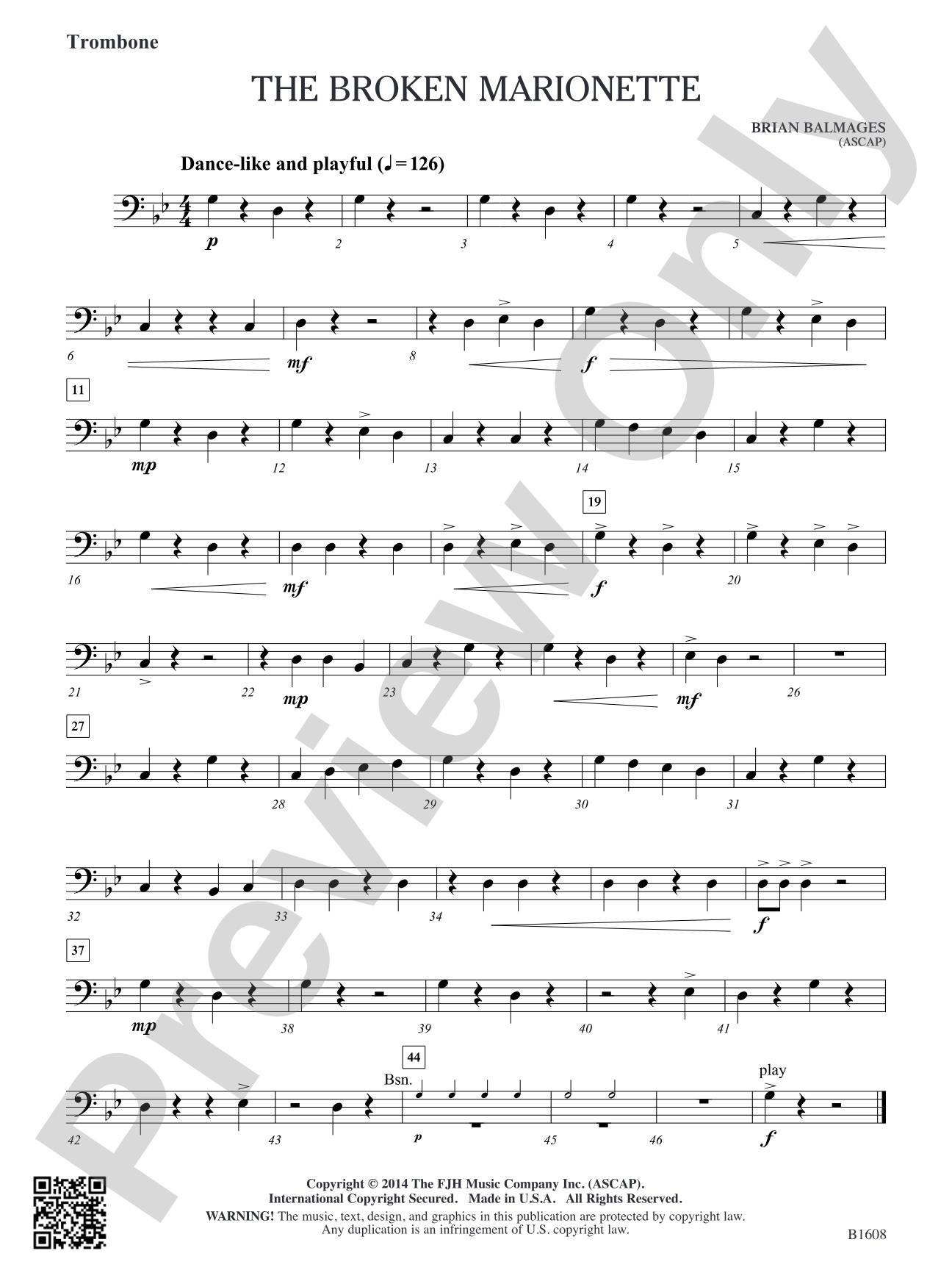

The Broken Marionette: Trombone
By Brian Balmages
Level:.5
Item: 98-PC-DB1608_TN1
$7.00
Pickup currently not available
Description
This fun and somewhat whimsical dance depicts a broken marionette that is attempting to dance, but struggles because of tangled strings and other problems. Eventually, it appears that the marionette has found its way, only to unravel completely while the curtain begins to come down. One last “hurrah” helps leave a smile with the audience just before the curtain closes completely. Fun and extremely unique for this level!


Don't just read it, hear it, play along with it, and watch your students grow with it. In MakeMusic Cloud, The Broken Marionette: Trombone comes alive with professional accompaniment, adjustable tempo, and built-in practice tools that turn solo practice into real progress.
Open in the Player
Jump straight in and assign it today.
Start Your Free Trial
Open this title and explore the full library in minutes.
Sample Audio
1
Audio File
--:--
0:00
0:00
Sample Video
No sample videos found.
Additional Details
Series:
FJH MOS Performance
Publisher:
The FJH Music Company, Inc.
SKU:
98-PC-DB1608_TN1
More about this title
About the Composer: Brian Balmages

Brian Balmages has established himself as a major voice in contemporary band and orchestral music, with performances spanning from elementary school ensembles to major concert halls including Carnegie Hall, the Kennedy Center, and the Sydney Opera House. His accolades include the A. Austin Harding Award from the American School Band Directors Association, the 2020 NBA William D. Revelli Composition Contest for Love and Light, and election to the American Bandmasters Association. He received the inaugural James Madison University Distinguished Alumni Award and was commissioned by the University of Miami to compose for the inauguration of its sixth president.
As a conductor, Balmages maintains an active profile at all-state festivals, university ensembles, and professional orchestras worldwide, with notable guest appearances at the Midwest Clinic, Western International Band Clinic, and the College Band Directors Conference. His music was performed at the 2013 Presidential Inaugural Prayer Service attended by President Obama and Vice President Biden. Currently, he serves as Director of MakeMusic Publications and Digital Education for Alfred and MakeMusic.
Why we love this
Balmages nails the balance between narrative clarity and genuine musicality here. The piece tells its story without ever feeling heavy-handed, letting the band's voicing and rhythmic choices do the dramatic work. For a half-step piece, it punches well above its weight in terms of engagement and keeps student musicians invested in something that feels genuinely theatrical.
What to expect
Imagine watching a puppet fight against its own strings with comedic determination. The music captures physical struggle through rhythmic fragmentation and tonal instability, then pivots to moments of hopeful coordination before the inevitable collapse. It's humorous without being silly, engaging without demanding virtuosity.
Who it's for
This is ideal for developing bands that have solid fundamentals but are ready for programmatic thinking and stylistic nuance. The accessibility of the writing means younger or less experienced ensembles can execute it cleanly while still conveying character and humor.
How to get the most out of it
- Treat the opening section as character introduction. Let the early stuttering rhythms feel slightly clumsy and uncertain before building momentum into the first attempts at coordination.
- Balance the ensemble texture so that the "tangled strings" sections remain transparent. Avoid letting inner voices muddy what should sound like controlled chaos.
- Shape the unraveling passage with clear dynamic decline. This is where the piece earns its theatrical payoff, so resist the temptation to rush; let the dissolution breathe.
- Land that final "hurrah" with full confidence and energy. It's the marionette's last gesture, and it should feel genuinely celebratory rather than apologetic.
How to use it
Program this as a concert centerpiece or closer that showcases your band's musicality beyond traditional marches and ballads. Its theatrical quality and narrative arc make it especially valuable for family concerts or festival appearances where you want to demonstrate that student bands can tackle storytelling and character work with sophistication.
Skills your students will build
- Playing programmatic music with character and intentionality
- Maintaining rhythmic precision through syncopated and fragmented passages
- Balancing ensemble texture when multiple lines are competing for attention
- Dynamic shaping and phrasing over larger formal arcs
- Responding to conductor interpretation of dramatic narrative