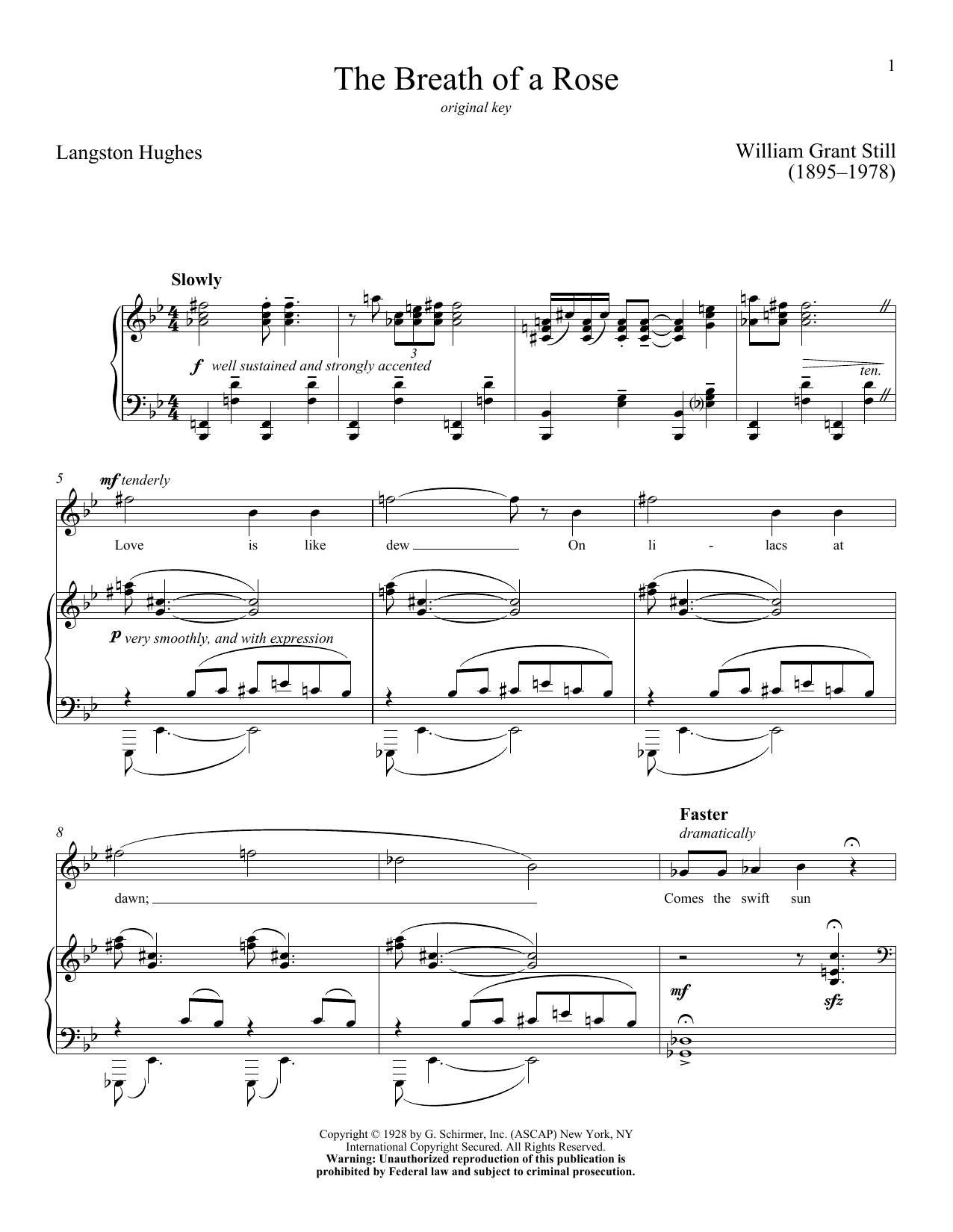
The Breath Of A Rose Sheet Music Preview

The Breath Of A Rose: Piano Vocal

By Langston Hughes / By Richard Walters / Arranged by William Grant Still

Item: 35-DS00296984

Digital Download
$5.99
Description

The Breath Of A Rose: Piano Vocal isn't in MakeMusic Cloud just yet...but it could be. Let us know you'd like to see it, and you'll help shape what comes next. In the meantime, start a free trial and dive into thousands of interactive titles your students can play along with today.

Sample Audio
No sample audio found.
Sample Video
Additional Details
Publisher: Hal Leonard
Page Count: 4
SKU: 35-DS00296984

More about this title

About the Composer: Langston Hughes

Langston Hughes (1901-1967) stands as one of the most influential poets of the Harlem Renaissance, bringing the rhythms and vernacular of African American speech into American literature. His work bridged poetry and music naturally; Hughes collaborated with composers throughout his career, understanding that his words carried their own musicality and demanded settings that honored both the language and the emotional depth beneath it.

Why we love this

William Grant Still's arrangement transforms Hughes' delicate imagery into music that feels both intimate and expansive. The setting respects the poem's restraint while giving singers room to find their own lyrical voice, making it equally effective in art song recitals or as a thoughtful addition to a larger vocal program.

What to expect

Tender and reflective, with an underlying sophistication that rewards careful listening. The music captures something ephemeral about Hughes' image, creating a soundscape that is both carefully crafted and seemingly effortless.

Who it's for

Advanced high school singers, college voice students, and soloists seeking intimate repertoire that engages both musical and literary sensibilities. Teachers introducing students to the intersection of African American poetry and classical vocal writing will find this setting particularly valuable.

How to get the most out of it

  • Shape the vocal line to follow the natural speech patterns of Hughes' text; avoid over-romanticizing the language at the expense of clarity.
  • Balance the piano's accompaniment so it supports rather than overwhelms the singer, especially in passages where the text carries the primary emotional weight.
  • Explore the dynamic range within quiet moments; some of the piece's most powerful effects come from subtle shifts rather than dramatic swells.

How to use it

Pair this with other Harlem Renaissance settings or American vocal miniatures for a concert exploring poetry and music. Its intimate four-page scope makes it ideal for recital programs where it can stand alone or anchor a group of contrasting songs.

Skills your students will build

  • Interpreting poetry through musical phrasing and dynamic control
  • Balancing lyrical singing with clear diction in contemporary American settings
  • Collaborative listening between voice and piano accompaniment
  • Understanding how composers approach texts from African American literary traditions

You May Also Like