
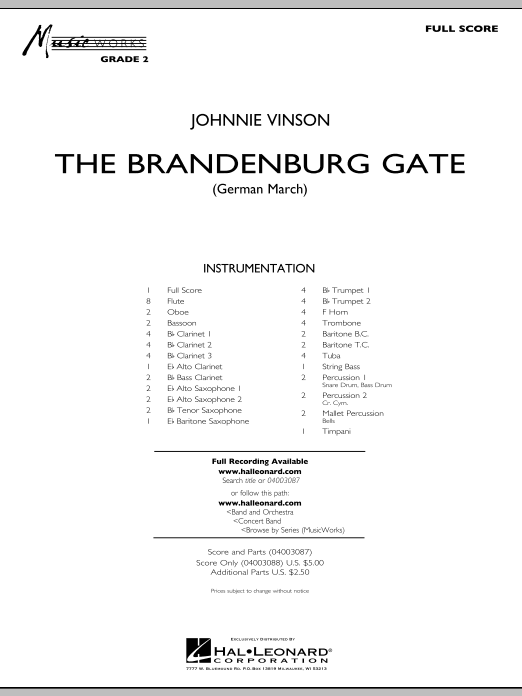

The Brandenburg Gate (German March): Concert Band Conductor Score & Parts
By Johnnie Vinson
Grade: 2
Item: 35-PK00181113
$65.00
Pickup currently not available
Buy Extra Parts (Digital PDF Download)
Parts Added to Cart!
Description
Heralded by a fanfare-like figure for trumpets in the first strain, here is an appealing German-style march solidly scored for young players. Low brass take the lead on the second strain, followed by a contrasting lyrical section featuring the woodwinds. The full ensemble brings us to a rousing finish in this terrific-sounding march. (This is a nice follow-up to Johnnie's earlier "international" marches "St. Petersburg March, New Forest March" and "The Crown of Castile".) Dur: 2:30


The Brandenburg Gate (German March): Concert Band Conductor Score & Parts isn't in MakeMusic Cloud just yet...but it could be. Let us know you'd like to see it, and you'll help shape what comes next. In the meantime, start a free trial and dive into thousands of interactive titles your students can play along with today.
Request This Title
Tell us you want it.
Start Your Free Trial
Explore everything that's ready to play right now.
Sample Audio
No sample audio found.
Sample Video
No sample videos found.
Additional Details
Publisher:
Hal Leonard
SKU:
35-PK00181113
More about this title
About the Composer: Johnnie Vinson
Johnnie Vinson is a prolific composer and arranger whose output spans concert band, jazz ensemble, and educational wind music. His compositional voice blends accessibility with genuine musicianship, making him a trusted voice for directors seeking repertoire that challenges students without overwhelming them.
Vinson's catalog reflects deep understanding of what concert bands at all levels need: pieces that sound substantial, engage multiple sections meaningfully, and reward careful preparation. His writing for young ensembles consistently demonstrates how good orchestration and clear musical intent can produce genuinely satisfying performances.
Why we love this
This march works because it refuses to coast on formula. The trumpet fanfare opening hooks listeners immediately, the low brass feature in the second strain shifts weight and color without losing momentum, and the woodwind-driven lyrical section arrives with real contrast rather than filler. Students get to inhabit distinctly different roles across the form, and audiences hear a march that sounds confident and complete.
What to expect
Crisp, organized energy with a touch of Germanic character. The piece maintains the straightforward momentum of a march while offering enough sectional variety and textural interest to engage both players and listeners. There's pride in the sound without pretension.
Who it's for
Grade 2 concert bands ready to move beyond simple march forms will find solid material here. This works equally well for groups preparing for festival competition or for programs seeking crowd-pleasing concert openers that demonstrate ensemble capability.
How to get the most out of it
- Shape the opening trumpet fanfare with clear articulation and a sense of announcement. This is your concert's first impression; let it ring with authority.
- Balance the low brass section feature carefully. These players carry the melodic weight here, so ensure they project without drowning the harmonic foundation beneath them.
- Treat the lyrical woodwind section as a genuine shift in character. Encourage sustained tone and longer phrase shapes to contrast with the march's rhythmic momentum.
- Build the final ensemble statement deliberately. The rousing finish rewards directors who resist rushing and instead let the full scoring breathe into each bar.
How to use it
Position this as an opening number or early-concert selection where you want to establish ensemble precision and confidence. It pairs well alongside other Vinson marches if you're programming thematically, or it can anchor a concert block focused on festival repertoire and accessible concert pieces.
Skills your students will build
- Trumpet fanfare articulation and rhythmic precision
- Low brass melodic expression and section balance
- Woodwind sustained tone and phrase shaping
- Ensemble blend across contrasting sections
- March form recognition and structural listening