
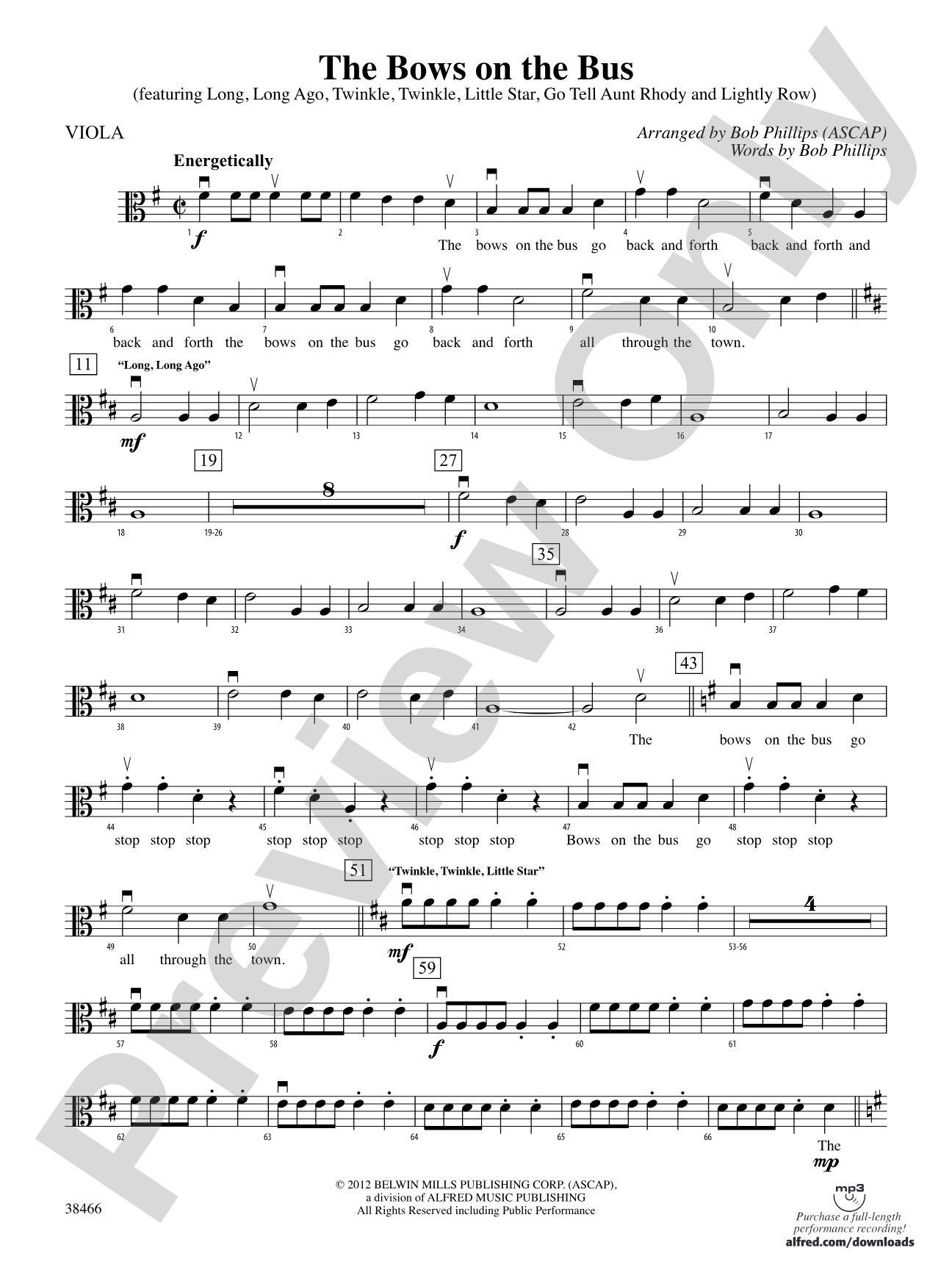

The Bows on the Bus: Viola
Featuring: Long, Long Ago / Twinkle, Twinkle, Little Star / Go Tell Aunt Rhody / Lightly Row
Words by Bob Phillips / arr. Bob Phillips
Grade: 1
Item: 00-PC-0015514_VA1
$5.99
Pickup currently not available
Description
Here is the perfect first-year repertoire! Favorite beginning tunes are arranged in a novelty setting that makes them tons of fun and reinforces right-arm technique. Travel through various bowing skills as you sing along to this traditional favorite. Imagine singing and playing this---the bows on the bus go stop, stop, stop, go back and forth, slur the notes, and cross the strings! Each skill is sung, played, and used in a folk tune. The arrangement includes "The Wheels on the Bus," "Long, Long Ago," "Twinkle, Twinkle, Little Star," "Go Tell Aunt Rhody," and "Lightly Row." Correlates to Sound Innovations for String Orchestra, Book 1 Level 5.


Don't just read it, hear it, play along with it, and watch your students grow with it. In MakeMusic Cloud, The Bows on the Bus: Viola comes alive with professional accompaniment, adjustable tempo, and built-in practice tools that turn solo practice into real progress.
Open in the Player
Jump straight in and assign it today.
Start Your Free Trial
Open this title and explore the full library in minutes.
Sample Audio
1
Audio File
--:--
0:00
0:00
Sample Video
No sample videos found.
Additional Details
Series:
Sound Innovations for String Orchestra
Publisher:
Alfred Music
Page Count:
148
SKU:
00-PC-0015514_VA1
More about this title
About the Arranger: Bob Phillips

Bob Phillips has spent more than four decades defining what innovative string education looks like. Born in 1953, he is both composer and arranger, but his most lasting contribution may be his work as a pedagogue and program builder. Over 25 book series bear his name, from Sound Innovations to the eclectic style collections (Fiddlers Philharmonic, Jazz Philharmonic, Rock Philharmonic, and others). His published works exceed 200 pieces for orchestras and bands; he holds ASCAP awards and sees his arrangements performed regularly at the Midwest Clinic.
For 27 years, Phillips directed the string program in Saline, Michigan, growing it to over 700 students and establishing it as a national model for both classical and contemporary repertoire. He founded the Saline Fiddlers Philharmonic, an ensemble that performed more than 80 shows annually and appeared at the White House and major festivals. Phillips has guest conducted all-state orchestras across the country and served as resident conductor for the Wintergrass Festival in Seattle. His instructional DVDs, String Clinics to Go, remain widely used in schools nationwide.
Why we love this
This arrangement captures the genius of pairing beloved folk tunes with targeted bowing instruction. Every musical phrase reinforces a specific bow skill, so students aren't just playing familiar melodies; they're building right-arm control through the melodies themselves. The humor and movement built into the novelty setting keeps first-year orchestras genuinely engaged while they're doing serious technical work.
What to expect
Playful and energetic, with a theatrical quality that makes learning feel like performance rather than drill. The familiar tunes give students immediate confidence, while the bow pattern variations keep the arrangement surprising and fun to play through multiple rehearsals.
Who it's for
Grade 1 beginning string orchestras that need repertoire with real musical payoff and transparent pedagogical scaffolding. This works especially well in programs using Sound Innovations Book 1 Level 5, where it becomes a celebration of what students have learned rather than an isolated concert piece.
How to get the most out of it
- Sing the bowing action along with the orchestra. The sung words (stop, go back and forth, slur, cross strings) make abstract bow patterns concrete and give students a physical anchor for each technique.
- Separate the five folk tunes into distinct rehearsal units so students experience each bowing concept fresh. Jumping between all five at once can obscure the pedagogical clarity Phillips built into each tune.
- Emphasize evenness and control in the stop-and-start passages. Sudden stops and starts expose loose right-arm tension faster than legato passages, so use these moments to assess each section's bow hold.
How to use it
Ideal as a winter or spring concert opener, where its novelty and humor set an engaged tone for the rest of the program. It also works beautifully as a culminating piece for a unit on bowing technique, giving students a satisfying musical application of isolated bow exercises they've practiced all semester.
Skills your students will build
- Controlled stop-and-start bowing (staccato control)
- Alternating bow directions with precision
- Slurred passages across two or more notes
- String crossing with clarity and minimal bow angle adjustment
- Coordination of left and right hand in familiar melodic contexts
- Ensemble rhythm and balance while focusing on individual bow technique