The Bowery Sheet Music Preview

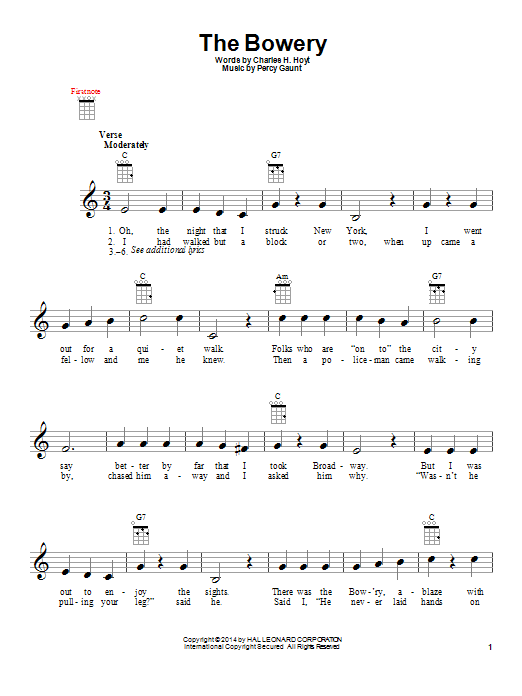
The Bowery: Ukulele

Item: 35-DS00284756

Digital Download
$3.99
Description

The Bowery: Ukulele isn't in MakeMusic Cloud just yet...but it could be. Let us know you'd like to see it, and you'll help shape what comes next. In the meantime, start a free trial and dive into thousands of interactive titles your students can play along with today.

Sample Audio
No sample audio found.
Sample Video
Additional Details
Publisher: Hal Leonard
Page Count: 2
SKU: 35-DS00284756

More about this title

Why we love this

This standard carries genuine historical weight. It's the kind of tune that shaped American vernacular music, and ukulele players get to claim a piece of that legacy while working through accessible, rewarding chord changes.

What to expect

A snapshot of early twentieth century urban America, full of character and streetwise charm. The melody sits comfortably on the ukulele, inviting players to add their own phrasing and personality.

Who it's for

Ukulele students ready to tackle standards and players building a repertoire of American traditional songs. This works equally well for solo performance or as part of a mixed ensemble.

How to get the most out of it

  • Lock into a steady tempo from the start; this tune's charm lives in its straightforward rhythmic groove.
  • Pay attention to any syncopation in the original melody and preserve it rather than straightening it out.
  • Let the fingerstyle or strumming pattern breathe naturally with the phrases instead of mechanically counting every beat.

How to use it

Pair it with other standards from the same era for a themed concert, or use it as a gateway piece to help students understand the ukulele's role in American popular music history. It's compact enough to fit into a medley or to stand alone as a charming interlude.

Skills your students will build

  • Chord changes common to early twentieth century popular music
  • Reading lead sheet notation
  • Interpreting melody and harmonic movement on the ukulele fingerboard
  • Developing interpretive phrasing in traditional repertoire

You May Also Like