
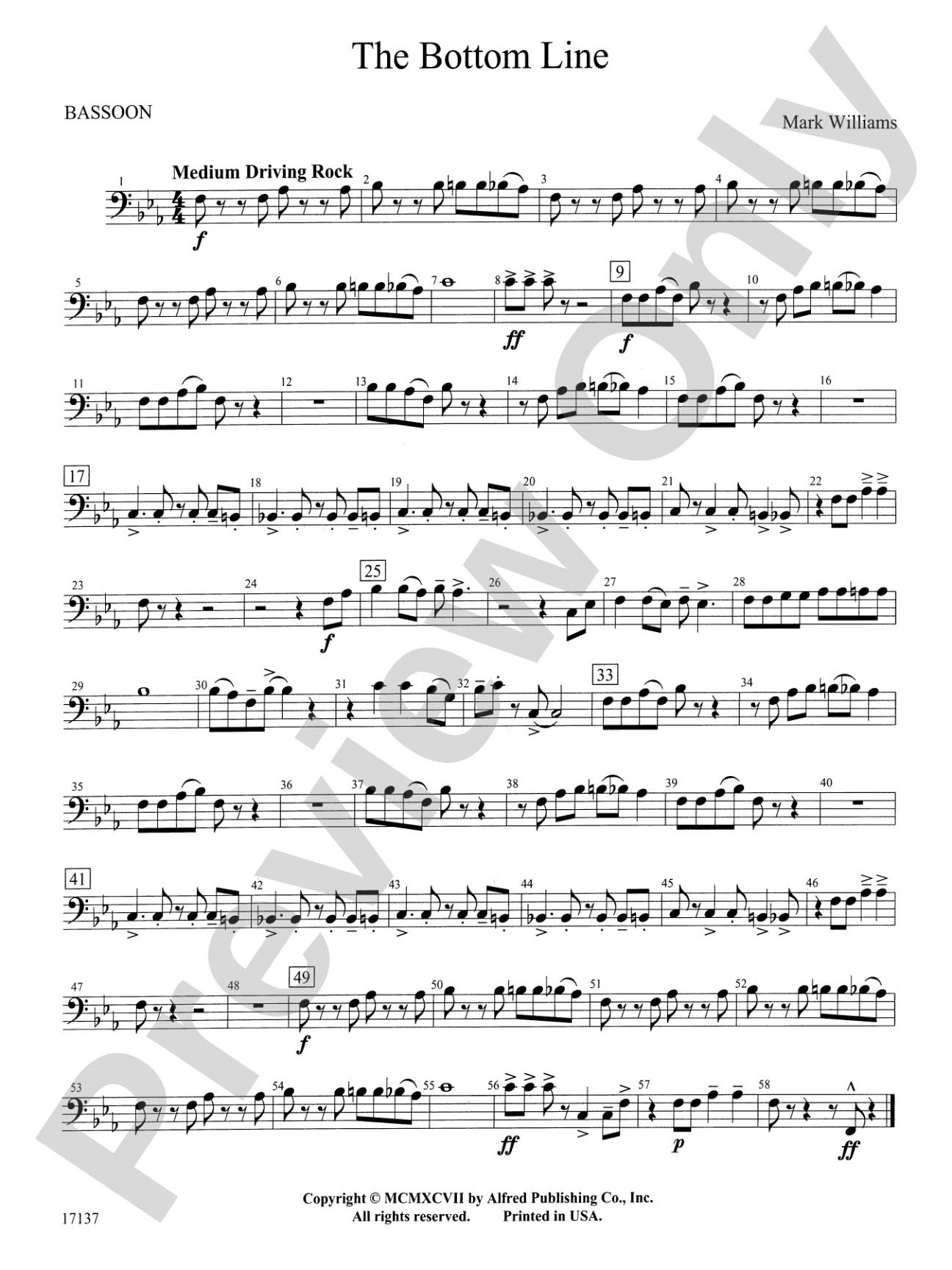

The Bottom Line: Bassoon
Low Brass / Low Woodwind Section Feature
By Mark Williams
Grade: 1.5 (Easy)
Item: 00-PC-0000215_B1
$3.00
Pickup currently not available
Description
Feature your combined low brass/low woodwind sections with this funky, minor blues chart. Reward the "workhorses" of your band with this entertaining role reversal. Great as a recruiting tool to get more low brass and woodwind players in your band program.


Don't just read it, hear it, play along with it, and watch your students grow with it. In MakeMusic Cloud, The Bottom Line: Bassoon comes alive with professional accompaniment, adjustable tempo, and built-in practice tools that turn solo practice into real progress.
Open in the Player
Jump straight in and assign it today.
Start Your Free Trial
Open this title and explore the full library in minutes.
Sample Audio
1
Audio File
--:--
0:00
0:00
Sample Video
No sample videos found.
Additional Details
Series:
Challenger Band Series
Publisher:
Alfred Music
Page Count:
120
SKU:
00-PC-0000215_B1
More about this title
About the Composer: Mark Williams

Mark Williams built his reputation as one of school music's most prolific and practical composers, publishing over 200 works across band, orchestra, and choir. His deep roots in elementary and secondary music education in Washington State shaped his understanding of what actually works in rehearsal. He earned degrees from Eastern Washington University and served as a woodwind performer and arranger for the 560th Air Force Band, bringing professional musicianship into every score he wrote.
Beyond his compositional output, Williams was a tireless clinician and guest conductor who traveled to 34 states, five Canadian provinces, and Australia. He co-authored the Accent on Achievement Band Method and received recognition including the Western International Band Clinic's Gralia Competition and multiple ASCAP Special Awards. When not composing, Williams performed bassoon regularly and served as conductor and artistic director for the Spokane British Brass Band.
Why we love this
This chart does what every director dreams of: it makes your tuba and low reed players feel like soloists. The blues idiom is immediately engaging for players and audiences alike, and the easy Grade 1.5 level means your lower sections can execute the style confidently without technical barriers getting in the way of the fun. You'll watch recruitment interest spike when potential band members see their would-be peers on the featured parts.
What to expect
A blues groove with attitude. The minor tonality gives it edge and sophistication, while the funky rhythm section pocket keeps things light and accessible. Your low section suddenly becomes the heartbeat of the band, and the arrangement lets them play with style and personality rather than just supporting from underneath.
Who it's for
Band directors looking to feature and celebrate the low brass and low woodwind players who anchor the ensemble. This works equally well for middle school and early high school programs, rewarding dedicated players and motivating younger students who might be considering what section to join.
How to get the most out of it
- Nail the blues shuffle feel with your rhythm section first, then layer the melodic voices against that pocket. Lock the comping figures before adding harmonic color.
- Give your low brass and woodwinds space to breathe on the melody lines. This is their moment to shine, so resist over-conducting and let them own the groove.
- Emphasize the minor tonality and its emotional weight. Blues in a minor key has swagger and attitude; make sure the band plays with confidence, not apology.
- Check that articulation matches between tuba, baritone, and low reeds when they're doubling or trading phrases. Unified tongue attack will tighten the feature.
How to use it
Program this as a concert or pep band feature that energizes the audience and celebrates often-overlooked players. It pairs well on a mixed-level concert where you want an entertaining contrast to your more formal works, and its easy technical demands mean you can include it without disrupting rehearsal focus on your more demanding repertoire.
Skills your students will build
- Blues feel and shuffle rhythms in a minor key
- Intonation and blend in low register doubled passages
- Section cohesion when trading melodic phrases
- Style and articulation in contemporary harmonic contexts
- Confidence playing featured parts as a section