The Book: Piano/Vocal/Chords Digital Sheet Music

The Book: Piano/Vocal/Chords Digital Sheet Music

Sheryl Crow, Jeff Trott

Item: 00-PS-0006121

Digital Download
$3.99
Description

The Book: Piano/Vocal/Chords Digital Sheet Music isn't in MakeMusic Cloud just yet...but it could be. Let us know you'd like to see it, and you'll help shape what comes next. In the meantime, start a free trial and dive into thousands of interactive titles your students can play along with today.

Sample Audio
No sample audio found.
Sample Video
Additional Details
SKU: 00-PS-0006121

More about this title

About the Artist: Sheryl Crow

Sheryl Crow rose to prominence in the 1990s as a singer, songwriter, and multi-instrumentalist whose work bridged pop, rock, and country influences. Her career spans over three decades, marked by multiple Grammy Awards, chart success, and a reputation for crafting songs with memorable melodies and authentic emotional depth. In music education contexts, her catalog offers accessible yet sophisticated examples of contemporary songwriting that engage students in both performance and analysis.

Crow's influence on popular music lies in her ability to blend genre boundaries while maintaining strong melodic and harmonic sensibilities. Her songs have become staples in piano/vocal performance classes, recitals, and student arrangements, offering material that feels current while remaining technically manageable for intermediate to advanced musicians.

Why we love this

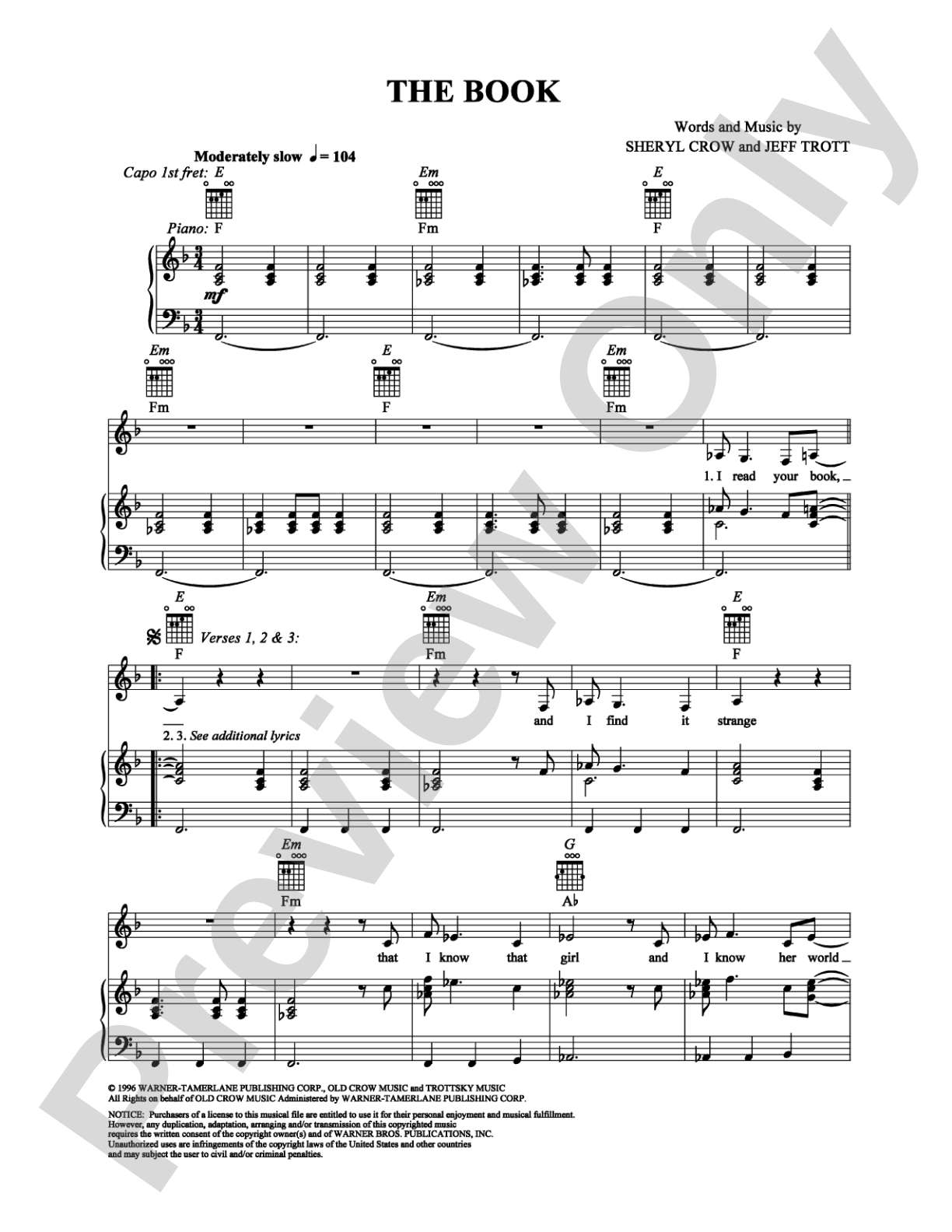
This digital sheet music captures one of Crow's signature songs with all three systems (piano, vocal line, and chord symbols) on a single score, making it ideal for collaborative piano students, vocalists preparing for recital, or classroom sing-alongs. The arrangement balances accessibility with musical interest, allowing singers at different levels to find their footing while accompanists engage with a well-crafted piano part that's neither trivial nor overly dense.

What to expect

The music carries Crow's characteristic blend of conversational vocal storytelling over rock-inflected harmonic movement. There's a directness to her melodies that feels both personal and immediately singable, supported by a piano part that grounds the song in pop/rock tradition while allowing room for emotional nuance.

Who it's for

This is essential for pianists studying contemporary pop/rock repertoire, singers preparing songs for recital or audition, and music students exploring songwriting craft through popular material. It also works well for classroom sing-alongs, ensemble rehearsals, and informal performance settings where the three-system layout serves both accompanist and vocalist equally.

How to get the most out of it

  • Establish the groove through the piano part before the vocal entry. Crow's songs often succeed on rhythmic clarity, so lock the accompaniment's pocket first.
  • Use the chord symbols to inform interpretive choices in the vocal phrasing. These symbols often suggest harmonic tension points where the singer should lean into expression.
  • Balance vocal intimacy with the energy of the accompaniment. The piano part can easily overshadow a delicate vocal line, so shape dynamics carefully between the two.
  • Reference a recording to capture Crow's signature vocal delivery and articulation style, which often includes rhythmic syncopation that sheet music alone may not fully convey.

How to use it

Program this in a contemporary American songwriting unit, pairing it with other 1990s-2000s pop/rock material to examine how successful artists structure melody and harmony. It also serves as a bridge between classical vocal training and contemporary performance styles for intermediate singers preparing their first popular repertoire recitals.

Skills your students will build

  • Singing with rock and pop phrasing conventions (rhythmic flexibility, supported belting, conversational tone)
  • Reading and interpreting chord symbols in a contemporary context
  • Coordinating piano accompaniment with a vocal line across multiple systems
  • Understanding song form and harmonic progression in popular music
  • Stylistic interpretation of contemporary songwriter material

You May Also Like