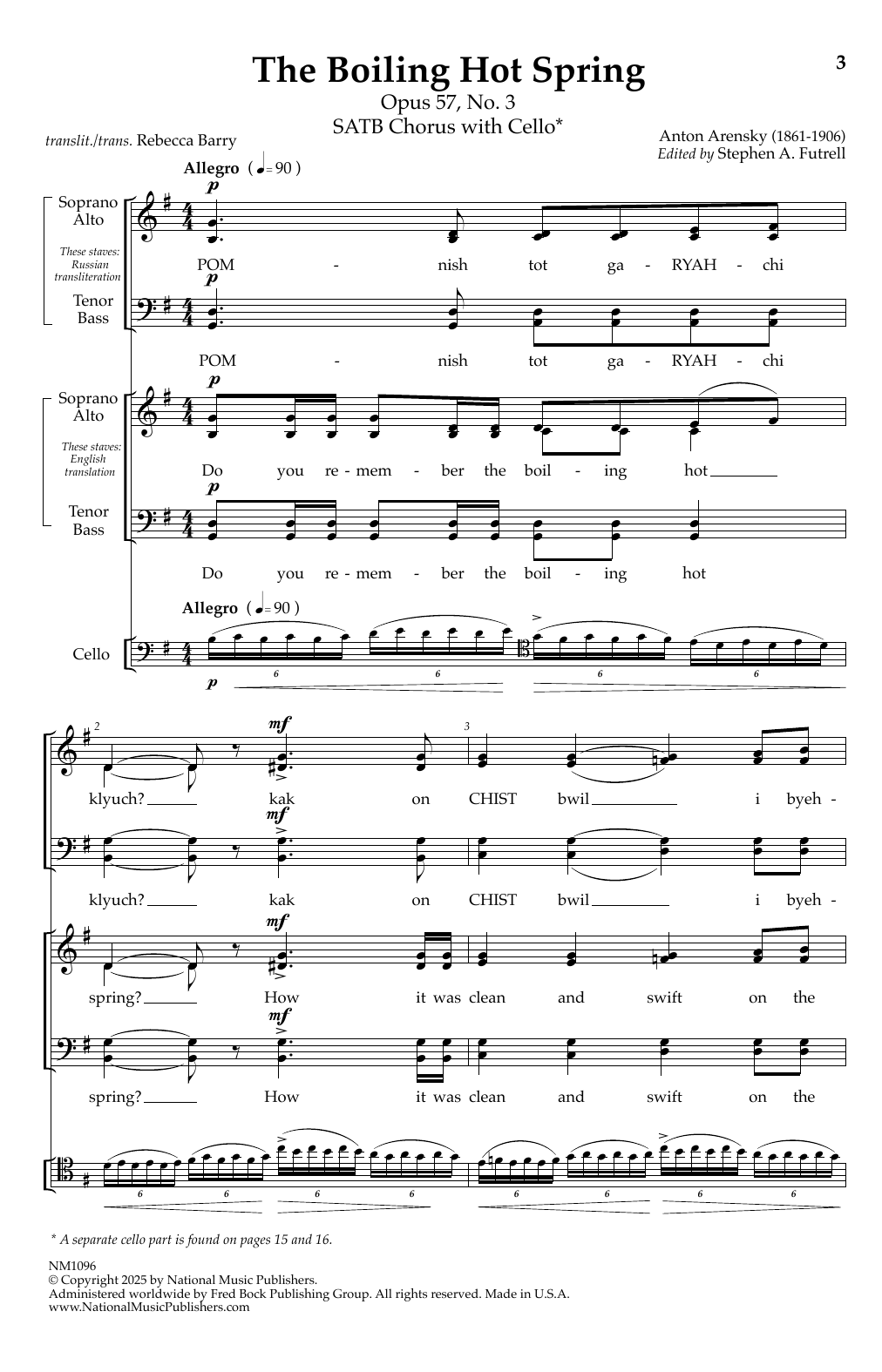
The Boiling Hot Spring Sheet Music Preview

The Boiling Hot Spring: SATB Choral Octavo

By Anton Arensky / Edited by Stephen A. Futrell

Item: 35-DS01463093

Digital Download
$3.50
Description

The Boiling Hot Spring: SATB Choral Octavo isn't in MakeMusic Cloud just yet...but it could be. Let us know you'd like to see it, and you'll help shape what comes next. In the meantime, start a free trial and dive into thousands of interactive titles your students can play along with today.

Sample Audio
No sample audio found.
Sample Video
Additional Details
Publisher: Hal Leonard
Page Count: 15
SKU: 35-DS01463093

More about this title

About the Composer: Anton Arensky

Anton Arensky (1861–1906) was a Russian composer and pianist whose gift for orchestration and harmonic sophistication made him a central figure in late 19th-century Russian musical life. He served as director of the Moscow Conservatory and composed across all major forms, from symphonies and concertos to chamber works and vocal music, yet his choral output remains underperformed in many programs despite its emotional depth and technical craft.

Arensky's approach to choral writing reflects the Romantic sensibility of his era combined with a distinctly Russian harmonic palette. His song cycles and choral works demonstrate how a skilled composer could balance accessibility with genuine compositional ambition, creating pieces that reward both singers and audiences without demanding virtuosity beyond reach.

Why we love this

Arensky gives your choir a Russian Romantic work with genuine artistic substance rather than filler material. The harmonic language is rich without becoming murky, and the SATB writing sits comfortably for singers while maintaining that sophisticated sound directors seek when programming concert repertoire.

What to expect

The imagery of boiling hot spring evokes natural energy and transformation captured through Arensky's shimmering harmonic language and fluid vocal lines. The piece conveys movement and vitality without sacrificing the lyrical sensibility that defines his compositional voice.

Who it's for

This work suits advanced high school choirs and collegiate ensembles with solid musicianship and comfort reading chromatic harmony. Directors seeking a concert piece that broadens students' exposure to Russian repertoire beyond Tchaikovsky will find this a compelling choice.

How to get the most out of it

  • Attend to the specific vowel colors Arensky requires; maintain clarity in the upper register while allowing the warmth of Russian vowels to bloom in the middle and lower voices.
  • Balance the ensemble texture by resisting the urge to let sopranos dominate in climactic passages; Arensky layers his lines for collective effect, not soloistic display.
  • Shape longer phrases by identifying the harmonic motion and allowing subtle dynamic contour rather than forcing artificial crescendos.

How to use it

Position this work as a window into Russian Romantic choral traditions, pairing it with other Arensky songs or using it to build a program exploring how different cultures approached secular choral composition in the 19th century. Its moderate length and intrinsic musicality make it equally effective as a concert centerpiece or as part of a thematic exploration.

Skills your students will build

  • Reading chromatic harmony and Russian harmonic practice
  • Balancing texture across four independent lines
  • Shaping longer vocal phrases with attention to harmonic structure
  • Interpreting text expression in translation
  • Sustaining pure vowel placement across dynamic ranges

You May Also Like