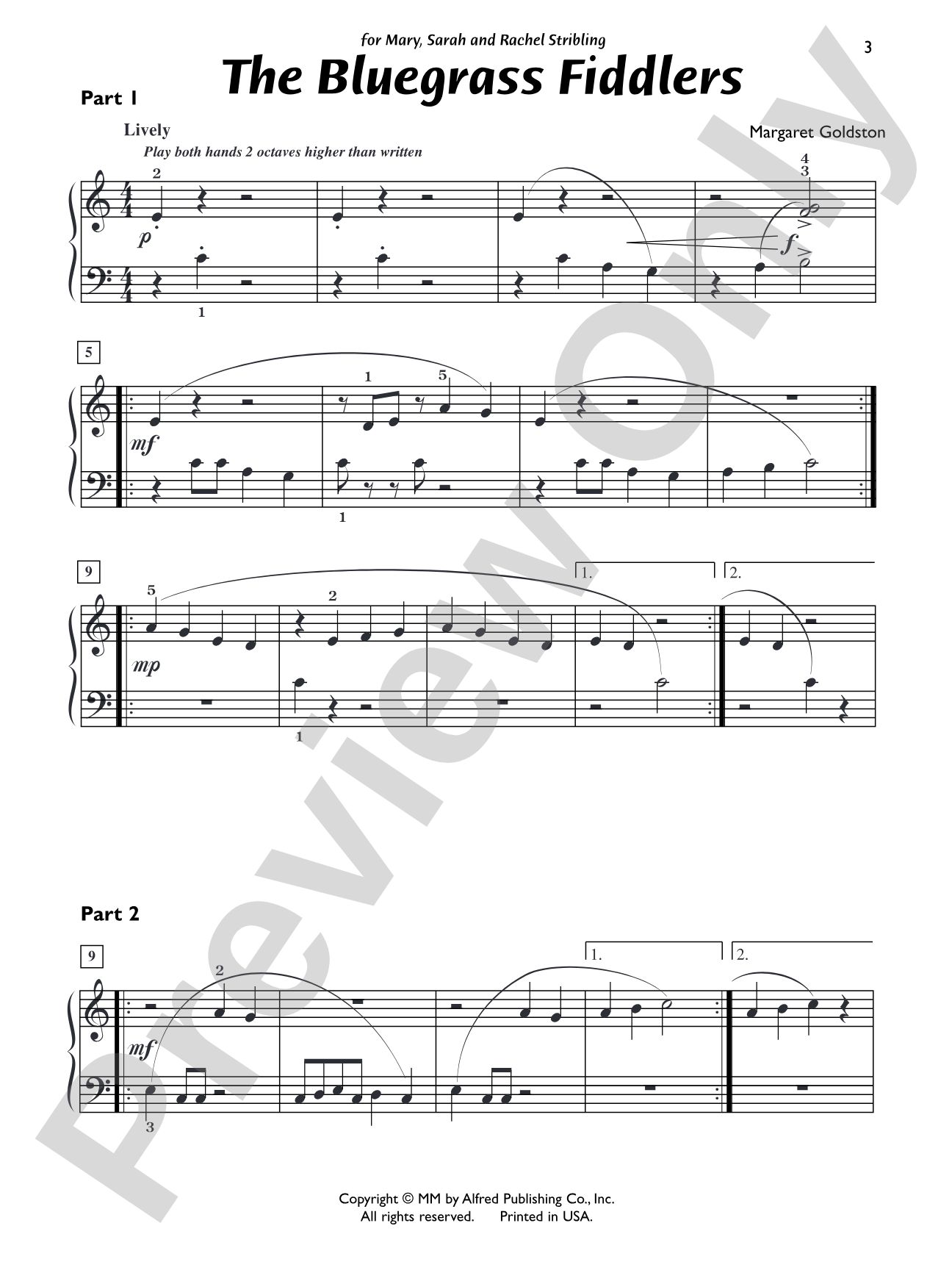
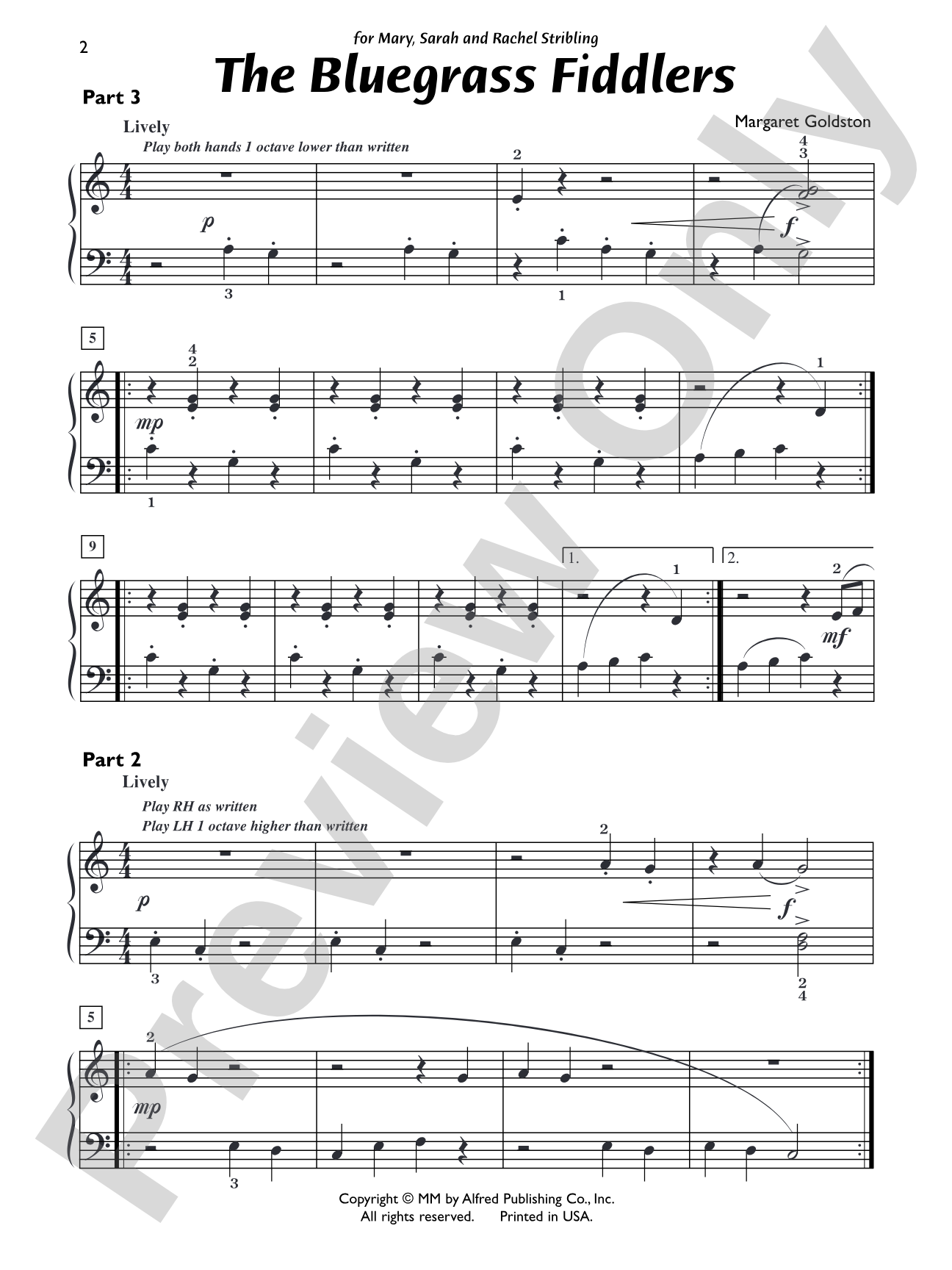
The Bluegrass Fiddlers - Piano Trio (1 Piano, 6 Hands) Sheet Music Preview

The Bluegrass Fiddlers - Piano Trio (1 Piano, 6 Hands): Piano

By Margaret Goldston

Level: Elementary

Item: 00-PB-0000814

Digital Download
$4.99
Description
What a lively, dance-styled bluegrass piece for 3 performers on 1 keyboard that is sure to be a favorite in performances or to just play for fun! Written in C Major, in 4/4 time, with easily executed eighth note rhythms, this song also has a good mix of staccato and legato techniques, and a lot of contrasting dynamics, as well as a nice distribution of melody-playing between the performers, so that each pianist has his or her turn to "shine." A Federation Festivals 2024-2028 selection.

The Bluegrass Fiddlers - Piano Trio (1 Piano, 6 Hands): Piano isn't in MakeMusic Cloud just yet...but it could be. Let us know you'd like to see it, and you'll help shape what comes next. In the meantime, start a free trial and dive into thousands of interactive titles your students can play along with today.

Sample Audio
No sample audio found.
Sample Video
Additional Details
Series: The Alfred Trio Series
Publisher: Alfred Music
Page Count: 8
SKU: 00-PB-0000814

More about this title

About the Composer: Margaret Goldston

Margaret Goldston

Margaret Goldston (1932-2003) built her career as a composer, educator, and clinician who shaped young musicians across North Carolina and beyond. Trained in piano performance at Louisiana State University and recognized as a School of Music Alumnus of the Year in 1991, she deepened her compositional craft through private study with Pulitzer Prize winner Robert Ward.

Goldston earned recognition as Composer of the Year by the North Carolina Federation of Music Clubs in both 1983 and 1994, and her work appeared regularly on contest lists and festival bulletins throughout her lifetime. She conducted masterclasses and teacher workshops across the United States and Canada, cementing her influence on music education. In 2020, the Music Teachers National Association honored her posthumously as a Foundation Fellow, affirming the lasting impact of her compositions.

Why we love this

This piece captures authentic bluegrass character without demanding advanced technique or fingering gymnastics, making it an ideal choice for young pianists eager to explore beyond classical training. The careful distribution of melody ensures all three performers stay engaged and invested, and that combination of accessibility with genuine musicality explains why it earned Federation recognition.

What to expect

Lively and spirited, with a foot-tapping pulse that invites movement and celebrates the energy of bluegrass tradition. The interplay between staccato passages and legato phrases creates rhythmic sparkle, while the dynamic contrasts keep the momentum fresh and prevent the piece from settling into a single mood.

Who it's for

Three pianists at the elementary level who want to perform together on a single keyboard and experience the joy of shared melody playing. It works equally well for a mixed-age studio class or recital setting where ensemble playing is a goal.

How to get the most out of it

  • Establish a steady tempo before adding dynamics; the eighth-note rhythms stay tighter when the pulse is rock-solid first.
  • Map out the staccato and legato passages together as an ensemble so the contrast actually registers; inconsistent articulation blurs the bluegrass character.
  • Balance volume between performers carefully during melody exchanges; the piece thrives when each pianist's featured lines cut through clearly.
  • Practice the dynamic shifts in isolation before running full sections; sudden drops and swells read as intentional rather than accidental when timed together.

How to use it

Feature this as a novelty ensemble piece that lightens a recital program without sacrificing musicality or pedagogical value. It also serves as a confidence builder for young pianists who may feel intimidated by traditional chamber literature but respond to the accessibility and genre appeal.

Skills your students will build

  • Coordinating ensemble balance and communication across three performers on one keyboard
  • Distinguishing and executing staccato and legato articulation within the same passage
  • Reading and responding to dynamic markings with accuracy and intention
  • Managing eighth-note rhythms in 4/4 time with rhythmic precision
  • Trading melodic responsibility while maintaining ensemble cohesion

You May Also Like