
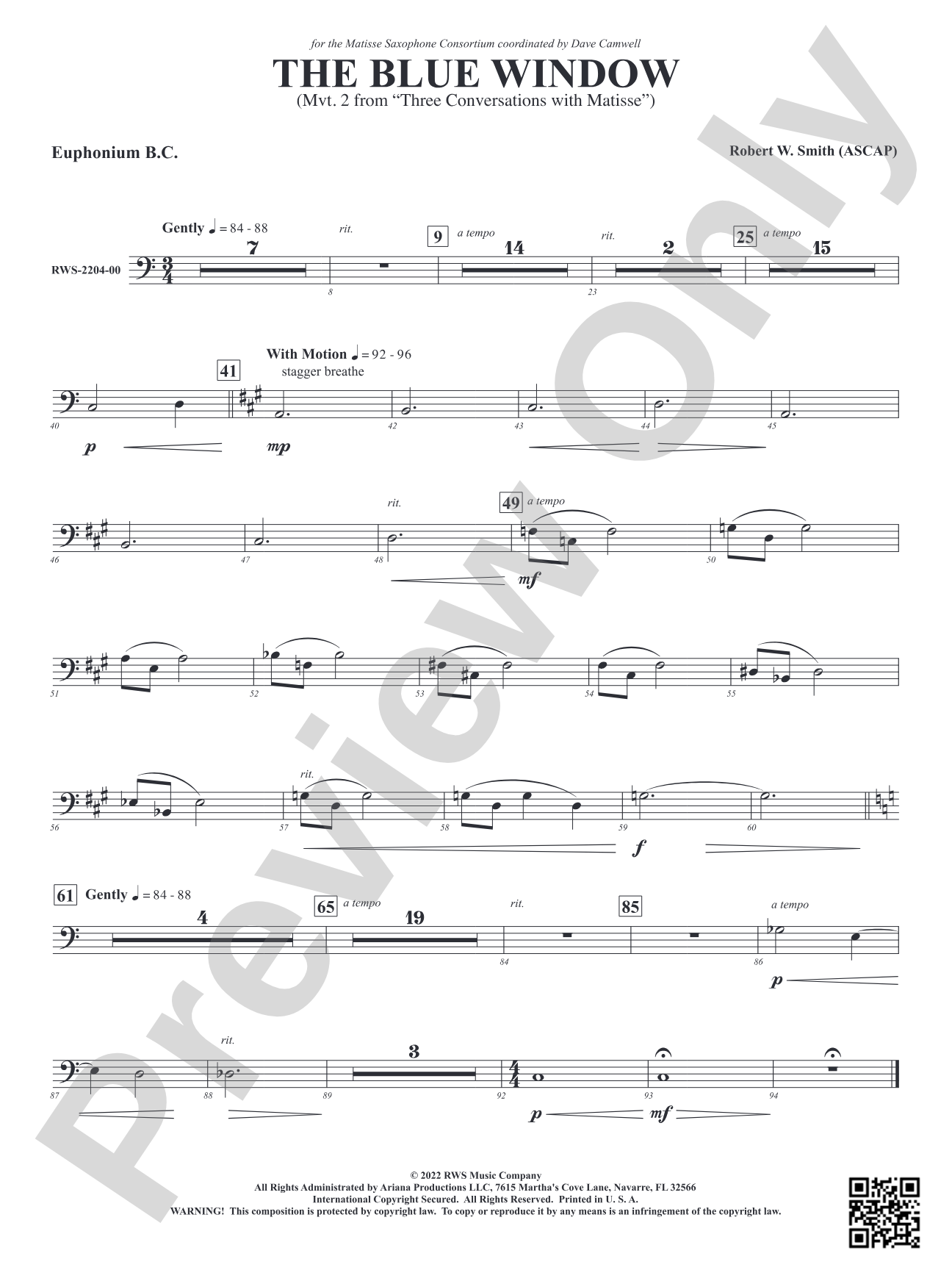

The Blue Window - Mvt. 2 from Three Conversations with Matisse: Baritone B.C.
Mvt. 2 from Three Conversations with Matisse
By Robert W. Smith
Grade: 4.5
Item: 98-PC-RWS2204_BBC1
$3.99
Pickup currently not available
Description
Inspired by "The Blue Window" by Henri Matisse, this lyrical statement for alto saxophone and band is a subdued departure from the more colorful and powerful movements of "Three Conversations With Matisse". Reflective and poignant, your soloist, ensemble and audience will be quietly enthralled in a musical setting that harkens to days gone by. Simply stated….beautiful.
Original Item#: RWS-2204-00


Original Item#: RWS-2204-00
The Blue Window - Mvt. 2 from Three Conversations with Matisse: Baritone B.C. isn't in MakeMusic Cloud just yet...but it could be. Let us know you'd like to see it, and you'll help shape what comes next. In the meantime, start a free trial and dive into thousands of interactive titles your students can play along with today.
Request This Title
Tell us you want it.
Start Your Free Trial
Explore everything that's ready to play right now.
Sample Audio
1
Audio File
--:--
0:00
0:00
Sample Video
No sample videos found.
Additional Details
Series:
RWS - Symphony Band
Publisher:
RWS Music Company
SKU:
98-PC-RWS2204_BBC1
More about this title
About the Composer: Robert W. Smith

Robert W. Smith stands among America's most prolific and widely performed composers for concert band and orchestra, with over 400 published works distributed primarily through Alfred Music. He earned his Bachelor of Music Education from Troy State University and his Master of Music from the University of Miami, establishing himself through symphonic works like The Divine Comedy and The Odyssey that have resonated with musicians and audiences across North America, Europe, Australia, and Asia.
Beyond the concert hall, Smith's compositions have secured a place in popular culture, from Olympic broadcasts and presidential ceremonies in Japan to television specials including the Macy's Thanksgiving Day Parade and Opening Day at Dodger Stadium. His work for developing ensembles, particularly The Tempest, has become repertoire standard in bands nationwide. As a guest conductor and clinician, he has shared his craft across the United States, Canada, Japan, Australia, Italy, Austria, and the United Kingdom.
Why we love this
Smith captures something rare here: a moment of genuine introspection within the concert band medium. The alto saxophone soloist carries the emotional weight while the band provides sensitive accompaniment rather than overwhelming it, giving your ensemble a chance to demonstrate ensemble maturity and restraint. This movement stands apart from typical band literature precisely because it refuses to be showy, making it an ideal programming choice for contests and concerts where depth of expression outweighs technical display.
What to expect
Quiet and contemplative, the piece evokes the muted palette of Matisse's painting through restraint and careful color choices. There is melancholy in the solo line, but not despair; the band's supporting harmonies create moments of unexpected warmth that suggest memory and reflection rather than sorrow.
Who it's for
This movement belongs in the libraries of Grade 4.5 concert bands seeking meaningful solo and ensemble literature that challenges musicians musically rather than technically. Both aspiring alto saxophonists and mature ensembles will find something valuable here: the soloist gains experience in lyrical, introspective playing, while the band develops the sophisticated accompanying skills that separate accomplished ensembles from competent ones.
How to get the most out of it
- Shape the alto saxophone line with long, connected phrasing; this soloist needs space to breathe and the accompanying harmonies should never rush ahead of the melody's natural arc.
- Balance the band accompaniment so it functions as harmonic fabric rather than foreground; competitive ensembles often play too loudly in supporting roles.
- Let silence matter. The spaces between phrases carry as much weight as the notes themselves, so resist the urge to fill every moment.
- Work closely with your soloist on rubato and flexibility within the overall pulse; Smith's writing invites subtle tempo shifts that reflect the emotional contour of the piece.
How to use it
Program this as a moment of stillness in a concert; it works beautifully after a more extroverted opening movement and provides breathing room before a closing work of greater energy. At festivals, the combination of lyrical solo writing and refined ensemble work often impresses adjudicators more than pieces that rely on volume and virtuosity alone.
Skills your students will build
- Balancing solo and ensemble textures with refined dynamic control
- Sustaining long melodic lines with consistent breath support and phrasing (alto saxophone)
- Playing accompaniment roles with sensitivity and restraint
- Responding to rubato and subtle tempo shifts within a lyrical context
- Creating emotional depth through color and tone production rather than technical display