
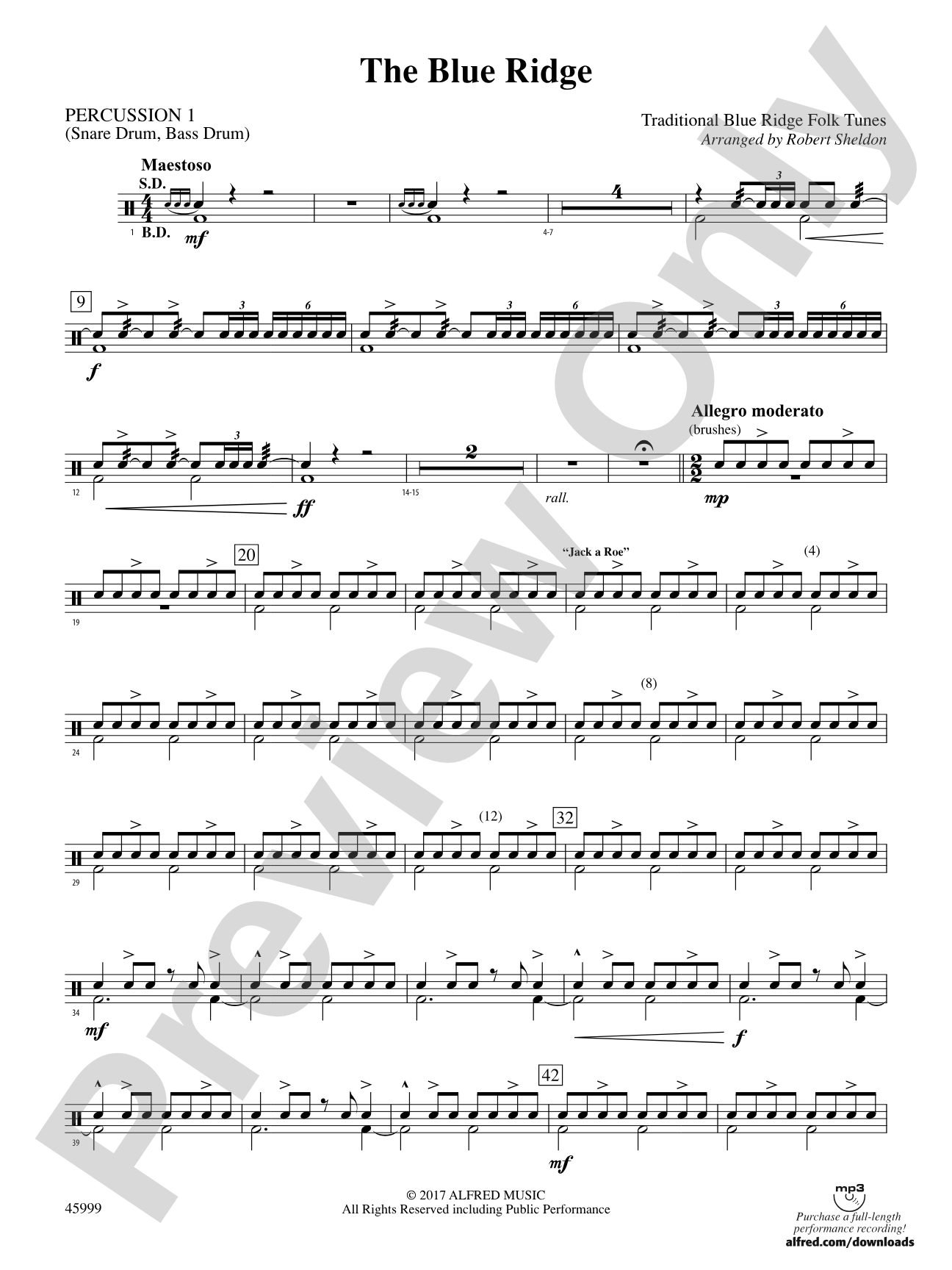

The Blue Ridge: 1st Percussion
Traditional Blue Ridge Folk Tunes / arr. Robert Sheldon
Grade: 4 (Medium Difficult)
Item: 00-PC-0017725_PC1
$3.00
Pickup currently not available
Description
The Blue Ridge Mountains have a rich history of folk music handed down by the families of the settlers in this region. Four of these wonderful songs have been included in this setting for concert band: the spirited "Jack-a-Roe," the haunting "Come All Ye Fair and Tender Ladies," the very popular "Tom Dooley" (arranged here in a most unexpected manner), and finally, the beautiful "Barbara Allen." (6:15)


Don't just read it, hear it, play along with it, and watch your students grow with it. In MakeMusic Cloud, The Blue Ridge: 1st Percussion comes alive with professional accompaniment, adjustable tempo, and built-in practice tools that turn solo practice into real progress.
Open in the Player
Jump straight in and assign it today.
Start Your Free Trial
Open this title and explore the full library in minutes.
Sample Audio
1
Audio File
--:--
0:00
0:00
Sample Video
Additional Details
Series:
Alfred Concert Band
Publisher:
Alfred Music
Page Count:
284
SKU:
00-PC-0017725_PC1
More about this title
About the Arranger: Robert Sheldon

Robert Sheldon's arrangements and compositions have become standard repertoire in concert bands across the country and internationally. His work appears regularly on state contest lists and all-state band programs, and he maintains an active schedule as a guest conductor and clinician at universities, honor bands, and music education conferences throughout North America, Europe, Asia, and Australia.
Sheldon has received numerous honors from the American School Band Director's Association, Phi Beta Mu, and ASCAP in recognition of his contributions to wind band literature. His arrangements balance accessibility with musical substance, allowing young ensembles to engage seriously with meaningful material. He received an honorary doctorate from VanderCook College of Music in 2020.
Why we love this
Sheldon's arrangement transforms folk melodies into four distinct musical landscapes without losing their character. The orchestration demands thoughtful balancing across all sections rather than simply doubling the melody, which keeps every musician engaged. Programming folk material arranged at this level bridges popular American music and concert band standards, giving students ownership of songs many already know while teaching them to listen for sophisticated harmonic and textural choices.
What to expect
Stepping into the Blue Ridge Mountains through four centuries of Appalachian music. The energy shifts from the jaunty spirit of 'Jack-a-Roe' to the tender, almost mournful beauty of 'Come All Ye Fair and Tender Ladies,' then pivots into an arrangement of 'Tom Dooley' that surprises listeners familiar with the melody. Throughout, Sheldon honors the authenticity of these folk traditions while giving them concert band voice.
Who it's for
Band directors programming concert repertoire for grades 4 bands with solid fundamentals across all sections. This setting works well for bands with developing ensemble cohesion, as the individual voice leading requires active listening without extreme technical demands.
How to get the most out of it
- Balance the melodic lines carefully between clarinet, saxophone, and trumpet sections. Folk tunes thrive when the tune is clear but not isolated; Sheldon's writing intentionally distributes the melody to create blend rather than solo prominence.
- Pay attention to the dynamic shape within each tune. The 'unexpected manner' of 'Tom Dooley' will benefit from precise control of crescendos and sudden changes; rushing these transitions muddies the effect.
- Let the percussionists anchor the rhythmic character of each song. Folk settings often rely on light, responsive percussion rather than driving rhythms, especially in the slower movements.
- Use rubato sparingly in the haunting sections (particularly in 'Come All Ye Fair and Tender Ladies'). A steady tempo with expressive phrasing works better than slowing or pushing individual phrases.
How to use it
Program this during the second half of your concert where audiences already feel settled. Pair it with one contrasting piece (perhaps a march or a contemporary work) to show your band's range. The arrangement's length (6:15) and traditional subject matter work especially well for community concerts, educational outreach events, or any program celebrating American music.
Skills your students will build
- Balancing melodic independence across different instrumental choirs
- Responding to harmonic color changes within a single folk tune
- Controlling dynamic shaping without losing rhythmic precision
- Collaborating between melody and accompaniment voices in folk-inspired textures
- Maintaining ensemble stability through sectional doublings and divisi writing