
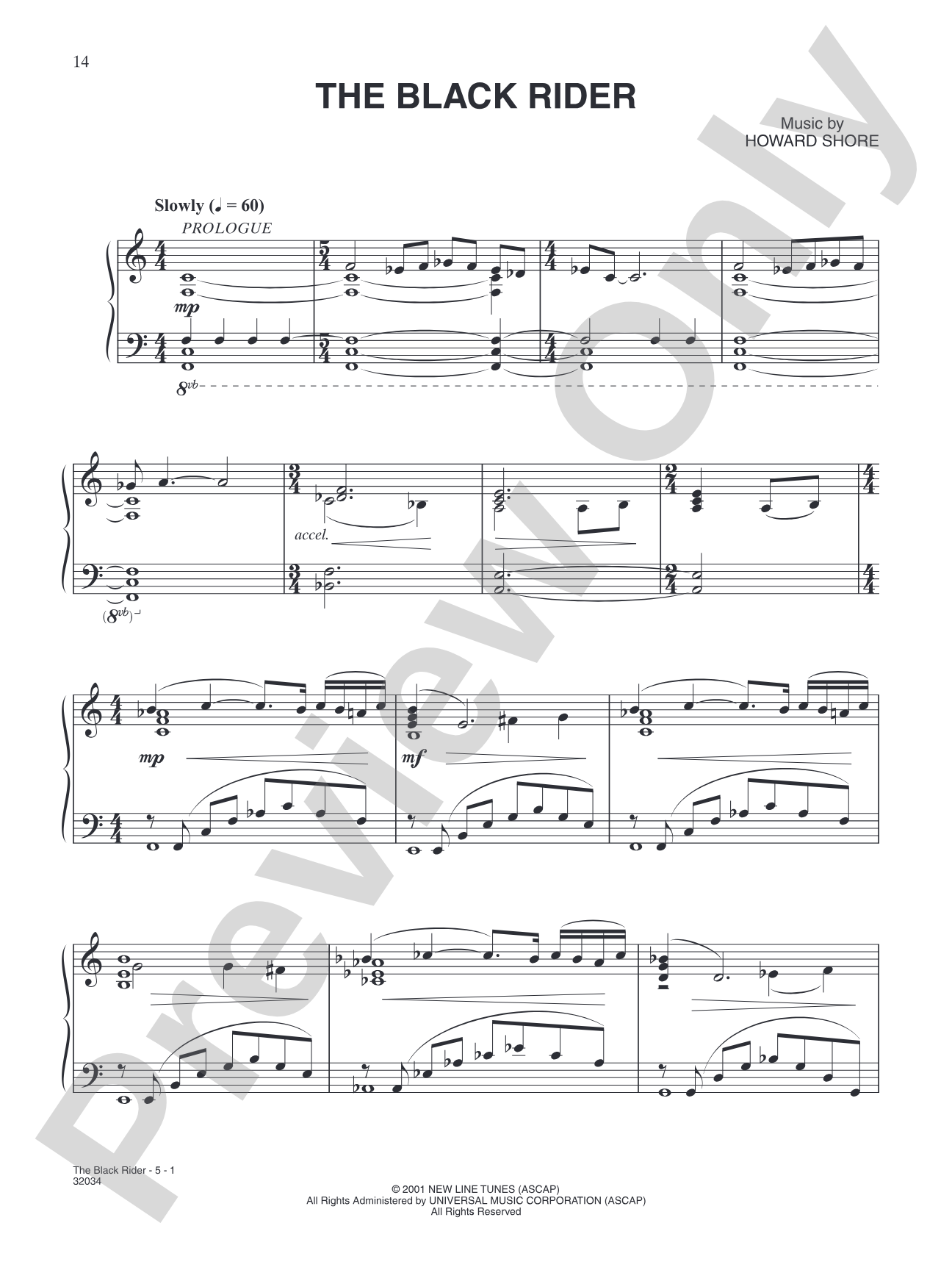

The Black Rider: Piano
The Motion Picture Trilogy
Music by Howard Shore
Level: Piano/Vocal
Item: 00-PS-0011838
$4.99
Pickup currently not available
Description
Previously available only in three separate books, Howard Shore's award-winning music for The Lord of the Rings trilogy is now available as a deluxe single volume of Piano/Vocal sheet music. Adorned with gorgeous color stills from the motion pictures, this is the ultimate musical tour of Middle-earth for pianists.


The Black Rider: Piano isn't in MakeMusic Cloud just yet...but it could be. Let us know you'd like to see it, and you'll help shape what comes next. In the meantime, start a free trial and dive into thousands of interactive titles your students can play along with today.
Request This Title
Tell us you want it.
Start Your Free Trial
Explore everything that's ready to play right now.
Sample Audio
No sample audio found.
Sample Video
No sample videos found.
Additional Details
Publisher:
Alfred Music
Page Count:
104
SKU:
00-PS-0011838
More about this title
About the Composer: Howard Shore
Howard Shore is a film composer whose orchestral scores have shaped the sound of modern cinema. His work on The Lord of the Rings trilogy earned him three Academy Awards and established him as a master of epic, thematically rich composition. Shore's ability to weave complex leitmotifs through large-scale narratives while maintaining emotional clarity has made his film music a staple of concert halls and music education worldwide.
Beyond his film work, Shore has composed for theater, ballet, and concert stages. His approach to orchestration and harmonic language draws from classical traditions while creating entirely new musical worlds. For pianists and music students, his scores offer a bridge between accessible melody and sophisticated compositional technique.
Why we love this
This collection gives pianists access to some of the most recognizable film music of the last two decades in a format built for the instrument itself. Rather than simple reductions, Shore's piano arrangements preserve the emotional architecture of the original scores while offering genuine technical and interpretive challenges. Pairing the music with color images from the films creates an engaging visual and musical journey that holds student interest across 104 pages.
What to expect
Cinematic grandeur translated to the keyboard. These arrangements capture sweeping landscapes, intimate character moments, and epic battles through Shore's gift for orchestral color and thematic development. Playing through this volume feels like conducting an orchestra from the piano bench, with moments of quiet beauty interrupted by passages of mounting intensity and wonder.
Who it's for
Intermediate to advanced pianists seeking substantial, engaging repertoire with emotional depth and narrative arc. This collection appeals to students who love film music, want to explore composition at a high level, or need impressive recital pieces with immediate cultural resonance.
How to get the most out of it
- Pay attention to Shore's use of leitmotif. Each character and location has its own musical identity; tracking these themes across different pieces deepens your interpretation and helps audiences follow the musical narrative.
- Balance texture carefully in passages where multiple thematic lines overlap. Shore often layers themes that need distinct voicing rather than blending into a thick, undifferentiated texture.
- Use the pedal thoughtfully to sustain harmonic color without muddying rapid melodic passages. Many of these arrangements benefit from selective pedaling that shifts with harmonic rhythm rather than with the phrase structure.
- Approach dynamics as emotional temperature rather than volume alone. Shore's scoring often uses register and timbre to suggest intensity; a high passage played quietly can feel more urgent than a louder, lower one.
How to use it
Feature individual pieces from this collection in solo recitals or studio showcases; the visual accompaniment of color stills makes excellent program notes. Use shorter selections as concert openers or closers to frame other repertoire, or program an entire recital around a single film's themes for a unified, story-driven concert experience.
Skills your students will build
- Reading and executing leitmotif-based musical narratives across multiple movements
- Managing layered textures and contrapuntal lines within a single-line instrument
- Pedal control in orchestral-style arrangements that require both sustain and clarity
- Interpreting dynamic and textural cues that suggest orchestral color and film scoring techniques
- Programming recitals with thematic coherence and dramatic arc