
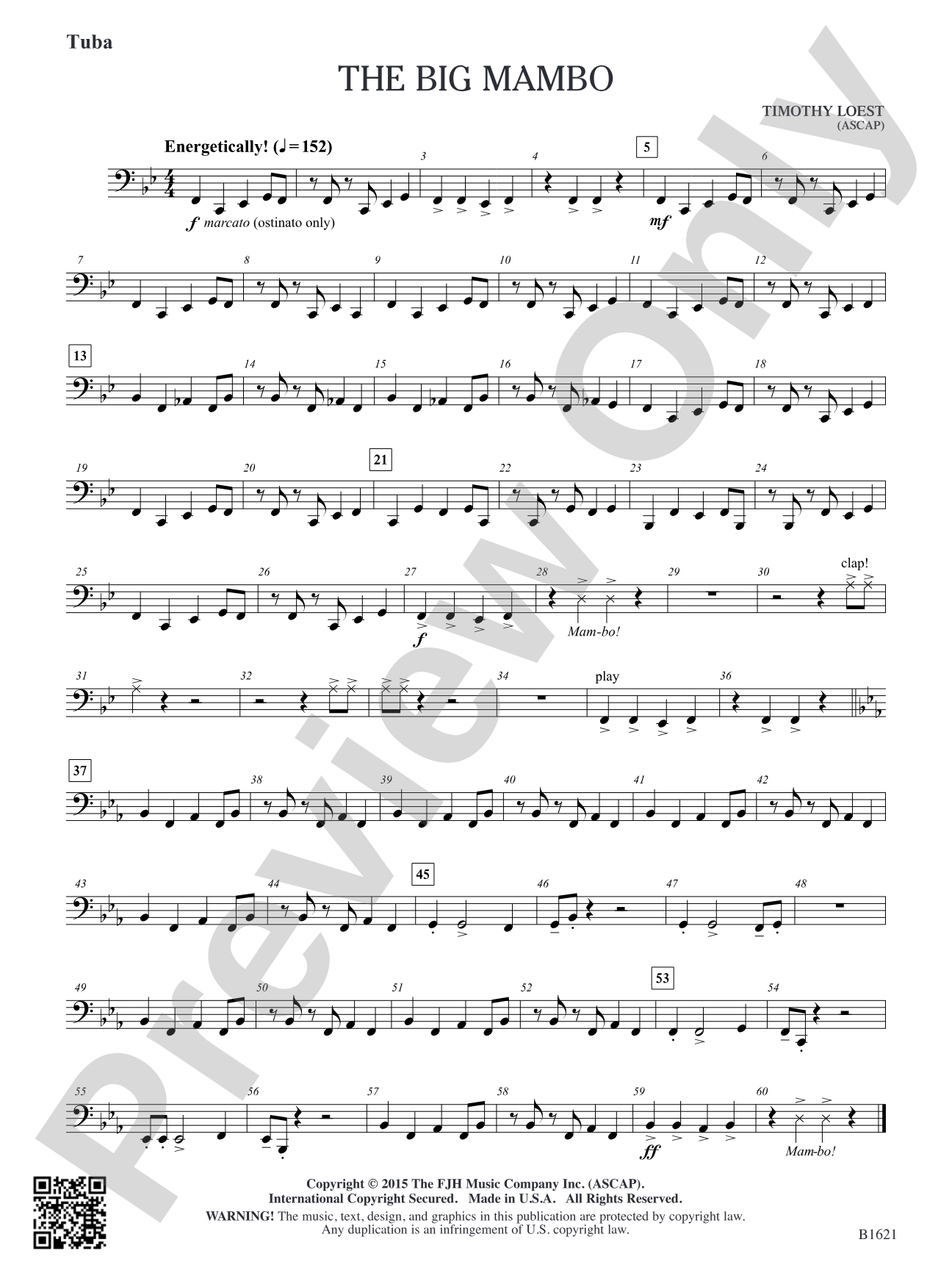

The Big Mambo: Tuba
By Timothy Loest
Grade: 1.5
Item: 98-PC-DB1621_TB1
$7.00
Pickup currently not available
Description
Discover the electrifying sounds of old Havana with this original, fiery mambo. Experience the thrill of irresistible syncopation supported by a variety of Latin percussion instruments including timbales, agogo bells, cowbell, claves, and samba whistle. Authentic, yet approachable. Mambo!


Don't just read it, hear it, play along with it, and watch your students grow with it. In MakeMusic Cloud, The Big Mambo: Tuba comes alive with professional accompaniment, adjustable tempo, and built-in practice tools that turn solo practice into real progress.
Open in the Player
Jump straight in and assign it today.
Start Your Free Trial
Open this title and explore the full library in minutes.
Sample Audio
1
Audio File
--:--
0:00
0:00
Sample Video
No sample videos found.
Additional Details
Series:
FJH Developing Band
Publisher:
The FJH Music Company, Inc.
SKU:
98-PC-DB1621_TB1
More about this title
About the Composer: Timothy Loest

Timothy Loest has built a career on writing music that sounds sophisticated while remaining genuinely playable by developing musicians. His compositions are performed by thousands of young ensembles annually, and his influence extends across pedagogy through collaborative work on foundational methods like Measures of Success and Warm-ups and Beyond. He earned his degrees from Illinois State University and Northwestern University, and in 2017 received the Cloyd Myers Memorial Award for Excellence in Music Education from the Illinois Grade School Music Association.
Loest's music appears regularly on major television broadcasts, including The Tonight Show Starring Jimmy Fallon and Good Morning America, a testament to both his compositional craft and his understanding of what works in ensemble performance. A dedicated teacher at F.E. Peacock Middle School in Illinois for his entire career, he founded Fanfare Music Press in 2022 to maintain rigorous standards for band compositions and arrangements. He accepts commissions and maintains an active presence in the band directing community through his website and ongoing collaborations with publishers including FJH Music Company.
Why we love this
Loest captures the swagger and propulsive energy of authentic mambo while keeping the writing fully accessible to grade 1.5 ensembles. The percussion color palette feels genuinely Latin American without requiring specialty players; standard concert band instrumentation handles the idiom beautifully. Your students will feel like they're making real music from the first rehearsal, not approximating something beyond their reach.
What to expect
Imagine the heat and momentum of a Havana nightclub translated into a concert hall. The piece pulses with irresistible forward energy, built on syncopated grooves and the shimmer of timbales and agogo bells. It's joyful and driving without being chaotic, leaving your ensemble and audience genuinely energized.
Who it's for
Beginning to early intermediate concert bands looking to add authentic Latin music to their repertoire without overwhelming younger musicians. This works especially well for ensembles at the 1.5 level who are ready for something with rhythmic sophistication but still need straightforward reading and manageable ranges.
How to get the most out of it
- Establish the clave rhythm firmly in the opening statement. Have your percussion section lock that pattern before bringing in the rest of the band; it's the skeleton of the whole arrangement.
- Balance the syncopated figures across the sections so they groove together rather than fighting each other. A slower tempo with clean articulation beats a rushed tempo with muddied rhythms in this idiom.
- Let the Latin percussion instruments breathe and be heard. They're not accompaniment; they're part of the melodic conversation. Adjust your woodwind and brass dynamics accordingly in the busier sections.
- Emphasize the lifted quality of the attacks, particularly in the horn parts and melodic lines. Mambo thrives on rhythmic specificity and forward motion, not heaviness.
How to use it
Program this as an opening number or concert highlight in a mixed-genre concert. It pairs well alongside classical standards because of how distinctly different it sounds, and it creates a natural bridge into conversations about world music and cultural tradition with your ensemble. Consider pairing it with another Latin work or a film music selection to create a thematic concert segment.
Skills your students will build
- Reading syncopated rhythms in Latin ensemble contexts
- Balancing multiple independent rhythmic lines without losing the pulse
- Understanding clave and its role as a foundational pattern
- Playing with appropriate articulation and swing feel for Latin idiom
- Listening across the ensemble to lock in groove and percussion color
- Exposing upper woodwinds and lower brass to authentic Latin writing without overcomplication