
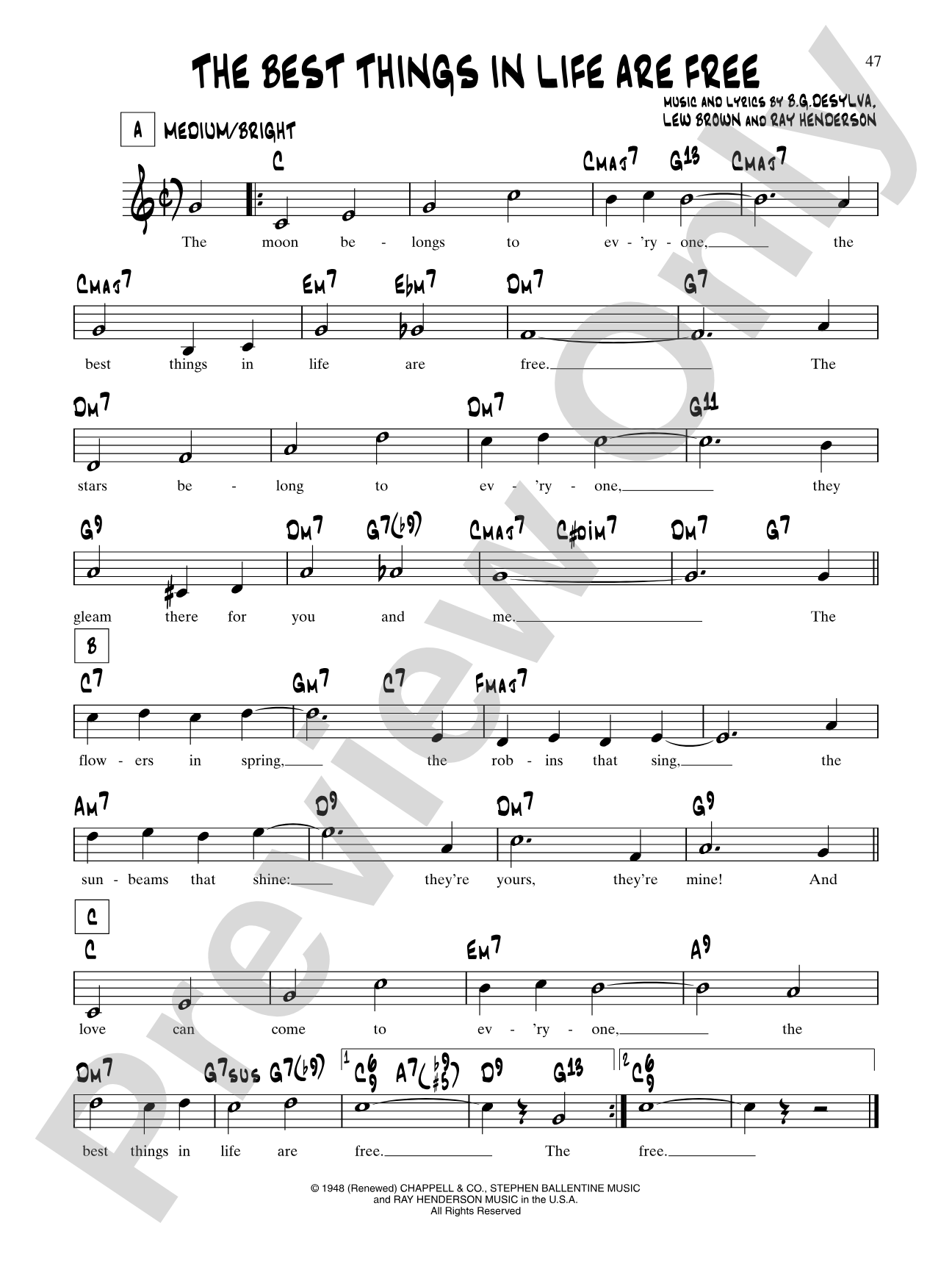

The Best Things In Life Are Free (From "Good News"): Lead Sheet
Sam Cooke
Item: 00-PSL-000211
$4.99
One moment…
Description
Broadway, blues, folk, jazz, gospel, country, and soul are represented on the remarkable album Sam Cooke at the Copa. Our album-matching folio includes eight pages of biographical and historical information about Sam Cooke during his time at the Copa. Titles are: Opening * Introduction * The Best Things in Life Are Free * Bill Bailey * Nobody Knows You When You Are Down and Out * Frankie and Johnny * If I Had a Hammer * When I Fall in Love * Twisting the Night Away * Band Introductions * This Little Light of Mine * Blowin' in the Wind * Tennessee Waltz.


The Best Things In Life Are Free (From "Good News"): Lead Sheet isn't in MakeMusic Cloud just yet...but it could be. Let us know you'd like to see it, and you'll help shape what comes next. In the meantime, start a free trial and dive into thousands of interactive titles your students can play along with today.
Request This Title
Tell us you want it.
Start Your Free Trial
Explore everything that's ready to play right now.
Sample Audio
No sample audio found.
Sample Video
No sample videos found.
Additional Details
Publisher:
Alfred Music
Page Count:
76
SKU:
00-PSL-000211
More about this title
About the Artist: Sam Cooke
Sam Cooke (1931-1964) was a transformative figure in American popular music, bridging gospel, soul, R&B, and pop with a voice of remarkable warmth and control. His artistry helped establish soul music as a mainstream force and his songwriting, often addressing social themes, demonstrated that commercial success and artistic substance were not mutually exclusive. Cooke's performances at venues like the Copacabana nightclub in New York showcased his versatility across jazz standards, folk songs, and his own compositions, proving his appeal extended far beyond any single genre.
Why we love this
This folio captures Cooke at a pivotal moment in his career, performing in an upscale supper club setting that demanded both vocal polish and genuine musicality. The range of material—from blues to folk to Tin Pan Alley standards—mirrors the eclecticism that made Cooke such a compelling performer, giving pianists and singers access to genuine interpretive challenges across multiple styles. Programming selections from this collection lets ensembles and soloists explore how a master vocalist navigated repertoire across boundaries.
What to expect
These arrangements evoke the intimate sophistication of a nightclub performance, where a skilled vocalist commands attention without bombast. The chord progressions and melodic lines carry both vintage Tin Pan Alley elegance and the soulful warmth that defined Cooke's artistry. There's an undercurrent of cultural significance beneath the surface charm; performing this material requires acknowledging both its entertainment appeal and its historical weight.
Who it's for
Vocalists and pianists exploring American standards and soul repertoire will find this folio essential for understanding how a master interpreter approached diverse material. Jazz singers, pop vocalists, and pianists preparing cabaret or recital programs will benefit from studying Cooke's versatility across folk, blues, gospel, and popular idioms. This resource is equally valuable for music educators teaching the history of soul music and its relationship to earlier American popular song traditions.
How to get the most out of it
- Study the original recorded performance alongside the lead sheet to capture Cooke's phrasing and rhythmic freedom, particularly his use of space and breath within melodic lines.
- Balance the sophistication of the harmonic progression with the simplicity and directness of Cooke's vocal delivery; resist over-arranging in rehearsal.
- Attend to the swing feel and subtle groove that permeates these arrangements, especially in pieces like 'Twisting the Night Away' where rhythmic precision matters less than pocket placement.
- Consider the emotional subtext of each selection; even upbeat numbers carry the weight of Cooke's artistry and the historical context of his performance in a prestigious, segregated-era venue.
How to use it
Feature individual selections in jazz recitals, pop vocal concerts, or American music survey programs that trace the lineage from early standards through soul and R&B. This folio works particularly well for creating a thematic program around American songwriting across genres, or for exploring how a single artist reimagined repertoire from different traditions. The included biographical and historical context makes it valuable for educational performances where cultural and musical context enriches the listening experience.
Skills your students will build
- Reading lead sheets and interpreting chord symbols across multiple harmonic styles
- Vocal phrasing and interpretation in jazz and popular song contexts
- Genre-specific articulation and rhythmic feel (swing, blues, folk, gospel inflection)
- Understanding of song interpretation and arrangement choices
- Accompaniment skills for diverse vocal styles and tempos