
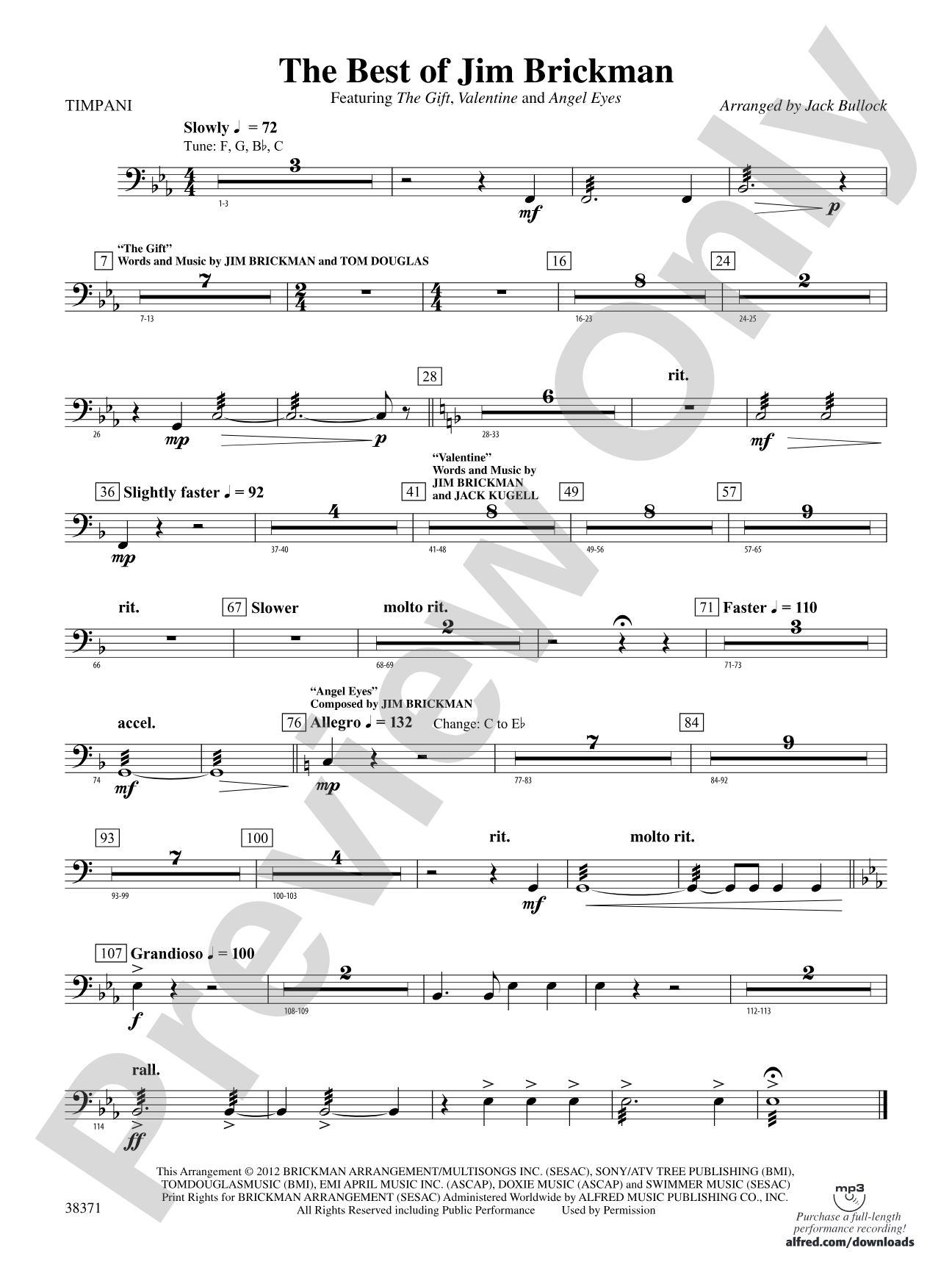

The Best of Jim Brickman: Timpani
Featuring: The Gift / Valentine / Angel Eyes
Arr. Jack Bullock
Grade: 3 (Medium Easy)
Item: 00-PC-0015802_TMP
$5.99
Pickup currently not available
Description
The American songwriter and pianist, Jim Brickman, has had a "star-studded" career in popular music. His music is characterized with fresh ballad-style melodies and this collection is certain to please. Including "The Gift," "Valentine" and "Angel Eyes," this endearing through-played medley is a tremendous choice to showcase the musicality of your band. (5:00)


Don't just read it, hear it, play along with it, and watch your students grow with it. In MakeMusic Cloud, The Best of Jim Brickman: Timpani comes alive with professional accompaniment, adjustable tempo, and built-in practice tools that turn solo practice into real progress.
Open in the Player
Jump straight in and assign it today.
Start Your Free Trial
Open this title and explore the full library in minutes.
Sample Audio
1
Audio File
--:--
0:00
0:00
Sample Video
No sample videos found.
Additional Details
Series:
Pop Concert Band
Publisher:
Alfred Music
Page Count:
230
SKU:
00-PC-0015802_TMP
More about this title
About the Arranger: Jack Bullock

Jack Bullock brings three decades of professional experience as a performer, composer, and arranger to every project he undertakes. His formal training includes degrees at the undergraduate, graduate, and doctoral levels in music education, with trumpet study under renowned artists including Harry Glantz and Craig McHenry. He performed with the Miami Philharmonic Orchestra and Miami Opera Company, and toured nationally with traveling dance bands across multiple decades.
As a prolific arranger and composer, Bullock has created more than 600 publications across concert band, orchestra, jazz ensemble, and marching band contexts. He taught instrumental music in secondary and higher education for 20 years, including seven years as an assistant band director at Ithaca College's School of Music, where he also served as chair of the Music Education Department. His contributions to music education extend to co-authoring the Belwin 21st Century Band Method and arranging for the Music Expressions curriculum published by Alfred Music and Belwin. Bullock is an ASCAP member since 1980 and has led clinics and workshops throughout North America and England.
Why we love this
Bullock understands how to translate popular song into effective concert band writing without sacrificing the emotional core that makes these melodies resonate. The medley format lets you program something substantial and recognizable without eating up too much rehearsal time on a single piece, and the Grade 3 scoring ensures your students stay engaged with genuine musicality rather than fighting technical hurdles.
What to expect
The Brickman arrangements maintain the warmth and straightforward emotional directness of the original compositions. You'll hear fresh melodic lines supported by clean harmonies that let the tunes shine without unnecessary complexity, creating something that feels both contemporary and timeless.
Who it's for
Concert bands at the Grade 3 level looking for an accessible yet musically satisfying piece that appeals to student performers and audiences alike. Directors seeking a medley with immediate recognition value will find this collection particularly useful for pops concerts or family-friendly programming.
How to get the most out of it
- Balance the lyrical moments by bringing out sustained lines in the woodwinds; the medley thrives on legato phrasing that mirrors the ballad style of the originals.
- Shape each song section distinctly so the transitions feel intentional rather than abrupt; treat the medley as three separate pieces that share a concert.
- Let the rhythm section anchor the tempo without rushing; these melodies breathe best when the band feels the pulse rather than chasing it.
- Give special attention to dynamic shaping in the quieter passages; Grade 3 bands sometimes default to a comfortable medium dynamic, but these ballads need genuine contrast to land emotionally.
How to use it
This medley works especially well as a crowd-pleasing closer or opener on a mixed concert that balances classical and contemporary repertoire. The five-minute duration and accessible instrumentation make it a strong choice for honor band festivals or community concert settings where you want material that connects with a broad audience.
Skills your students will build
- Playing sustained lyrical lines with consistent tone and phrasing
- Executing smooth transitions between contrasting musical sections
- Balancing ensemble blend across multiple melodic statements
- Responding to dynamic shaping and expressive direction within accessible ranges
- Reading parts that feature both rhythmic and melodic responsibility