
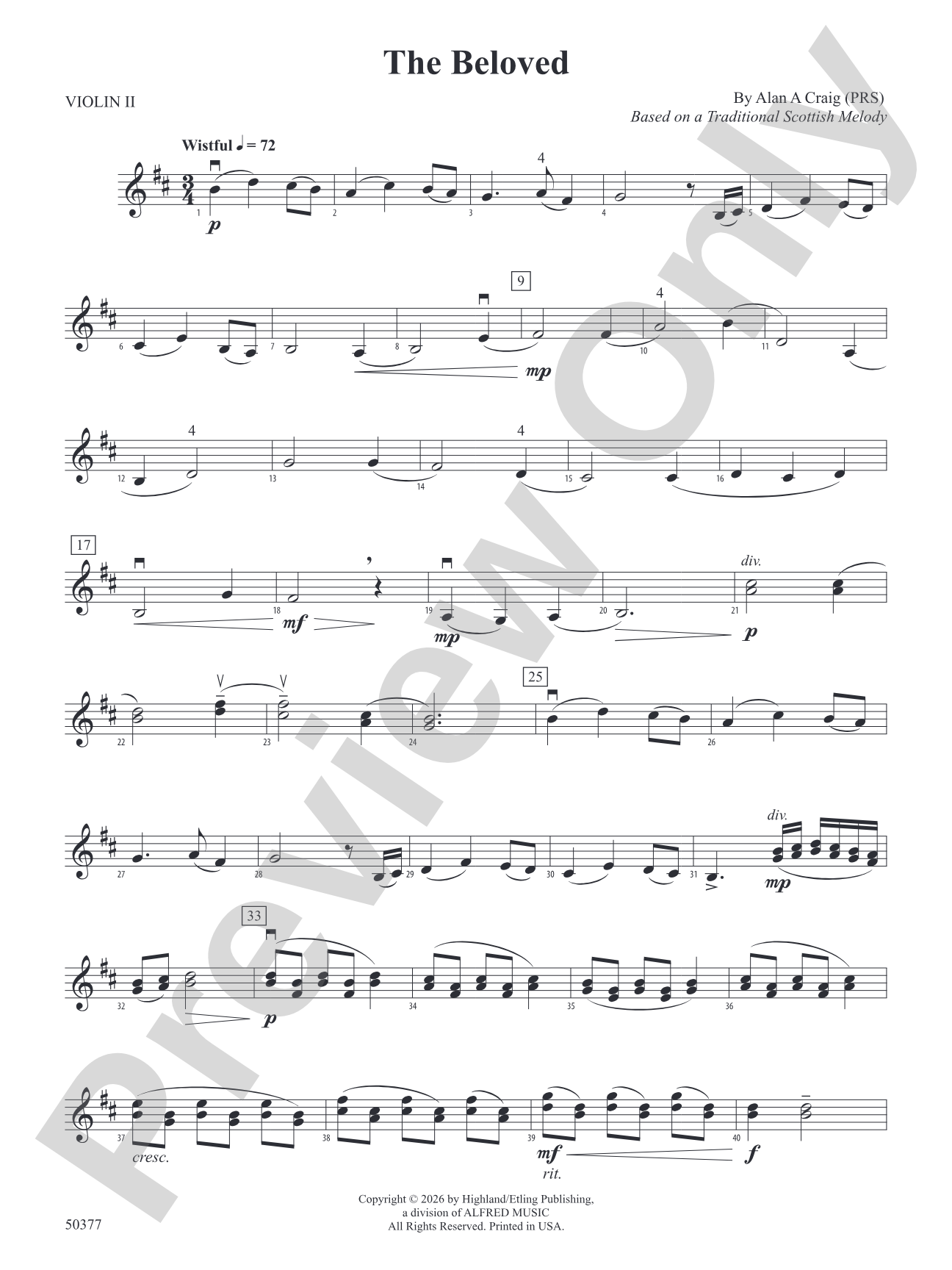

The Beloved: 2nd Violin
By Alan A. Craig
Grade: 3
Item: 00-PC-0019836_VN2
$3.00
Pickup currently not available
Description
Robert Burns' 1791 poem "Ae Fond Kiss" is considered by many to be among the greatest love songs ever penned and is performed by singers worldwide, usually with a poignant traditional Scots melody that mirrors the emotional landscape of the text. This much-loved tune is the exquisite thread woven through the 21st-century musical fabric of Alan A. Craig's The Beloved. The Scottish composer has infused his evocative work with echoes of an unmistakably Celtic hue and invites the string ensemble to use their instruments as lyrical voices joined in a vivid expression of tenderness and tragedy.


Don't just read it, hear it, play along with it, and watch your students grow with it. In MakeMusic Cloud, The Beloved: 2nd Violin comes alive with professional accompaniment, adjustable tempo, and built-in practice tools that turn solo practice into real progress.
Open in the Player
Jump straight in and assign it today.
Start Your Free Trial
Open this title and explore the full library in minutes.
Sample Audio
1
Audio File
--:--
0:00
0:00
Sample Video
Additional Details
Series:
Highland String Orchestra
Publisher:
Alfred Music
SKU:
00-PC-0019836_VN2
More about this title
About the Composer: Alan A. Craig

Alan A. Craig is a Glasgow-based composer, conductor, and educator whose work spans concert music, opera, and arrangements performed internationally. Since 2002, he has directed the music department at Glasgow Clyde College and founded the Springfield Cambridge Festival Chorus and Orchestra, an ensemble that combines high-level performances with significant charitable fundraising, raising over £500,000 for Children's Hospices Across Scotland. His compositions and arrangements have appeared in television and film productions worldwide.
Craig's experience conducting over 100 stage and concert productions and performing with ensembles including the Royal Scottish National Orchestra and City of Prague Philharmonic Orchestra informs his writing for both professional and community musicians. He was appointed MBE in the 2026 New Year's Honours list and received the Paul Harris Fellowship from Rotary International in recognition of his contributions to music and community service.
Why we love this
Craig transforms a canonical Scottish poem and its traditional melody into a contemporary string work that preserves the emotional core of the source material while offering fresh orchestral color. The piece sits squarely at Grade 3, making it accessible to developing ensembles without sacrificing the lyrical sophistication that performers and audiences will recognize. Programming this work gives your orchestra a culturally grounded piece with genuine substance, one that resonates across age groups and skill levels.
What to expect
Tender yet tinged with melancholy, this work captures the bittersweet quality of a farewell rendered through string sonorities. Echoes of Celtic music weave through modern harmonic language, creating an intimate atmosphere that feels both timeless and urgently present. The melody emerges naturally from the ensemble, never imposed but discovered, inviting listeners into a shared moment of emotional clarity.
Who it's for
String orchestras at the intermediate level will find a musically substantial work that builds musicianship without overwhelming technical demands. Directors preparing for festivals or seeking repertoire that honors Scottish cultural heritage while meeting contemporary performance standards will value this piece. Solo string players in community orchestras can also learn ensemble balance and melodic awareness through its integrated design.
How to get the most out of it
- Treat the string section as a unified choir of voices. The melody moves through different instrumental families, so balance individual lines to create a seamless vocal quality rather than a strictly orchestral texture.
- Establish the Celtic character through subtle rhythmic flexibility. Allow natural rubato in phrases that echo the poetic text, especially where harmonic tension peaks.
- Pay close attention to dynamic shape around the traditional melody's contours. The emotional weight of Burns' poem requires a conductor who listens for where crescendos and diminuendos should breathe rather than relying on marked dynamics alone.
- Use rehearsal time to explore the specific timbre Craig requests. Divisi passages and doublings should blend rather than stand apart; focus on achieving a cohesive color across all parts.
How to use it
This piece serves beautifully as a concert centerpiece for programs exploring Scottish music, poetry, or the relationship between text and instrumental music. It pairs well with both traditional folk arrangements and contemporary classical works, bridging community interests and concert hall standards. Consider programming it in the first half of a concert where its reflective quality can settle an audience before more demanding or dramatically contrasting works.
Skills your students will build
- Sustaining lyrical phrasing across longer melodic lines
- Balancing individual instrumental parts within an ensemble texture
- Responding to subtle dynamic and tempo variations that enhance emotional expression
- Reading and executing divisi passages with clarity and blend
- Connecting instrumental technique to vocal and poetic language