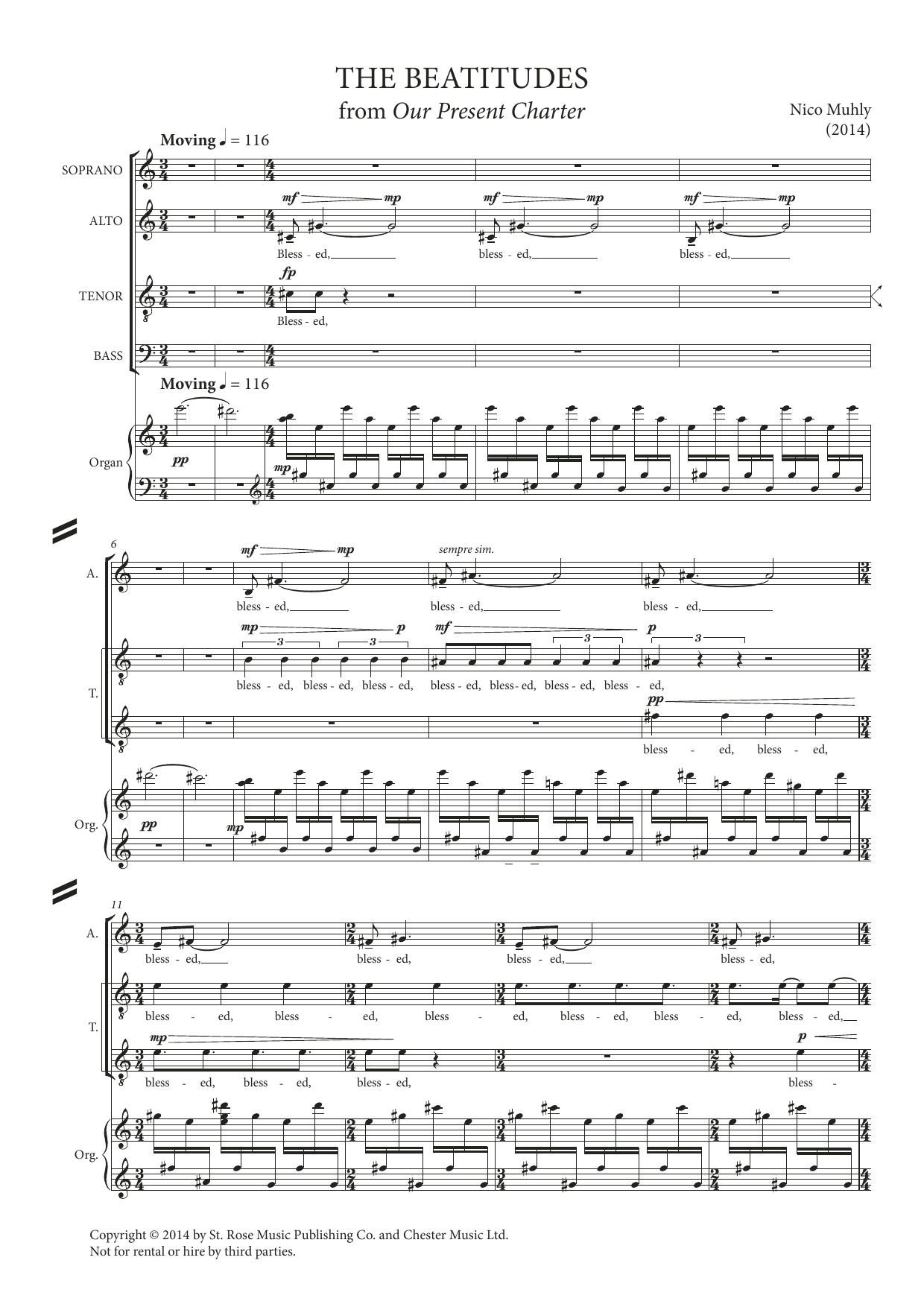
The Beatitudes (from Our Present Charter) Sheet Music Preview

The Beatitudes (from Our Present Charter): SATB Choral Octavo

As performed by Nico Muhly

Item: 35-DS00414895

Digital Download
$2.99
Description

The Beatitudes (from Our Present Charter): SATB Choral Octavo isn't in MakeMusic Cloud just yet...but it could be. Let us know you'd like to see it, and you'll help shape what comes next. In the meantime, start a free trial and dive into thousands of interactive titles your students can play along with today.

Sample Audio
No sample audio found.
Sample Video
Additional Details
Publisher: Hal Leonard
Page Count: 15
SKU: 35-DS00414895

More about this title

About the Artist: Nico Muhly

Nico Muhly is an American composer whose catalog spans opera, orchestral work, and choral music. His writing for voices balances accessibility with harmonic sophistication, drawing on both minimalist and tonal traditions. Muhly's choral works are frequently performed by collegiate and professional ensembles, and his ability to craft singable lines within complex harmonic contexts has made him a fixture in contemporary sacred and secular repertoire.

Why we love this

Muhly's setting of The Beatitudes refuses the plodding reverence many directors associate with sacred text. The harmonic language is modern but never opaque, and the part writing rewards clear ensemble blend without demanding technical wizardry. This is music that sounds substantial and contemporary in a concert program while remaining within reach of strong community choirs.

What to expect

The work carries spiritual weight without sentimentality, finding moments of genuine beauty in the text's promises of blessing. Muhly's harmonic palette shifts between consonance and carefully placed dissonance, creating emotional depth that unfolds gradually rather than through dramatic gesture.

Who it's for

This octavo suits choirs comfortable with contemporary harmonic language and lyrical flexibility. It works equally well for collegiate ensembles, professional choruses, and advanced high school programs seeking repertoire that sounds fresh without alienating audiences.

How to get the most out of it

  • Establish the harmonic context early in rehearsal by isolating each voice part's contribution to Muhly's sonority. His chords often derive from unexpected note combinations, so singers need to hear exactly how their line sits within the whole.
  • Watch the text declamation for natural phrasing rather than pushing strict metric regularity. Muhly's rhythms follow speech patterns, and over-counting will flatten the emotional arc.
  • Balance blend over projection, especially in the more sustained passages. Muhly's harmonic language depends on clarity of individual lines, not weight.

How to use it

Position this as a centerpiece in a contemporary sacred music concert, or use it as a counterpoint to more traditional choral settings in a mixed program. The fifteen pages suggest a substantial anchor work rather than an opener or closer.

Skills your students will build

  • Singing contemporary harmonic language with chromatic alterations and extended sonorities
  • Tracking individual melodic lines through complex chord structures
  • Responding to text-driven phrasing that prioritizes natural declamation over metrical rigidity
  • Achieving blend in SATB writing where harmonic function depends on precise intonation

You May Also Like