The Ash Grove: Flute Sheet Music Preview

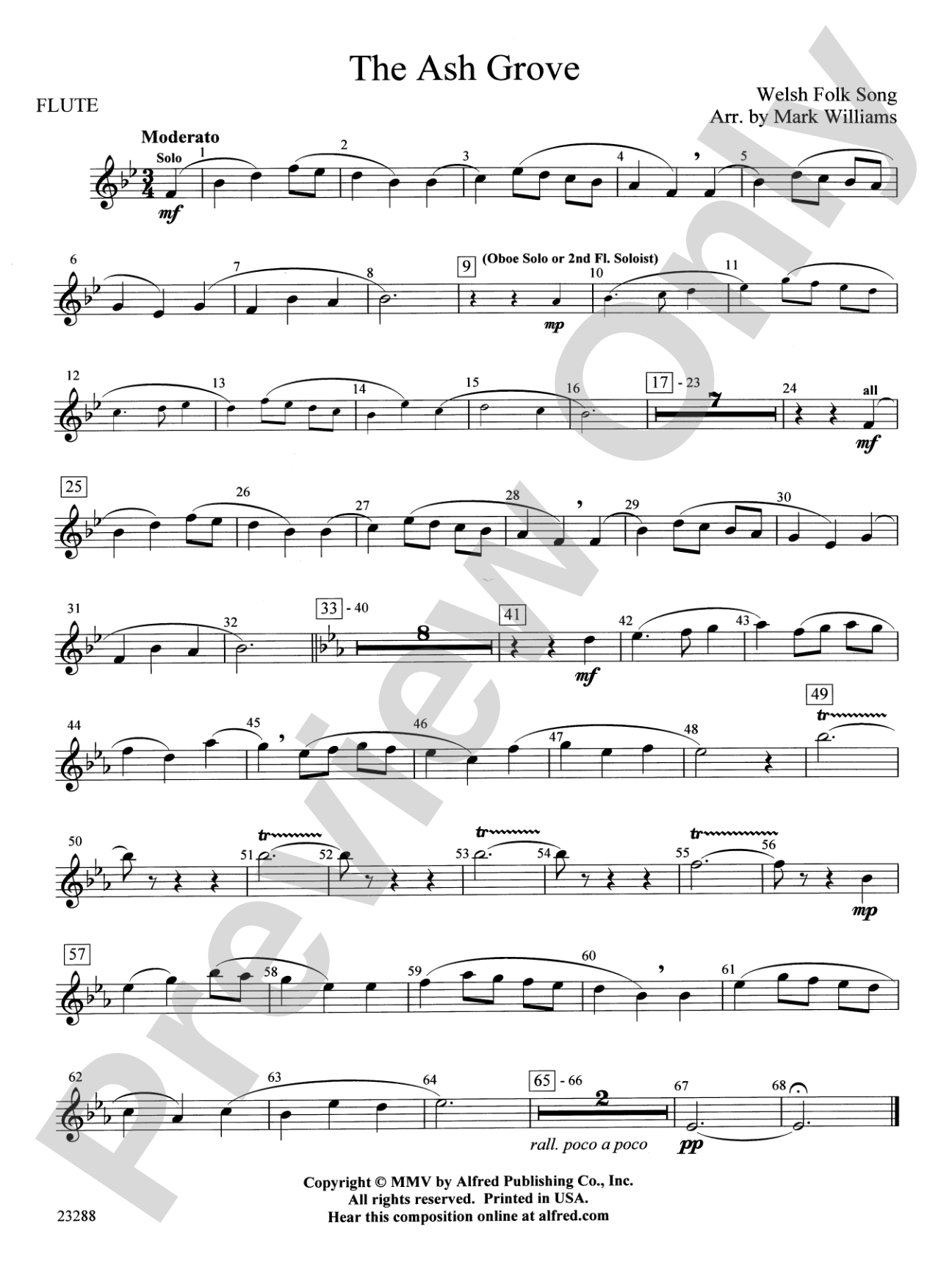
The Ash Grove: Flute

Arr. Mark Williams

Grade: 1.5 (Easy)

Item: 00-PC-0000638_F1

Digital Download
$3.00
Description
The elegant simplicity of this favorite Welsh folk song shines through in this skillful arrangement by Mark Williams. Filled with solo opportunities for flute, clarinet, oboe, alto sax, horn and baritone (liberally cross-cued), this work provides great opportunities for working on tone, balance and phrasing. A very tasteful addition to your band library.

Don't just read it, hear it, play along with it, and watch your students grow with it. In MakeMusic Cloud, The Ash Grove: Flute comes alive with professional accompaniment, adjustable tempo, and built-in practice tools that turn solo practice into real progress.

Sample Audio
0:00
0:00
Sample Video
Additional Details
Series: Challenger Band Series
Publisher: Alfred Music
Page Count: 124
SKU: 00-PC-0000638_F1

More about this title

About the Arranger: Mark Williams

Mark Williams

Mark Williams built a career as one of the most prolific voices in school band and orchestra composition, with over 200 published works spanning multiple genres and ensembles. His influence on music education extended far beyond the page; as a clinician and guest conductor, he worked with programs across 34 states, five Canadian provinces, and Australia, while also serving as woodwind performer and arranger for the 560th Air Force Band.

Based in Washington state for much of his teaching life, Williams specialized in elementary band and held degrees from Eastern Washington University. His contributions to the field earned him recognition including the Western International Band Clinic's Gralia Competition and multiple ASCAP Special Awards. Beyond his compositional work, he remained an active bassoon performer and served as conductor and artistic director for the Spokane British Brass Band.

Why we love this

Williams understands what makes an arrangement serve young players without sacrificing musicality. The cross-cued solo opportunities mean your strongest players stay engaged while the arrangement remains accessible for a Grade 1.5 band, and the focus on tone, balance, and phrasing gives you concrete musical goals beyond just reading notes.

What to expect

Warm and unhurried, with a folk melody that settles into the listener like a familiar memory. The arrangement respects the tune's gentle character while creating moments of brightness through the orchestration, making it feel sophisticated without being complicated.

Who it's for

This arrangement works well for Grade 1.5 concert bands seeking accessible repertoire with built-in opportunities to develop musicianship. Directors can use it to feature multiple soloists in a single rehearsal without complicated rotation, making it ideal for concerts where you want to showcase individual players.

How to get the most out of it

  • Shape the phrases across the full length rather than stopping at bar lines; this Welsh melody wants to breathe and move forward naturally.
  • Use the solo cuing strategically to feature different sections in successive rehearsals, allowing you to isolate and refine tone quality in smaller groups before bringing the full band together.
  • Balance the solo voice against the accompaniment by rehearsing them separately first, then bringing them together gradually so neither layer overwhelms the other.
  • Emphasize the lyrical quality of the folk melody itself; the arrangement's elegance comes from respecting the tune's inherent simplicity, not adding interpretive flourishes.

How to use it

Program this early in the concert year when you want to establish foundations in tone production and phrasing; the melody's straightforwardness lets students focus on sound quality rather than technical challenges. It also pairs naturally with other folk-based selections or works well as a centerpiece for a program exploring different cultural traditions.

Skills your students will build

  • Sustaining long melodic phrases with consistent tone and air support
  • Playing solo passages with confidence in front of the full ensemble
  • Listening to and balancing with accompaniment voices
  • Understanding how cross-cuing creates flexibility in ensemble scoring
  • Shaping a simple melody expressively without technical distractions

You May Also Like