
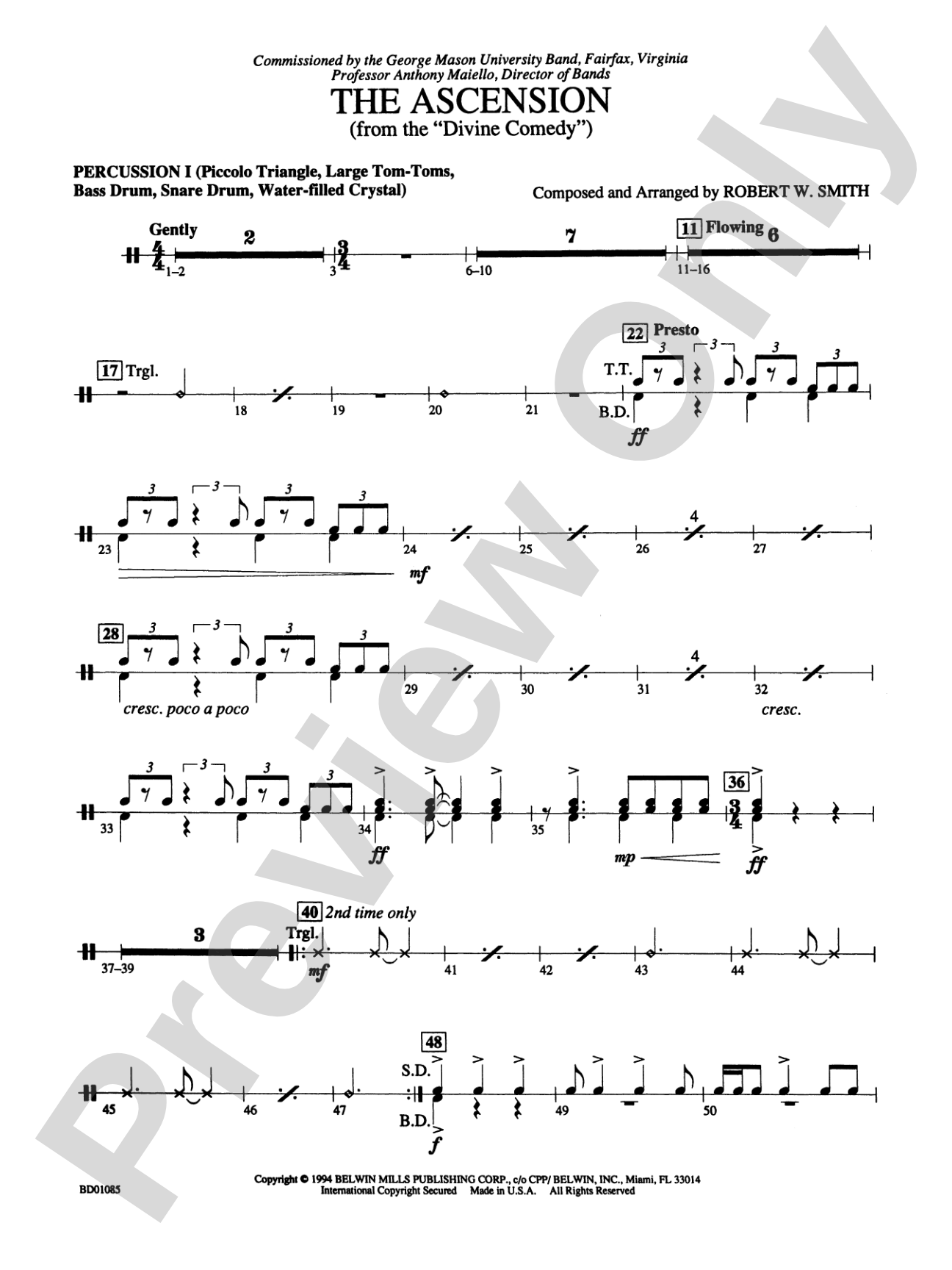

The Ascension (from The Divine Comedy): 1st Percussion
From The Divine Comedy
By Robert W. Smith
Grade: 5 (Medium Advanced)
Item: 00-PC-0002003_PC1
$3.00
Pickup currently not available
Description
The third movement of a major new work by Robert W. Smith based on Dante Alighieri's literary classic The Divine Comedy, The Ascension is a sizzling musical experience with bravura wind parts and dazzling percussion that is charismatic in its boldness. It's indicative of a highly creative period for this young American composer. (6:15)


The Ascension (from The Divine Comedy): 1st Percussion isn't in MakeMusic Cloud just yet...but it could be. Let us know you'd like to see it, and you'll help shape what comes next. In the meantime, start a free trial and dive into thousands of interactive titles your students can play along with today.
Request This Title
Tell us you want it.
Start Your Free Trial
Explore everything that's ready to play right now.
Sample Audio
1
Audio File
--:--
0:00
0:00
Sample Video
Additional Details
Series:
Belwin Classic Band
Publisher:
Alfred Music
Page Count:
258
SKU:
00-PC-0002003_PC1
More about this title
About the Composer: Robert W. Smith

Robert W. Smith stands among America's most recorded composers for concert band and orchestra, with over 400 published works primarily distributed through Alfred Music. His education includes a Bachelor's in Music Education from Troy State University and a Master's in Music from the University of Miami. Smith's symphonic works, including The Divine Comedy and The Odyssey, have secured performances across North America, Europe, Australia, and Asia, establishing him as a major voice in contemporary band literature.
Beyond the concert hall, Smith's music has reached millions through television broadcasts, Olympic ceremonies, and major public events including the Macy's Thanksgiving Day Parade telecast and Opening Day at Dodger Stadium. His work for developing ensembles, particularly The Tempest, has become foundational repertoire in band programs nationwide. As a conductor and clinician, he has led performances and master classes throughout the United States, Canada, Japan, Australia, and Europe.
Why we love this
The Ascension captures Smith at his most inventive, balancing dramatic orchestration with genuine accessibility for Grade 5 bands. The piece moves beyond typical programmatic writing by making the narrative muscular and direct—your musicians will feel the momentum and boldness in their own parts, not just hear it as a concept. At just over six minutes, it's substantial enough to anchor a concert without requiring the rehearsal investment of a full symphony.
What to expect
Ascension unfolds as a surge of orchestral color and textural density, with wind parts written to showcase technical facility and musicality in equal measure. The percussion palette crackles with energy, propelling the piece forward through waves of rhythmic intensity that evoke climbing toward something transcendent and brilliant.
Who it's for
Concert bands at the Grade 5 level seeking a showpiece that challenges advanced sections while remaining performable by mid-level musicians across the ensemble. Directors programming Dante-inspired or thematic concerts will find this an immediate centerpiece. The piece appeals to ensembles ready for Smith's sophisticated harmonic language and technical demands in both winds and percussion.
How to get the most out of it
- Balance the bravura wind writing so individual sections shine without overshadowing the harmonic foundation; Smith layers multiple melodic ideas simultaneously, so careful voicing matters.
- Let the percussion parts breathe as written. The dazzling writing is only effective when players commit fully to the rhythmic and dynamic specificity Smith demands.
- Shape the larger form by treating section transitions as dramatic moments rather than breaks. This movement flows from one emotional peak to the next.
- Establish a clear tempo grid early in rehearsals. The piece contains multiple rhythmic layers that align best when the conductor's pulse is unwavering.
How to use it
Program this as the climactic final work on a concert exploring programmatic or narrative-driven band literature. It pairs naturally with Smith's other symphonic works or with other Grade 5 pieces that explore literary themes. The six-minute duration makes it ideal for a concert's second half, where its bravura writing can command full attention without dominating the overall program structure.
Skills your students will build
- Executing sustained technical passages in high registers while maintaining tone clarity
- Balancing multiple simultaneous melodic lines within a dense harmonic texture
- Reading and responding to complex percussion scoring with varied articulations and dynamics
- Maintaining rhythmic precision when ensemble texture shifts between sections
- Shaping phrasing across larger formal sections rather than within individual phrases