The Angel's Message (Angelus Ad Virginem) (arr. Philip Lawson) Sheet Music Preview

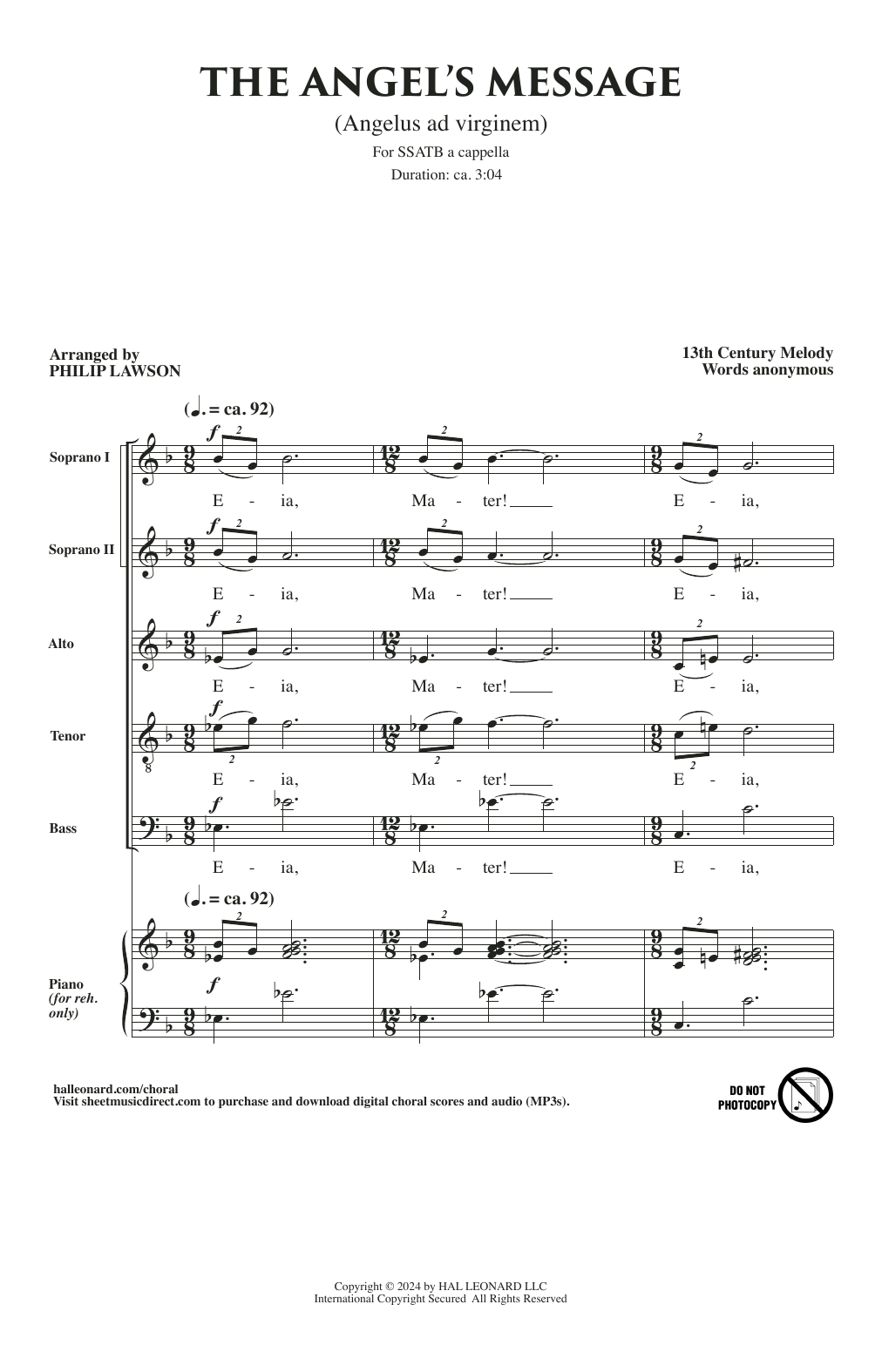
The Angel's Message (Angelus Ad Virginem) (arr. Philip Lawson): SSATB Choral Octavo

By 13th Century Melody / Arranged by Philip Lawson

Item: 35-DS01484658

Digital Download
$2.99
Description

The Angel's Message (Angelus Ad Virginem) (arr. Philip Lawson): SSATB Choral Octavo isn't in MakeMusic Cloud just yet...but it could be. Let us know you'd like to see it, and you'll help shape what comes next. In the meantime, start a free trial and dive into thousands of interactive titles your students can play along with today.

Sample Audio
No sample audio found.
Sample Video
Additional Details
Publisher: Hal Leonard
Page Count: 13
SKU: 35-DS01484658

More about this title

About the Composer: 13th Century Melody

Angelus Ad Virginem emerges from the rich vocal tradition of medieval Europe, originating in 13th century liturgical practice. This melody represents a pivotal moment in choral music history when sacred texts began to move beyond monophonic chant toward polyphonic settings, laying groundwork for the Renaissance choral repertoire that followed.

Why we love this

Philip Lawson's arrangement strips away unnecessary complexity while honoring the medieval melody's inherent beauty. It sits comfortably for mixed ensembles and gives singers genuine musical satisfaction, whether you're building a Christmas program or seeking repertoire that connects your singers to centuries of choral practice.

What to expect

A sense of quiet reverence fills this piece. The melody carries devotional warmth without sentimentality, and the harmonies feel both ancient and accessible, creating space for contemplation within the choral sound.

Who it's for

This works beautifully for upper-voice dominant or mixed choirs seeking substantial Christmas repertoire with historical depth. It suits directors who want their singers experiencing genuine medieval choral practice rather than simplified holiday arrangements.

How to get the most out of it

  • Shape the melodic line with gentle forward motion rather than emphasizing individual phrases as separate units. The melody wants to breathe as one continuous arc.
  • Balance the upper voices carefully; the SSA/SSAA voicing means soprano lines carry much of the musical weight, so ensure the second sopranos and altos have support and don't disappear beneath the firsts.
  • Let the text inflection guide your phrasing. Medieval Latin vowels and consonants have their own natural momentum; resist over-romanticizing with modern interpretive choices.
  • The arrangement's harmonic language is restrained and direct. Clarity of harmonic movement matters more than lush blending; each chord should register distinctly.

How to use it

Position this as a centerpiece in a Christmas program exploring music across centuries, or open a concert with it to establish an intimate, reflective tone. Its 13 pages and moderate difficulty make it feasible to learn alongside more contemporary holiday selections.

Skills your students will build

  • Reading and sustaining pure vowel sounds in medieval Latin text
  • Balancing multiple soprano lines within a compact voicing
  • Maintaining harmonic awareness while singing a melody rooted in monophonic tradition
  • Performing with textual clarity in a language different from singers' native speech

You May Also Like