
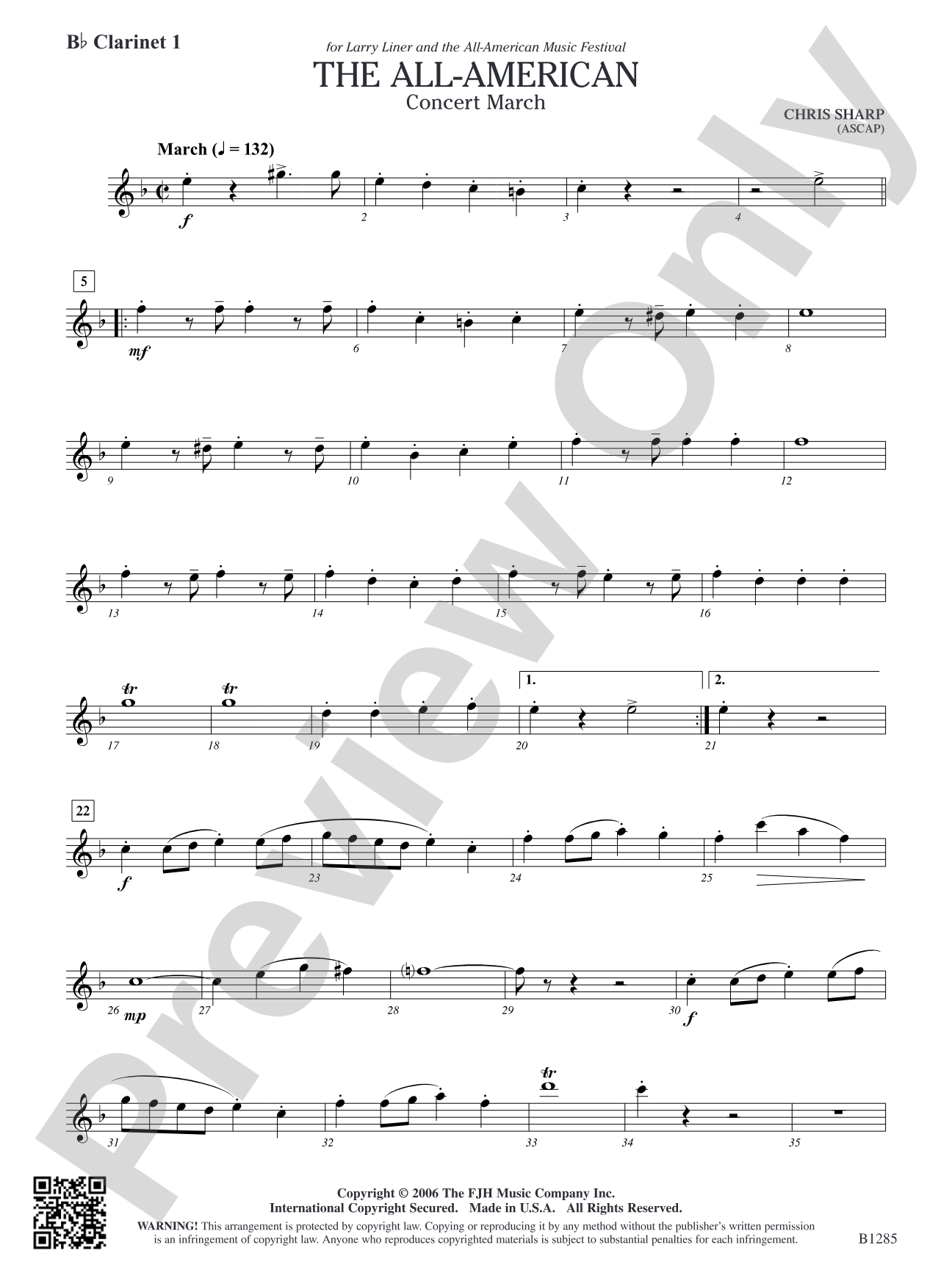

The All-American (Concert March): B-flat Clarinet 1
Concert March
By Chris Sharp
Grade: 3.5
Item: 98-PC-DB1285_C1
$7.00
Pickup currently not available
Description
An excellent original concert march, this work is written in the traditional style of Fillmore, King, and Sousa, yet includes a few clever twists and turns to showcase your woodwind section. After the traditional dogfight, woodwinds shine in their light and playful feature. Brass return to complement woodwinds with a powerful statement of the trio theme. Stirring!


Discover MakeMusic Cloud: thousands of interactive titles your students can play along with today.
Sample Audio
1
Audio File
--:--
0:00
0:00
Sample Video
No sample videos found.
Additional Details
Series:
FJH Concert Band
Publisher:
The FJH Music Company, Inc.
SKU:
98-PC-DB1285_C1
More about this title
About the Composer: Chris Sharp

Chris Sharp holds a Ph.D. and has built a career spanning performance, composition, arrangement, and education. As a trombonist, he spent eleven years as a performing musician and band leader at Walt Disney World, then transitioned into arranging and orchestrating for Disney parks globally since 1984, creating music for live shows, recordings, and television broadcasts. His freelance work has extended to Universal Studios, Ringling Brothers and Barnum & Bailey Circus, the Boston Pops, the Dallas Brass, and military ensembles including the USAF Airmen of Note.
Sharp's contributions to music education are equally substantial. He teaches at the middle school, high school, and college levels, currently serving as Director of Bands at Polk State College in Winter Haven, Florida, where he also teaches music theory, music technology, and arranging. His compositions and arrangements for concert and jazz band have received frequent performances at major venues including the Midwest Clinic. He has adjudicated for Bands of America and Drum Corps International, and is a recipient of multiple ASCAPlus awards.
Why we love this
Sharp has crafted a march that respects tradition while refusing to be bound by it. The structural familiarity of a Fillmore-King-Sousa style framework gives your ensemble confidence, but the deliberate twists keep rehearsals engaging and performances memorable. The woodwind feature arrives exactly when you need it to highlight the section's musicality without leaving brass players disengaged.
What to expect
The opening unfolds like a classic American march, full of brass confidence and rhythmic swagger. When the woodwinds emerge, the mood becomes lighter and more intimate, almost playful, before brass bring back the grandeur with renewed authority. There's warmth in the writing that makes it feel celebratory rather than ceremonial.
Who it's for
Bands at the 3.5 grade level that have solid fundamentals and are ready to handle the independence required by a feature section. This march works equally well for a concert setting seeking patriotic material or a march showcase where you want something with personality beyond the standard repertoire.
How to get the most out of it
- Balance the opening march section by allowing the bass line to anchor the harmony; this gives the traditional dogfight clarity and forward motion without muddiness.
- Shape the woodwind feature with dynamic contrast and articulation changes. Sharp's 'light and playful' writing works best when ensemble members vary their approach between phrases rather than settling into a single character.
- Bring out the brass statement of the trio theme as a true complement to the woodwind writing, not an interruption. This requires clear sectional communication and careful balance between woodwind release and brass entrance.
- Use the repeat signs strategically; if you perform this at tempo without the repeats, the march gains momentum and feels more modern, while performing the repeats honors the traditional structure.
How to use it
Program this as your first concert piece in a march-themed set; it establishes the traditional sound while the twists signal that you're not playing a period piece museum. Alternatively, place it early in a general concert program to set an upbeat tone and showcase your woodwind section's musicality to the audience.
Skills your students will build
- Executing rhythmic clarity in traditional march figures while maintaining forward pulse
- Balancing sectional dynamics when moving between ensemble and featured sections
- Phrasing and articulation control in a feature passage requiring independence and sensitivity
- Understanding the role of inner voices in march harmony