
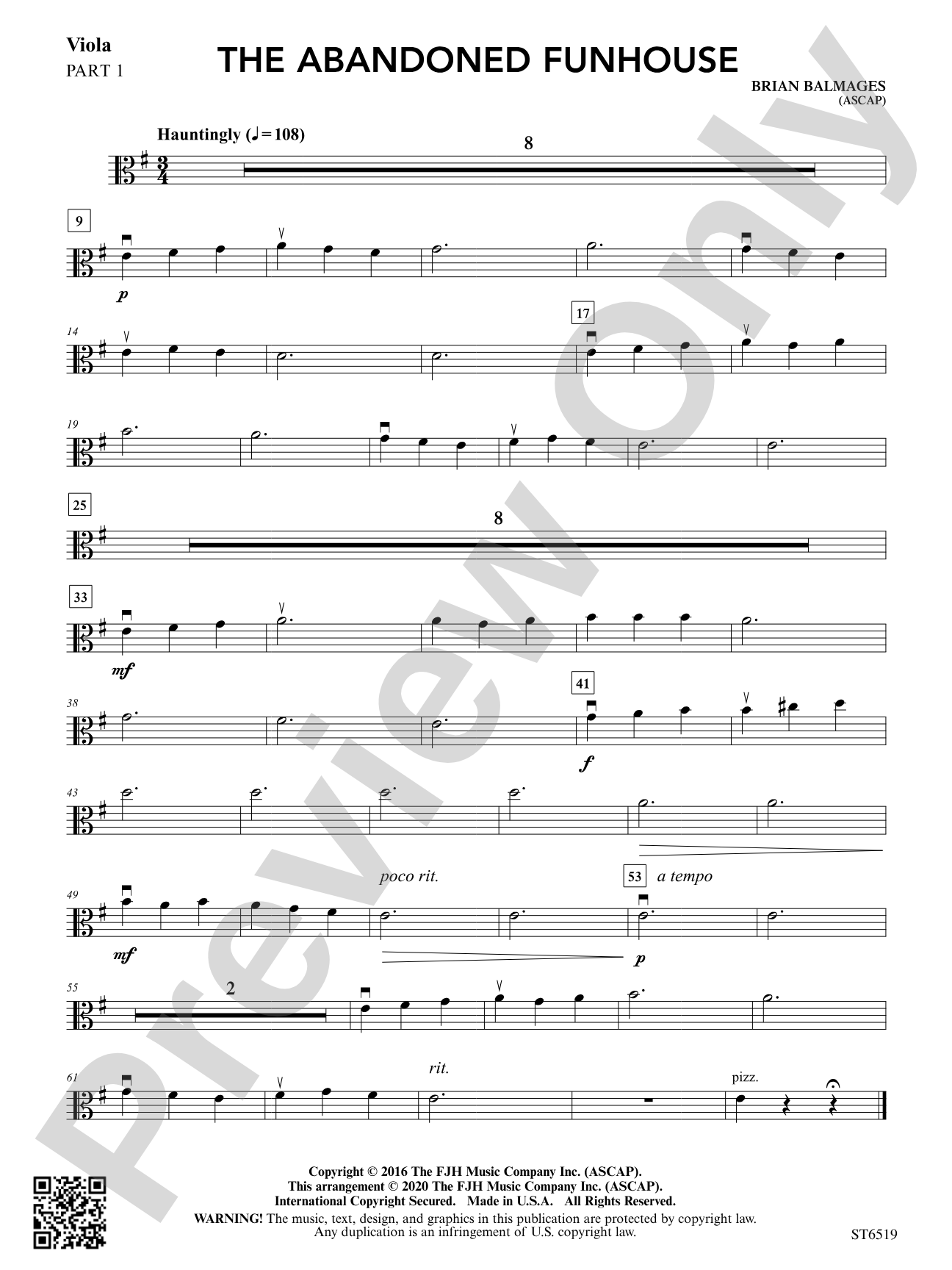

The Abandoned Funhouse: Part 1 Viola
By Brian Balmages
Level:.5
Item: 98-PC-DST6519_PART1_VA
$7.00
Pickup currently not available
Description
Written for the true beginner, this piece takes the listener on an eerie tour that can best be described as an unsettling experience with a touch of curiosity and anxiousness. 3-part fully adaptable with piano or guitar accompaniment.


Don't just read it, hear it, play along with it, and watch your students grow with it. In MakeMusic Cloud, The Abandoned Funhouse: Part 1 Viola comes alive with professional accompaniment, adjustable tempo, and built-in practice tools that turn solo practice into real progress.
Open in the Player
Jump straight in and assign it today.
Start Your Free Trial
Open this title and explore the full library in minutes.
Sample Audio
1
Audio File
--:--
0:00
0:00
Sample Video
No sample videos found.
Additional Details
Series:
The ReImagine Initiative
Publisher:
The FJH Music Company, Inc.
SKU:
98-PC-DST6519_PART1_VA
More about this title
About the Composer: Brian Balmages

Brian Balmages has established himself as a composer and conductor across orchestral, band, and chamber music repertoires. His works have been premiered and performed by professional symphony orchestras, university ensembles, and school groups in halls including Carnegie Hall, the Kennedy Center, and the Sydney Opera House. He received the A. Austin Harding Award from the American School Band Directors Association and won the 2020 NBA William D. Revelli Composition Contest for his composition Love and Light. An elected member of the American Bandmasters Association, he holds the inaugural James Madison University Distinguished Alumni Award from the School of Visual and Performing Arts.
As a conductor, Balmages regularly guests with all-state ensembles, university orchestras, and professional groups worldwide, appearing at the Midwest Clinic, Western International Band Clinic, and numerous ASTA conferences. His music was performed as part of the 2013 Presidential Inaugural Prayer Service attended by President Obama and Vice President Biden. Currently serving as Director of MakeMusic Publications and Digital Education for Alfred and MakeMusic, Balmages continues to expand access to meaningful music for students at all levels.
Why we love this
Balmages writes with beginner strings in mind, crafting music that sounds imaginative and polished without demanding technical sophistication. The 3-part adaptability means you can use exactly what you have in your section without reducing the piece to unison; every student has something to play. The programmatic narrative of an abandoned funhouse pulls young string players into committed musical storytelling from measure one, transforming what could be a dry exercise into a genuine concert experience.
What to expect
Eerie and curious in equal measure, the music unfolds with an unsettling quality that keeps the listener slightly off-balance. There's an exploratory, searching character to the writing that feels appropriate to the scenario of wandering through an abandoned space, where moments of beauty are tinged with mild dread. The touch of anxiousness never tips into true darkness; instead, it invites players and audiences alike into a carefully controlled moment of spooky intrigue.
Who it's for
This piece is designed for beginning string orchestras or flexible string ensembles where technical demands should stay minimal but musical intent should remain clear. Directors working with mixed-level or smaller string groups will find the adaptive scoring makes it possible to include everyone meaningfully. Young string players benefit from learning how to shape a narrative arc and respond to programmatic ideas without fighting difficult passage work.
How to get the most out of it
- Build the unsettling atmosphere by having players shape dynamics together; even at this level, the piece benefits from collective breath and restraint rather than constant full sound.
- Balance the string parts so that the highest part carries melody without drowning out the harmonic foundation underneath; test the balance in a few key sections before rehearsal to set expectations.
- Coordinate with your accompanist early to establish a steady, ghostly foundation that supports the strings' tonal explorations without rushing or dragging.
How to use it
Program this as a thematic opener for a concert or festival that includes other novelty or light contemporary works; it sets an engaging mood and immediately signals that you're offering something beyond standard string repertoire. It works equally well as a standalone contest or festival entry, where judges appreciate both the musical substance and the creative scenario. Consider pairing it with other Balmages pieces at the same level to create a cohesive program that showcases your ensemble's range.
Skills your students will build
- Maintaining ensemble cohesion across flexible voicings (3-part adaptable scoring)
- Responding to programmatic imagery and narrative arc in music
- Shaping dynamics and tone color to create atmosphere
- Balancing independent string parts while supporting overall ensemble blend
- Coordinate with accompaniment (piano or guitar) in ensemble settings