
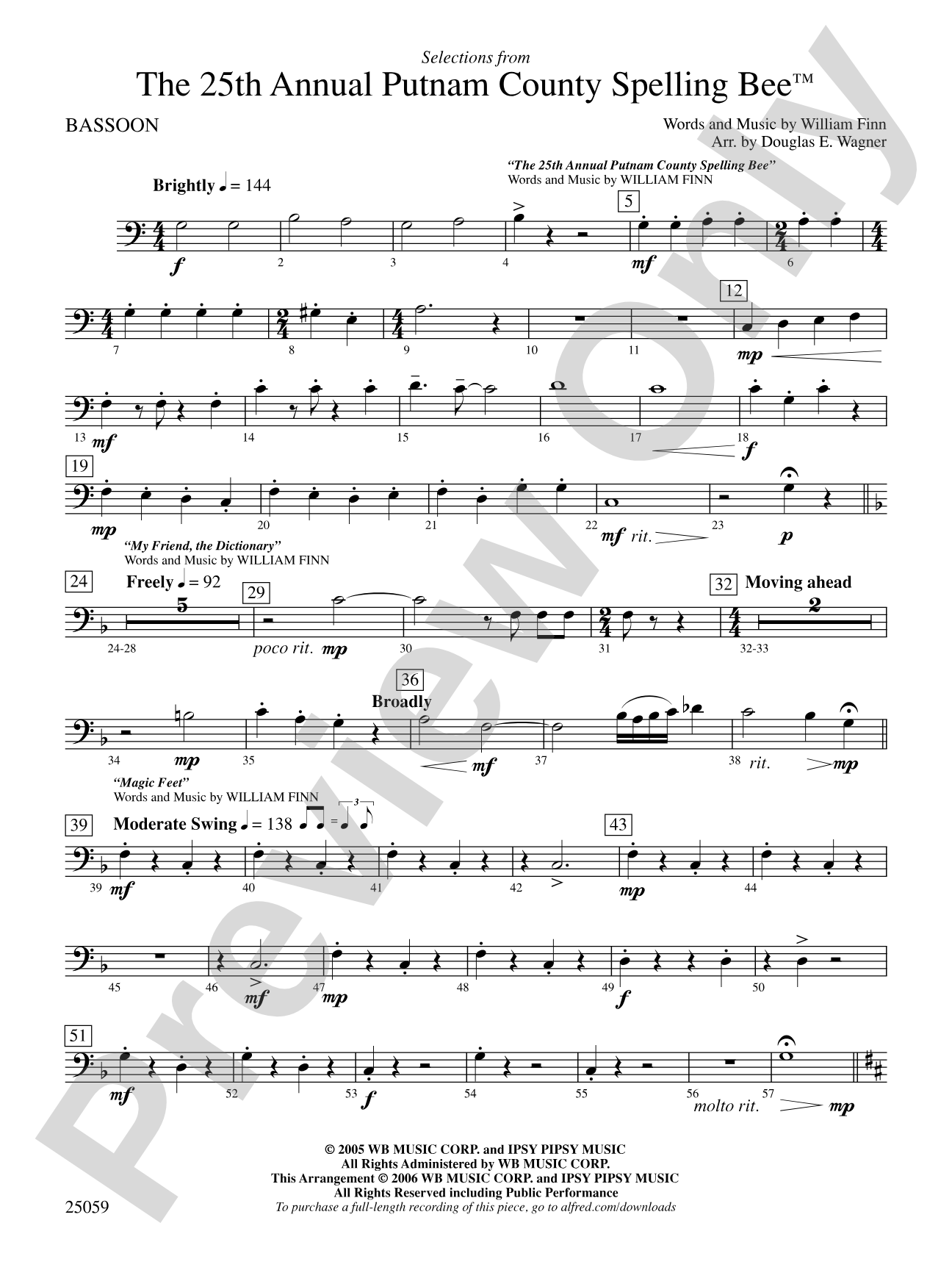

The 25th Annual Putnam County Spelling Bee,™ Selections from: Bassoon
Words and music by William Finn / arr. Douglas E. Wagner
Grade: 3
Item: 00-PC-0015660_B1
$3.00
Pickup currently not available
Description
Can you spell B-R-I-L-L-I-A-N-T? Well, that's the word that most aptly describes William Finn's GRAMMY® nominated soundtrack for the current Broadway hit, Spelling Bee. Doug Wagner captures all of the excitement in his dynamic concert (full) orchestra scoring that includes the titles "The 25th Annual Putman County Spelling Bee," "My Friend, the Dictionary," "Magic Foot" and "The I Love You Song." School, community and professional orchestras will quickly embrace this gem as an instant audience pleaser.


Don't just read it, hear it, play along with it, and watch your students grow with it. In MakeMusic Cloud, The 25th Annual Putnam County Spelling Bee,™ Selections from: Bassoon comes alive with professional accompaniment, adjustable tempo, and built-in practice tools that turn solo practice into real progress.
Open in the Player
Jump straight in and assign it today.
Start Your Free Trial
Open this title and explore the full library in minutes.
Sample Audio
1
Audio File
--:--
0:00
0:00
Sample Video
No sample videos found.
Additional Details
Series:
Pop Concert Full Orchestra
Publisher:
Alfred Music
Page Count:
224
SKU:
00-PC-0015660_B1
More about this title
About the Composer: William Finn
William Finn is a three-time Tony Award winner and composer of some of Broadway's most distinctive musicals, including Falsettos, A Little Night Music, and The 25th Annual Putnam County Spelling Bee. His theatrical voice blends sophisticated harmonic language with deeply human storytelling, creating scores that feel both intellectually engaging and emotionally immediate. Finn's work has been recorded by major orchestras and performed in schools and theaters worldwide, making him a significant figure in contemporary musical theater.
Why we love this
Doug Wagner's orchestration transforms Finn's witty, character-driven score into something that plays brilliantly in concert settings without losing the humor and warmth that made the Broadway show a success. Directors appreciate how accessible Grade 3 scoring accommodates growing orchestras while preserving the sophistication audiences expect from this GRAMMY-nominated work. The mix of recognizable titles ensures genuine audience engagement, particularly when programming contemporary Broadway alongside classical repertoire.
What to expect
The Putnam County Spelling Bee selections sparkle with theatrical flair and genuine emotional warmth. Wagner's orchestrations capture the show's quirky charm and tender character moments, moving from comic precision to surprising poignancy as the music unfolds. The overall effect is energetic, accessible, and genuinely entertaining, with orchestral colors that feel fresh and contemporary.
Who it's for
Orchestra directors seeking repertoire that connects with student musicians and general audiences alike will find this collection invaluable at the Grade 3 level. Both school and community orchestras benefit from music that sounds sophisticated and contemporary without requiring advanced technical demands. Programming this score appeals to musicians who grew up with musical theater and to younger players discovering that Broadway composition can be musically substantial.
How to get the most out of it
- Balance the melodic line against the ensemble accompaniment carefully; Finn's orchestrations often feature intimate character moments that need to project over supporting voices.
- Attend to the rhythmic precision required in ensemble figures, especially in 'Magic Foot,' where rhythmic clarity drives the comedic timing.
- Use the conductor score to track all four selections' distinct moods, shifting your interpretive approach to match each piece's emotional landscape.
- Collaborate with your principal players on phrasing; this music rewards singing through the orchestral color rather than mechanical execution.
How to use it
Program this as an anchor for a contemporary music concert, pairing it with other accessible Broadway selections or modern concert pieces. The four selections work well as a suite in the latter half of a concert program, where their theatrical energy can carry momentum toward a strong closing. Consider performing this during spring pops concerts or family-friendly programs where broader audiences appreciate the show's recognizable titles.
Skills your students will build
- Balancing lyrical melodic lines with supporting harmonic textures
- Maintaining rhythmic precision in ensemble figures and comic passages
- Responding to color changes and dynamic shifts in contemporary orchestral writing
- Phrasing through orchestral color and character-driven musical narrative
- Sight-reading and interpreting Broadway-influenced harmonic language