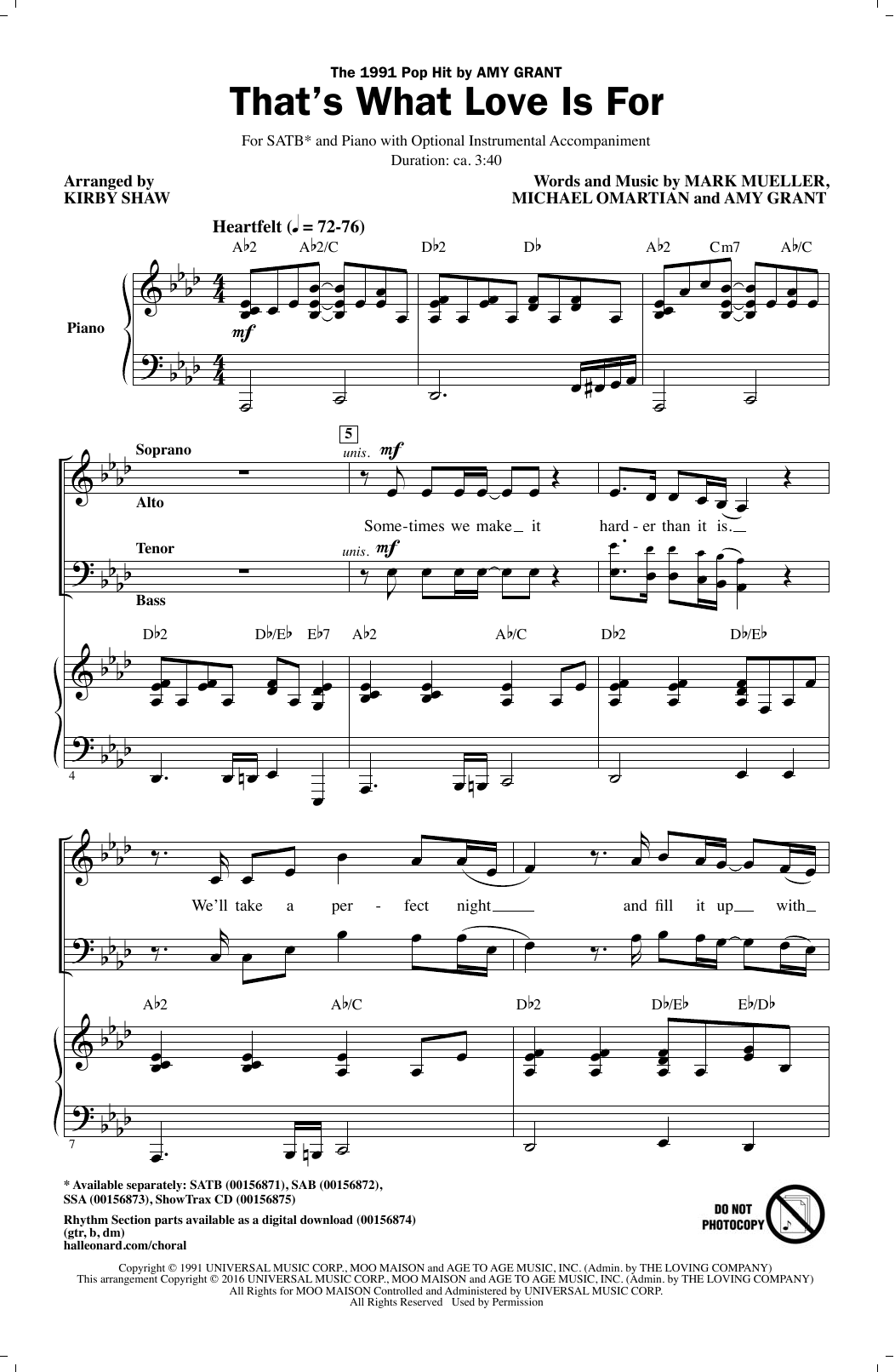
That's What Love Is For Sheet Music Preview

That's What Love Is For: SATB Choral Octavo

As performed by Amy Grant / As performed by Mark Mueller / As performed by Michael Omartian / Arranged by Kirby Shaw

Item: 35-DS00339217

Digital Download
$2.99
Description

That's What Love Is For: SATB Choral Octavo isn't in MakeMusic Cloud just yet...but it could be. Let us know you'd like to see it, and you'll help shape what comes next. In the meantime, start a free trial and dive into thousands of interactive titles your students can play along with today.

Sample Audio
No sample audio found.
Sample Video
Additional Details
Publisher: Hal Leonard
Page Count: 11
SKU: 35-DS00339217

More about this title

About the Artist: Amy Grant

Amy Grant emerged as one of contemporary Christian music's most influential artists, crossing over to mainstream pop success in the 1980s and 1990s. Her songwriting balances emotional directness with melodic sophistication, qualities that have made her catalog a natural fit for choral arrangements across genres and settings.

Why we love this

Kirby Shaw's arrangement captures the warmth and accessibility of the original while giving SATB singers a genuinely rewarding part structure. The pop sensibility sits comfortably in secular programming, and the emotional core of the song translates powerfully when sung by an ensemble.

What to expect

Honest and sincere, the arrangement unfolds with the conversational ease of someone speaking from the heart. Underneath sits solid harmonic writing that feels modern without becoming gimmicky, creating space for genuine emotional connection.

Who it's for

Choirs seeking contemporary repertoire that connects with audiences beyond traditional sacred or art song contexts. This works for high school and community ensembles ready to tackle pop arrangement conventions with musicality and restraint.

How to get the most out of it

  • Balance the lyrics for clarity; this song's impact depends on the audience hearing the message without effort.
  • Honor the contemporary harmonic language by keeping the sound cohesive across all four parts rather than letting soloists dominate.
  • Shape phrases according to natural speech patterns rather than strict musical phrasing to maintain the intimacy of the text.
  • Explore how the arrangement handles the original melody and allow singers to find moments of vulnerability without overdoing dynamics.

How to use it

Pair this with other accessible contemporary pieces to build a concert segment that speaks to listeners unfamiliar with traditional choral repertoire. It also serves well as an encore or closing number when you want to leave the audience with something emotionally resonant and singable.

Skills your students will build

  • Navigating contemporary harmonic language and non-traditional progressions
  • Balancing blend and clarity in pop-influenced arrangements
  • Shaping lyrical phrasing with attention to natural speech and emotional subtext
  • Maintaining ensemble cohesion in music with less reliance on classical voice leading conventions

You May Also Like