That's What I Believe from <i>Knoxville</i> Sheet Music Preview

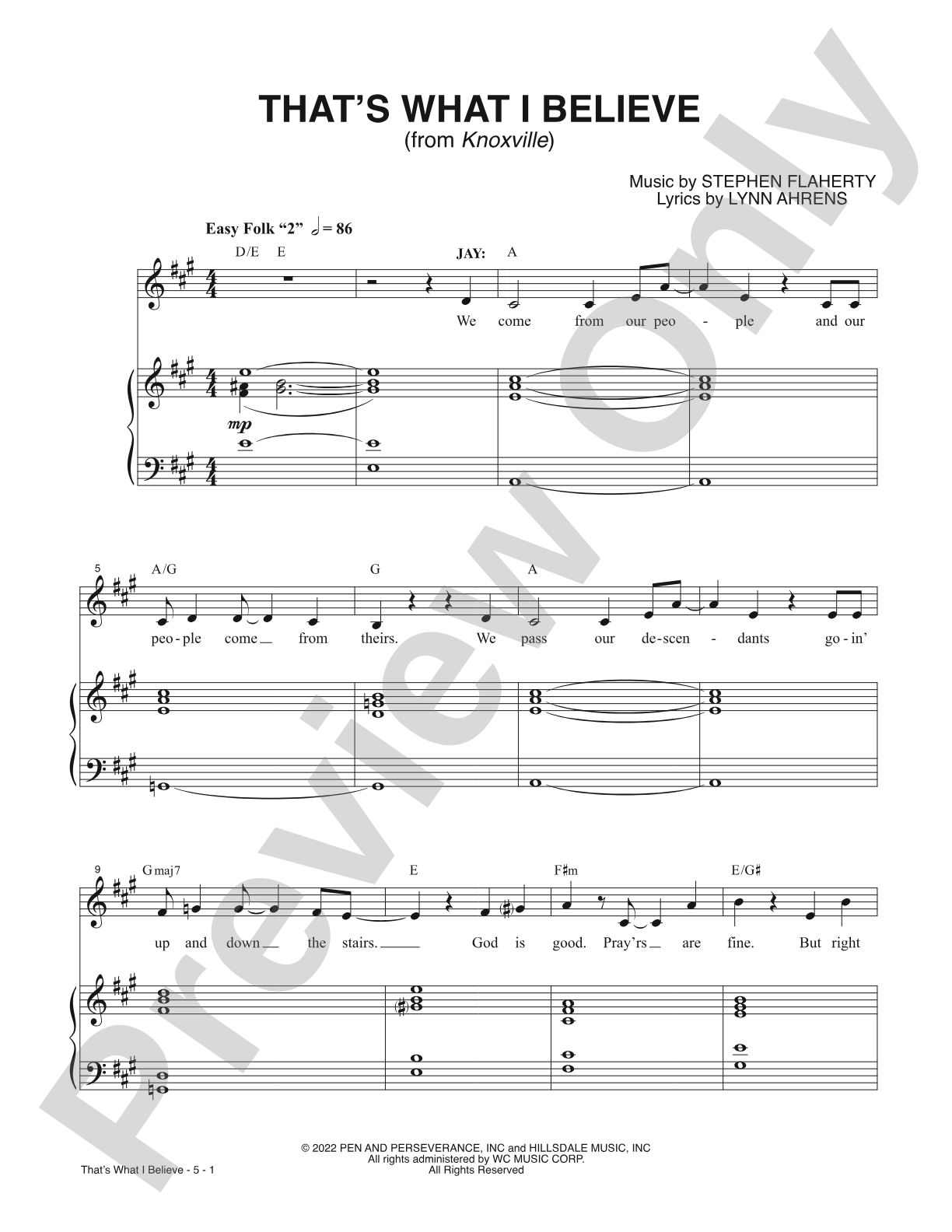
That's What I Believe from Knoxville: Piano/Vocal/Chords

from Knoxville

Music by Stephen Flaherty / Lyrics by Lynn Ahrens

Item: 00-PS-0016699

Digital Download
$4.50

One moment…

Description
Song from Knoxville - Music by Stephen Flaherty; Lyrics by Lynn Ahrens

Cover art provided by Asolo Repertory Theatre, Sarasota, Florida

That's What I Believe from Knoxville: Piano/Vocal/Chords isn't in MakeMusic Cloud just yet...but it could be. Let us know you'd like to see it, and you'll help shape what comes next. In the meantime, start a free trial and dive into thousands of interactive titles your students can play along with today.

Sample Audio
No sample audio found.
Sample Video
Additional Details
SKU: 00-PS-0016699

More about this title

About the Composer: Stephen Flaherty

Stephen Flaherty is a composer whose work spans Broadway, film, and concert music. His partnerships with lyricist Lynn Ahrens have produced widely performed musicals including Ragtime, Anastasia, and Hadestown, the last of which won eight Tony Awards in 2019. Flaherty's compositions are known for their theatrical momentum, memorable melodic lines, and sophisticated harmonic language that rewards both performers and listeners.

Beyond the stage, Flaherty has composed for animated films and concert works performed by orchestras worldwide. His music is taught in universities and performed frequently in educational settings, from high school musicals to advanced vocal studies. He has received numerous awards including Grammy, Oscar, and Golden Globe nominations, cementing his place as a significant voice in contemporary musical theater.

Why we love this

Flaherty writes vocal lines that sit beautifully for singers while remaining dramatically potent. This song balances accessibility with theatrical sophistication, making it equally suitable for voice students developing their interpretive skills and for performers preparing musical theater repertoire. The piano writing is idiomatic without being ostentatious, giving accompanists real material to shape the emotional arc.

What to expect

The song carries the warmth and directness characteristic of Flaherty's theatrical writing. There's an honesty to the melodic line that invites sincere expression, while the harmonies provide sophisticated emotional coloring beneath the surface. The piece sits in that space where accessibility and artistry meet naturally.

Who it's for

This song works for intermediate to advanced vocalists studying musical theater repertoire, voice students seeking contemporary material with strong melodic content, and pianists accompanying singers in studio or recital settings. It's equally valuable for high school singers in applied lessons and for college-level voice students building a diverse modern American musical theater library.

How to get the most out of it

  • Shape the vocal phrase by listening carefully to the piano's harmonic support; Flaherty's chords often suggest dynamic contours that aren't marked in the score.
  • Treat the piano part as a full ensemble partner, not background texture. The composer builds momentum and color through the accompaniment itself.
  • Examine the lyrical content and dramatic situation from the musical before interpreting; understanding the character's emotional stakes will inform phrasing and tempo choices.

How to use it

Program this alongside other contemporary musical theater selections to showcase modern American songwriting in a vocal recital or concert. It pairs well with material from other Flaherty and Ahrens scores, or as a bridge between classic Broadway standards and newer musical theater works. The song's emotional directness makes it effective as a standalone feature or as part of a thematically connected set.

Skills your students will build

  • Interpreting contemporary musical theater melody with lyrical sensitivity
  • Coordinating vocal phrasing with piano accompaniment patterns
  • Sustaining legit vocal tone through extended phrase lines
  • Understanding how harmonic color informs dramatic expression
  • Reading and performing piano/vocal score notation accurately

You May Also Like