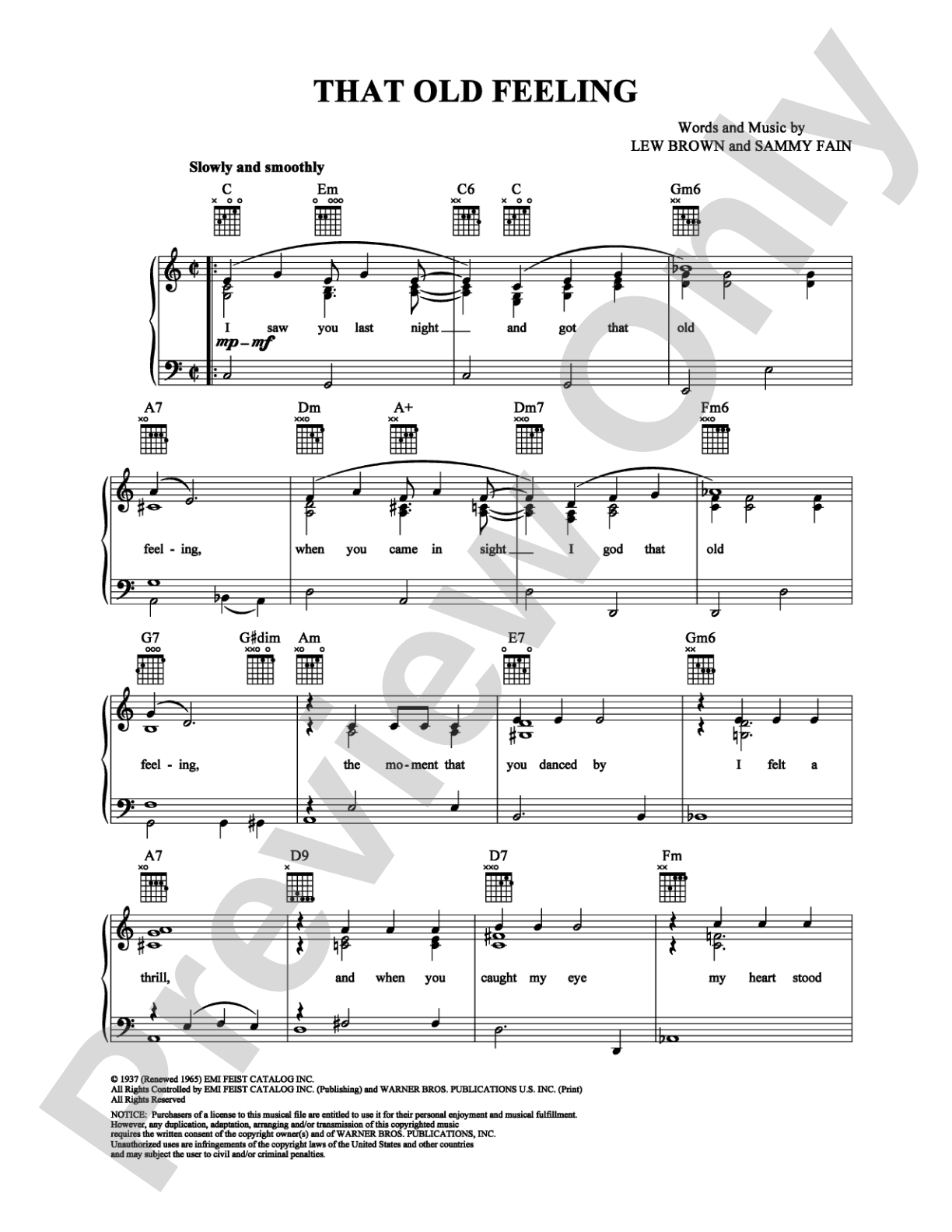
That Old Feeling: Piano/Vocal/Chords Digital Sheet Music

That Old Feeling: Piano/Vocal/Chords Digital Sheet Music

Lew Brown, Sammy Fain, Chet Baker

Item: 00-PS-0007150

Digital Download
$3.99
Description

That Old Feeling: Piano/Vocal/Chords Digital Sheet Music isn't in MakeMusic Cloud just yet...but it could be. Let us know you'd like to see it, and you'll help shape what comes next. In the meantime, start a free trial and dive into thousands of interactive titles your students can play along with today.

Sample Audio
No sample audio found.
Sample Video
Additional Details
SKU: 00-PS-0007150

More about this title

About the Artist: Chet Baker

Chet Baker (1929-1988) was an American jazz trumpeter and vocalist whose lyrical, introspective approach to both instruments defined cool jazz. His influence on jazz education extends beyond his recordings; his melodic sensibility and restrained phrasing serve as a masterclass in taste and economy of expression.

Baker's vocal style—intimate, vulnerable, and rhythmically sophisticated—demonstrates how a jazz singer can serve the song while maintaining complete harmonic awareness. For musicians studying jazz standards, his interpretations of evergreen tunes offer invaluable lessons in balancing melody with improvisation.

Why we love this

This lead sheet captures a standard that rewards both interpretive singers and accompanists. The chord changes are stable enough for students to trust the harmonic structure while offering genuine space for melodic and harmonic exploration, making it equally useful in a jazz combo setting or a vocalist's recital repertoire.

What to expect

Tender without being fragile. The harmonic language feels familiar yet slightly cool, the kind of ballad that sounds effortless until you try to sing it yourself. There's a quiet confidence running through this reading, no desperation, no excess.

Who it's for

Jazz vocalists preparing a standard for recital, singers in jazz ensembles or combos, and pianists developing their jazz accompaniment skills. This lead sheet works for intermediate to advanced musicians comfortable with jazz comping and reading chord changes.

How to get the most out of it

  • Sing the melody straight through first without interpretation. Let the natural shape of the tune reveal itself before adding rubato or dynamics.
  • Listen to how the chord changes suggest harmonic color. Small adjustments to vowel shape and vibrato can highlight the movement between chords without fighting against them.
  • When accompanying, support the vocalist's phrasing rather than insisting on strict time. Jazz standards from this era thrive on the interplay between rhythmic flexibility and harmonic clarity.
  • Pay attention to the lyric's emotional arc. Baker's approach was never sentimental; every vocal choice served the meaning of the words.

How to use it

Include this standard in a jazz-focused recital or as part of a program pairing American songbook material with blues or other jazz repertoire. It also serves ensembles studying the cool jazz era or exploring vocalist-and-piano repertoire.

Skills your students will build

  • Reading and interpreting lead sheets with jazz chord symbols
  • Balancing rubato with harmonic awareness in a standard
  • Jazz vocal phrasing and microtonality
  • Comping changes accurately while supporting a vocalist's interpretation

You May Also Like