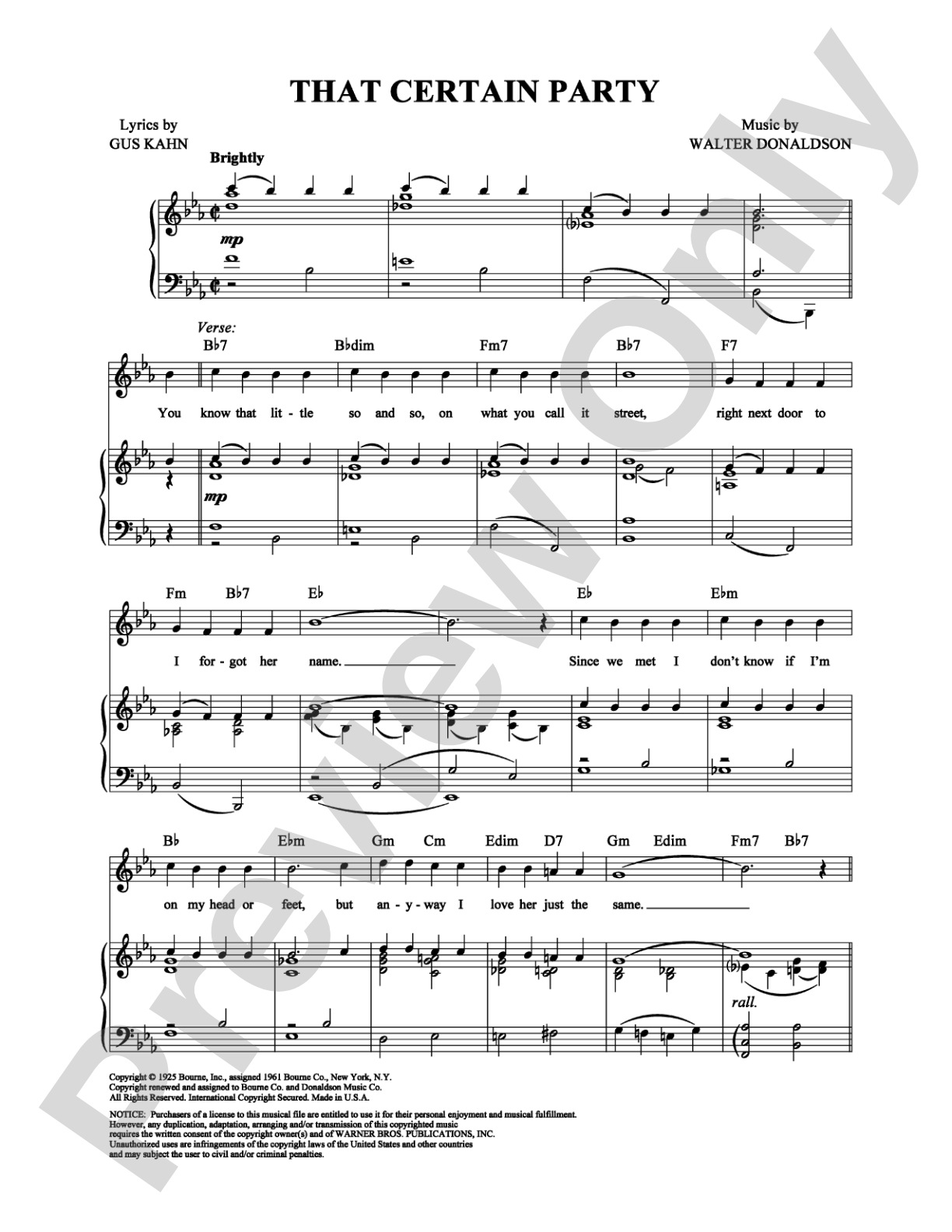
That Certain Party: Piano/Vocal/Chords Digital Sheet Music

That Certain Party: Piano/Vocal/Chords Digital Sheet Music

Eddie Cantor, Walter Donaldson, Nina Simone

Item: 00-PS-0000404

Digital Download
$3.99
Description

That Certain Party: Piano/Vocal/Chords Digital Sheet Music isn't in MakeMusic Cloud just yet...but it could be. Let us know you'd like to see it, and you'll help shape what comes next. In the meantime, start a free trial and dive into thousands of interactive titles your students can play along with today.

Sample Audio
No sample audio found.
Sample Video
Additional Details
SKU: 00-PS-0000404

More about this title

About the Artist: Nina Simone

Nina Simone was a classically trained pianist and composer who became one of the most influential jazz and soul artists of the 20th century. Her work spanned multiple genres, jazz, blues, folk, and classical, and she brought fierce intelligence and emotional depth to every standard she interpreted, often reimagining familiar melodies with unexpected harmonies and dramatic sensibility.

Why we love this

This standard offers singers and pianists a chance to study how a master interpreter approached a mid-century pop tune. Simone's recorded version reveals her gift for finding emotional depth in material that might otherwise feel lightweight, making it a valuable model for students learning how arrangement choices, harmonic reharmonization, and phrasing can transform a song.

What to expect

A sophisticated, urbane standard from the golden age of popular song. The piece carries an air of wry observation and emotional directness, inviting performers to find the character and intention beneath the melody.

Who it's for

Singers and pianists working on American songbook standards, jazz repertoire, or cabaret material will find this lead sheet essential. Intermediate to advanced vocalists can use this to explore how phrasing, dynamics, and harmonic interpretation shape the character of a familiar tune.

How to get the most out of it

  • Study Simone's recorded interpretation to understand her approach to rubato and phrasing; her use of space and silence is as important as the notes themselves.
  • Pay attention to the harmonic changes printed in the lead sheet; they often differ from the original songwriting and reflect how standards were reimagined in jazz and cabaret contexts.
  • Balance the vocal line with the piano accompaniment so neither overwhelms the other; the strength of this material lies in the conversation between voice and keyboard.

How to use it

Include this in a cabaret or standards concert where it can sit comfortably alongside other songs from the 1920s-1930s era. It works well as a solo feature showcasing a vocalist's interpretive range and ability to work intimately with a pianist.

Skills your students will build

  • Reading and interpreting lead sheet notation (melody, chord symbols, and lyric placement)
  • Harmonic analysis of jazz reharmonization and substitutions
  • Vocal phrasing and interpretive choices in the context of a standard
  • Piano accompaniment techniques for supporting a vocal line
  • Understanding how arrangement and interpretation can reshape a familiar song

You May Also Like