
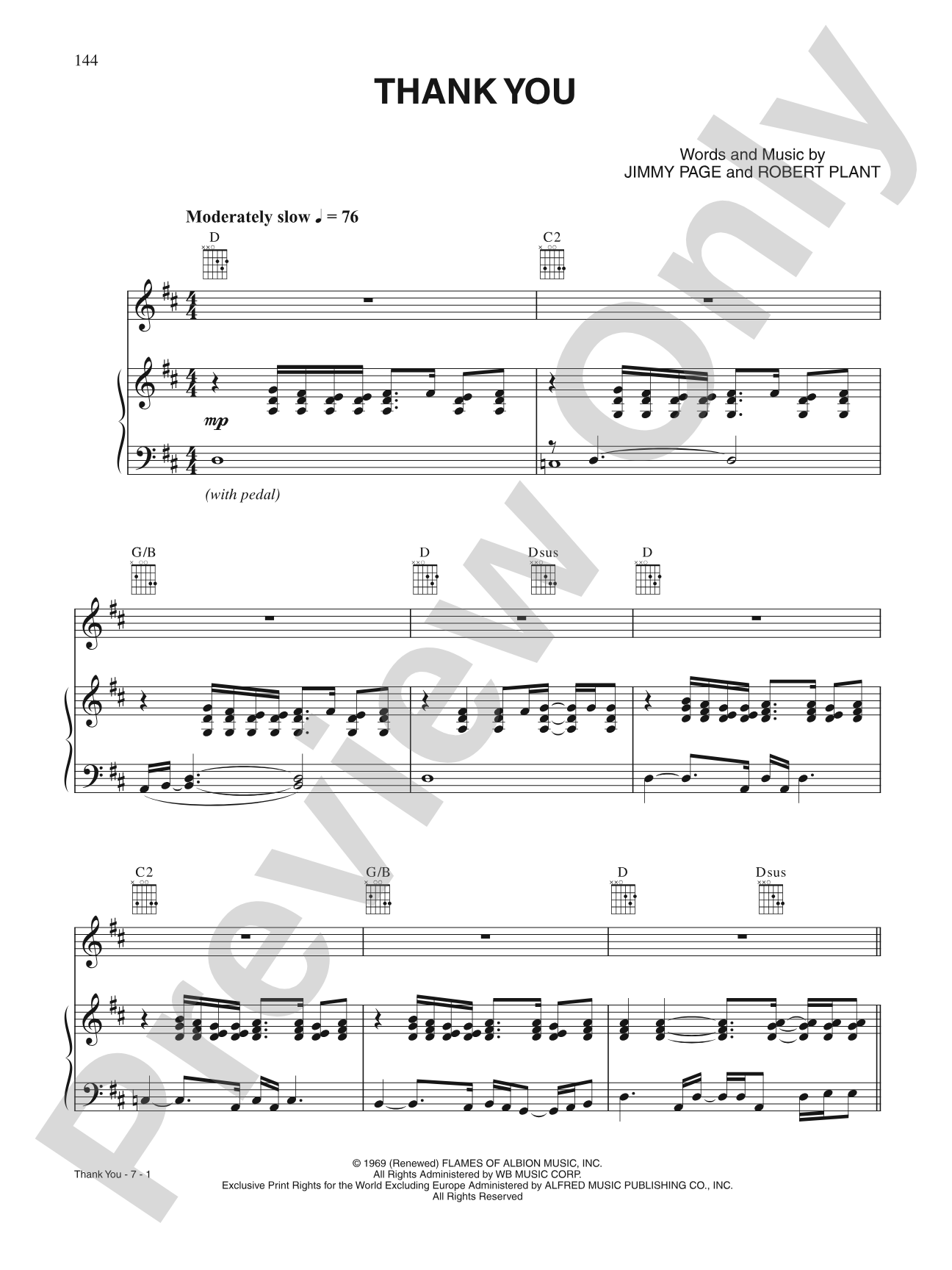
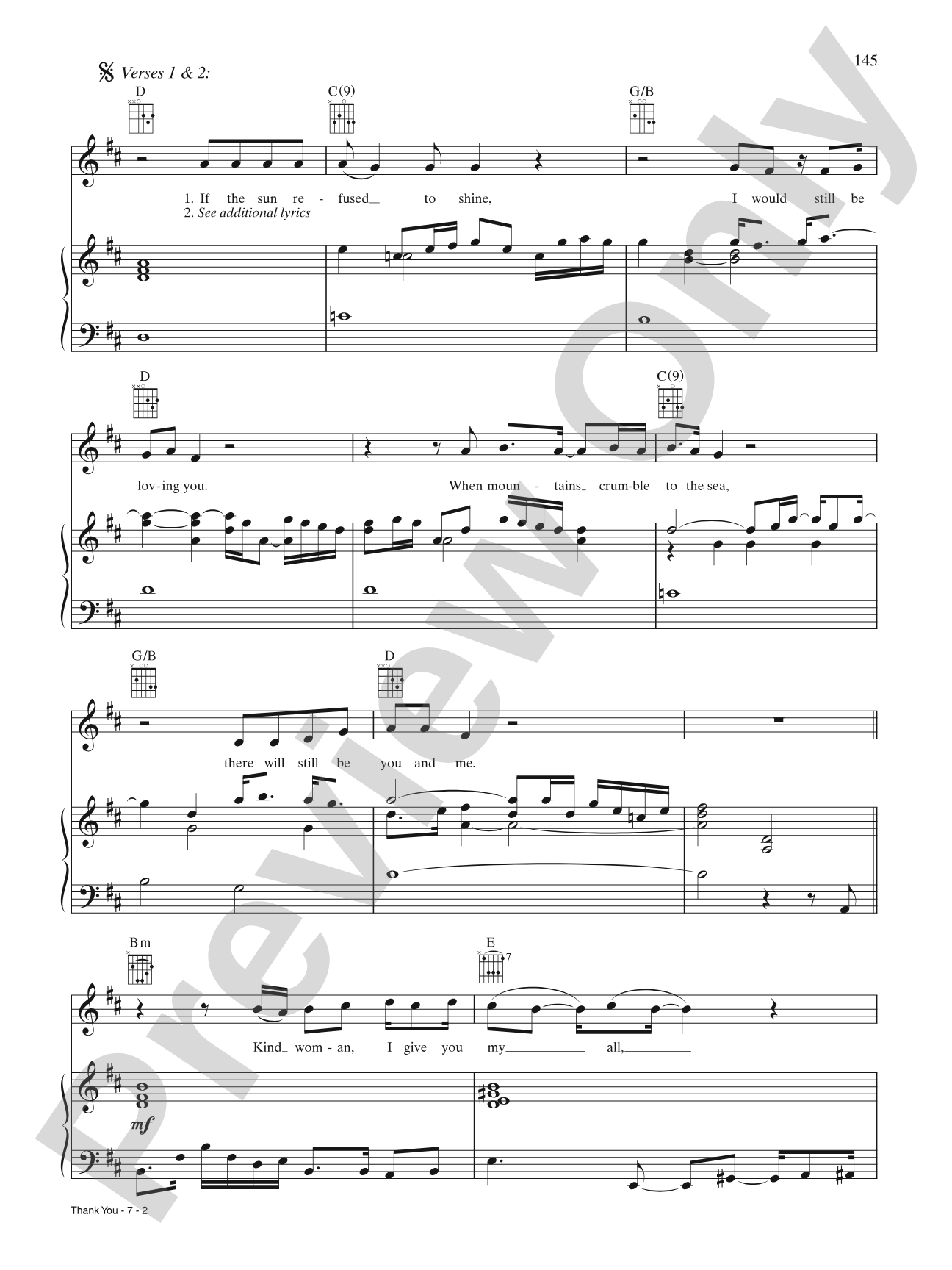

Thank You: Piano/Vocal/Chords
Led Zeppelin
Item: 00-PS-0015509
$5.99
Pickup currently not available
Related Items
Heartbreaker: Piano/Vocal/Chords |
$5.99
|
View | |
No Quarter: Piano/Vocal/Chords |
$5.99
|
View | |
The Ocean: Piano/Vocal/Chords |
$4.99
|
View | |
The Rain Song: Piano/Vocal/Chords |
$9.99
|
View | |
Since I've Been Loving You: Piano/Vocal/Chords |
$5.99
|
View | |
All My Love: Piano/Vocal/Chords |
$5.99
|
View | |
Carouselambra: Piano/Vocal/Chords |
$9.99
|
View | |
Fool in the Rain: Piano/Vocal/Chords |
$9.99
|
View | |
Trampled Under Foot: Piano/Vocal/Chords |
$5.99
|
View | |
Led Zeppelin: Piano Sheet Music Anthology: Piano/Vocal/Guitar Book |
$29.99
|
View |
Description
Led Zeppelin fans who play the piano know that certain songs by the legendary band are particularly well-suited to be played on keyboard instruments. Some of these are "All My Love," "No Quarter," "Stairway to Heaven," "Your Time Is Gonna Come," and more---and they're all here in this collectible sheet music anthology. Also included are a variety of the band's most popular songs from seven of their albums. This collection of 20 arrangements is the ultimate vehicle for pianists to explore the music of the greatest rock band of all time! Titles: All My Love * The Battle of Evermore * Black Dog * Carouselambra * The Crunge * Fool in the Rain * Going to California * Good Times Bad Times * Heartbreaker * Kashmir * No Quarter * The Ocean * The Rain Song * Rock and Roll * Since I've Been Loving You * Stairway to Heaven * Thank You * Trampled Under Foot * You Shook Me * Your Time Is Gonna Come.


Thank You: Piano/Vocal/Chords isn't in MakeMusic Cloud just yet...but it could be. Let us know you'd like to see it, and you'll help shape what comes next. In the meantime, start a free trial and dive into thousands of interactive titles your students can play along with today.
Request This Title
Tell us you want it.
Start Your Free Trial
Explore everything that's ready to play right now.
Sample Audio
No sample audio found.
Sample Video
No sample videos found.
Additional Details
Series:
Sheet Music Anthology
Publisher:
Alfred Music
Page Count:
164
SKU:
00-PS-0015509
More about this title
About the Composer: Jimmy Page
Jimmy Page shaped modern rock music as Led Zeppelin's guitarist, composer, and producer across the band's entire catalog from 1968 to 1980. His approach to songwriting merged blues foundations with experimental studio techniques, Eastern influences, and dynamic instrumental arrangements that became blueprints for hard rock and heavy metal. Page's compositions span intimate acoustic pieces to towering epics, demonstrating technical mastery and compositional sophistication that continues to influence musicians across genres.
Why we love this
This collection captures Led Zeppelin's music in forms that actually work on the keyboard, sidestepping the common problem of trying to adapt straight-ahead rock songs that don't translate well to piano. The arrangement of 20 songs across their classic albums gives pianists genuine variety in texture and difficulty, from intricate passages in "Kashmir" and "No Quarter" to the accessible momentum of "Black Dog" and "Good Times Bad Times." Programming this opens a door to serious students who want to engage with classic rock through piano rather than abandoning the repertoire they love.
What to expect
The collection swings between moody introspection and raw power. Quieter pieces like "Going to California" and "The Rain Song" invite you into rich harmonic territory, while harder rock tracks like "Black Dog" and "You Shook Me" demand rhythmic precision and punch. The arrangements preserve the mystique of the original recordings while reshaping them for the piano's particular strengths.
Who it's for
Pianists and singer-pianists with intermediate to advanced skills who grew up with Led Zeppelin or want to explore the band's catalog through keyboard-friendly arrangements. This works for students preparing solo recital material, for teachers building a contemporary rock repertoire alongside classical standards, and for pianists accompanying vocalists in casual or semi-professional settings.
How to get the most out of it
- Study the original recordings carefully before diving into the charts, especially for songs like "No Quarter" and "The Rain Song," where the keyboard textures and layering define the sound.
- Balance the vocal melody against the piano accompaniment so the singer isn't fighting against dense chord voicings; these arrangements reward restraint in the left hand during lyrical passages.
- Lock the rhythmic feel with the chord progression, particularly in shuffle-based tracks like "Rock and Roll" and "Trampled Under Foot," where groove matters as much as harmonic accuracy.
- Pay attention to dynamics across the full 164 pages; these songs span intimate moments and explosive crescendos, and the written dynamics will guide you through the arc of each piece.
How to use it
Slot individual songs into recitals to represent classic rock as a legitimate recital genre, or program a medley of two or three contrasting pieces as a complete set. Use shorter arrangements like "Good Times Bad Times" or "Rock and Roll" as recital openers that grab attention; save deeper cuts like "Kashmir" or "No Quarter" for moments where the audience is already engaged and can follow harmonic complexity.
Skills your students will build
- Reading and performing blues-based chord progressions and 12-bar forms
- Coordinating vocal melody with keyboard accompaniment across varying textures
- Interpreting dynamic and rhythmic nuance in rock arrangements
- Managing left-hand independence and voicing density to support rather than overshadow singers
- Translating iconic rock arrangements into playable keyboard parts