
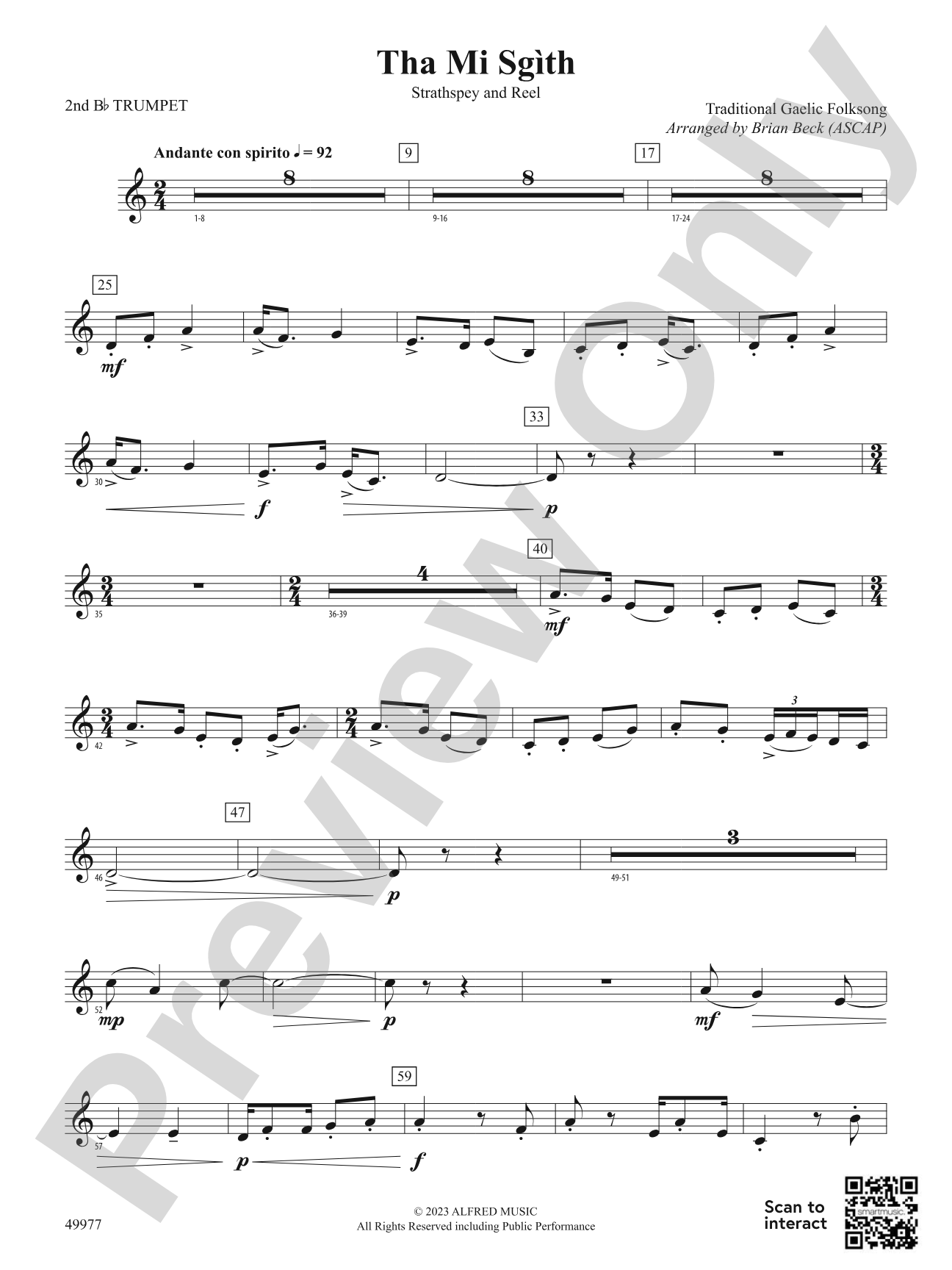

Tha Mi Sgìth: 2nd B-flat Trumpet
Strathspey and Reel
Traditional Gaelic Folksong / arr. Brian Beck
Grade: 3
Item: 00-PC-0019039_T2
$3.00
Pickup currently not available
Description
Tha Mi Sgìth is a Gaelic folksong about forbidden love. This stunning arrangement echoes the styles of Grainger, Grieg, and Holst but is very much in the voice of Brian Beck. Every part has attainable challenges that will motivate your students to practice. This work will be a terrific way to open or close your concert. (4:05)


Don't just read it, hear it, play along with it, and watch your students grow with it. In MakeMusic Cloud, Tha Mi Sgìth: 2nd B-flat Trumpet comes alive with professional accompaniment, adjustable tempo, and built-in practice tools that turn solo practice into real progress.
Open in the Player
Jump straight in and assign it today.
Start Your Free Trial
Open this title and explore the full library in minutes.
Sample Audio
1
Audio File
--:--
0:00
0:00
Sample Video
Additional Details
Series:
Young Symphonic
Publisher:
Alfred Music
SKU:
00-PC-0019039_T2
More about this title
About the Arranger: Brian Beck

Brian Beck is a composer and arranger whose concert band works appear regularly on festival programs and prescribed music lists across the country. His arrangements have earned recognition from The Instrumentalist and J. W. Pepper, been featured in Teaching Music Through Performance In Band, and selected for performances at the Midwest Band and Orchestra Clinic. Beck holds degrees from Texas A&M University-Commerce and the University of Houston, and has directed award-winning bands at both middle and high school levels in Texas, consistently earning Superior ratings at UIL contests and state honor band selections.
Beyond his work as an arranger, Beck serves as a clinician and educator for instrumental and vocal ensembles, bringing his experience as a former director of bands at Faubion Middle School in McKinney, Texas. His compositions and arrangements bridge classical and traditional influences, making them accessible to student musicians while maintaining musical substance.
Why we love this
This arrangement respects the lyrical beauty of a Gaelic melody while giving every section genuine musical work to do. Beck's orchestration feels generous: rather than hiding students behind doublings, each part contains purposeful figuration that builds musicianship and keeps players engaged through the entire piece. The Grade 3 difficulty lands exactly where it promises, making this a rare arrangement that works equally well for motivation and for concert impact.
What to expect
The arrangement wraps the folksong's melody of longing in gentle harmonic colors that evoke the piano-influenced sensibilities of Grainger and Holst. There is restraint here, a respect for the tune itself, combined with moments of swelling warmth that let the instrumental colors shine without drowning out the source material.
Who it's for
Grade 3 concert bands ready to program something with substance and cultural significance. Directors seeking a piece that challenges every section while remaining accessible are ideal users, as is any ensemble interested in folk and traditional music arranged with integrity.
How to get the most out of it
- Shape the opening statement of the melody with gentle rubato; let the initial phrase breathe before the supporting voices enter, establishing the contemplative mood Beck writes into the accompaniment.
- Balance the inner voices carefully during passages where the melody moves to upper woodwinds. Secondary parts should support without overwhelming the tune.
- Attend to the dynamic trajectory across the full arc rather than interpreting each phrase in isolation. This work gains power through cumulative development.
- Use the recorded accompaniment to anchor ensemble tempo and phrasing if available, particularly useful for sight-reading rehearsals early in the learning process.
How to use it
Program this as your concert opener to establish an intimate connection with your audience immediately, or close with it for a thoughtful send-off. The relatively short duration (4:05) and Grade 3 accessibility also make it effective for festival or contest appearances where you want to show musical maturity without overextending your rehearsal time.
Skills your students will build
- Phrasing and dynamic shaping of simple melodies
- Balancing melody with supporting harmonic voices
- Reading and executing parts arranged across multiple sections
- Sustaining tone quality through longer phrases
- Responding to rubato and flexible pacing in ensemble context