
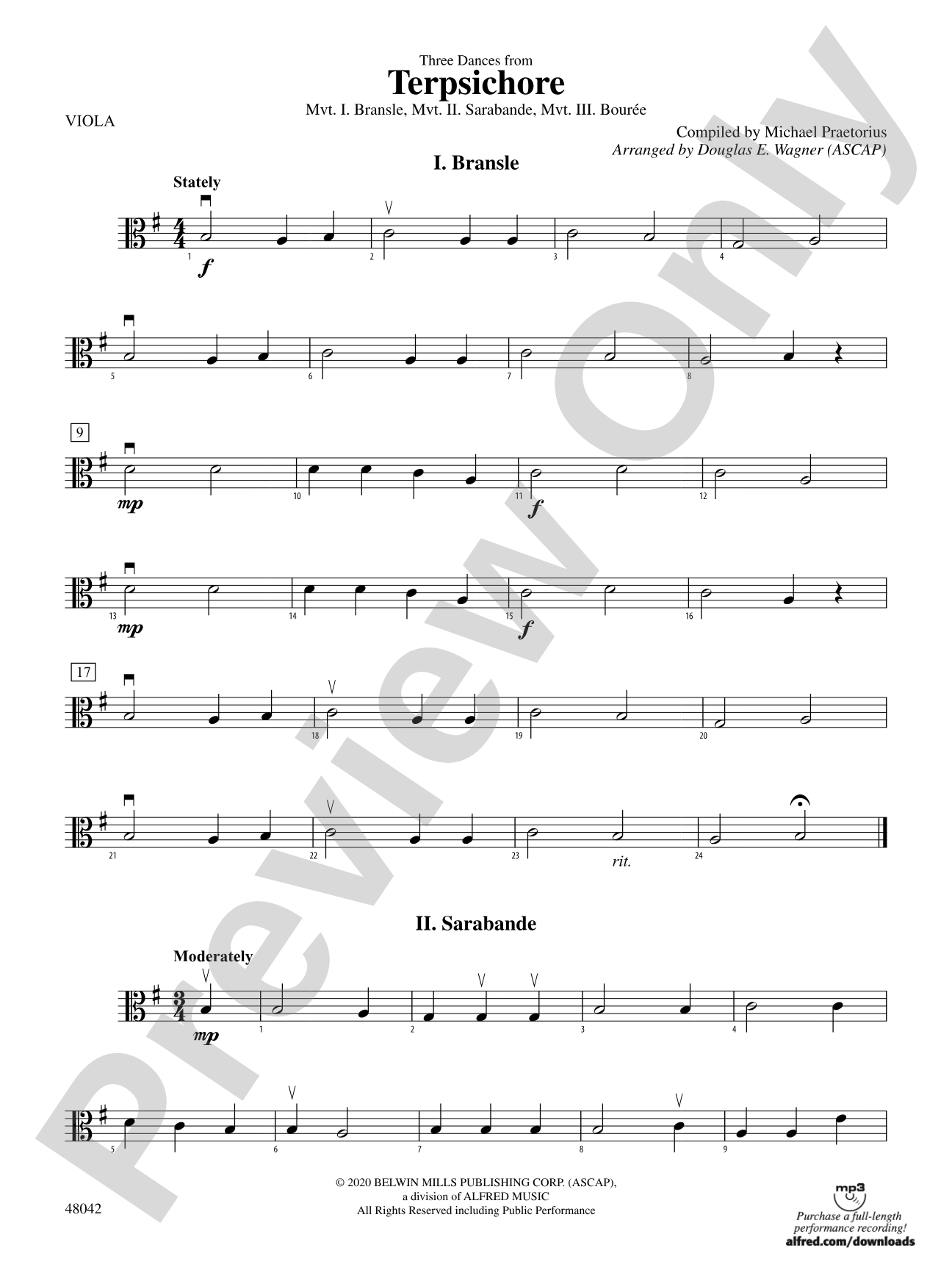

Terpsichore: Viola
Mvt. I. Bransle / Mvt. II. Sarabande / Mvt. III. Bourée
Compiled by Michael Praetorius / arr. Douglas E. Wagner
Grade: 1.5
Item: 00-PC-0018425_VA1
$5.99
Pickup currently not available
Description
This suite by Douglas E. Wagner for young string players is drawn from Terpsichore, a major compilation of 312 primarily French dance tunes published in 1612, compiled and arranged by Michael Praetorius. Three contrasting movements, "Bransle," "Sarabande," and "La Bourée," present a balanced and musically satisfying concert or contest selection, in addition to opening up a multitude of teachable moments in the rehearsal room. (3:20) This title is available in MakeMusic Cloud.


Don't just read it, hear it, play along with it, and watch your students grow with it. In MakeMusic Cloud, Terpsichore: Viola comes alive with professional accompaniment, adjustable tempo, and built-in practice tools that turn solo practice into real progress.
Open in the Player
Jump straight in and assign it today.
Start Your Free Trial
Open this title and explore the full library in minutes.
Sample Audio
1
Audio File
--:--
0:00
0:00
Sample Video
Additional Details
Series:
Belwin Beginning String Orchestra
Publisher:
Alfred Music
Page Count:
144
SKU:
00-PC-0018425_VA1
More about this title
About the Composer: Michael Praetorius
Michael Praetorius (1571-1621) was a German composer, theorist, and editor whose influence on Renaissance and early Baroque music education remains profound. Best known for compiling Terpsichore, a monumental collection of 312 dance tunes primarily from French sources, Praetorius created one of the most valuable repositories of instrumental music from the early 17th century. His work as both a practicing musician and scholarly documenter shaped how generations of composers and educators understood dance forms, modal practices, and instrumental writing.
Why we love this
Wagner's orchestration brings these centuries-old dances to life in a way that feels neither antiquated nor oversimplified. The three-movement structure gives young players exactly what they need: contrasting textures and tempos without excessive technical demands, plus natural momentum for a concert or festival program. The pedagogical payoff is substantial; rehearsing these movements opens doors to period style, articulation clarity, and the relationship between form and orchestration.
What to expect
These dances carry the grace and courtly precision of Renaissance France, yet they breathe easily under young fingers. The bransle dances with quick, pointed energy; the sarabande settles into a stately, sustained elegance; and La Bourée bounces back with character and momentum. Throughout, the writing honors the character of early instrumental music without asking players to stretch beyond their technical capacity.
Who it's for
String orchestra directors working with Grade 1 to 1.5 ensembles who want repertoire that satisfies both musical and educational goals. This works equally well for young community orchestras, school string programs, or beginning conservatory groups seeking historically informed but fully accessible material.
How to get the most out of it
- Attend closely to articulation across all parts. The bransle thrives on rhythmic precision and unified tonguing or bowing; mark every attack in parts to ensure the dance character registers clearly.
- Shape the sarabande's longer lines with restraint. Resist the urge to breathe or separate phrases too frequently; let the harmony and melody unfold smoothly across bar lines.
- Balance the second violin and viola parts in La Bourée so the harmonic foundation stays present without overwhelming the melodic line. Young players often under-voice inner parts.
- Use the recorded accompaniment strategically during early rehearsals to establish pulse and style, then work toward independent ensemble timing as confidence builds.
How to use it
Open a concert with this suite to establish a sophisticated, period-aware foundation that appeals to audiences and adjudicators alike. It pairs naturally with contemporary works or other Renaissance repertoire, and its three-movement arc provides excellent pacing in a festival or competition setting. The piece also serves as a bridge into Baroque music study for ensembles preparing for advanced repertoire.
Skills your students will build
- Articulation clarity in period dance styles (brisé vs. connected phrasing)
- Sustained tone and phrase shaping across longer melodic lines
- Harmonic awareness through inner-part voicing in three-movement form
- Ensemble balance and rhythmic precision at moderate tempos
- Recognition of Renaissance/Baroque form and its relationship to orchestration