
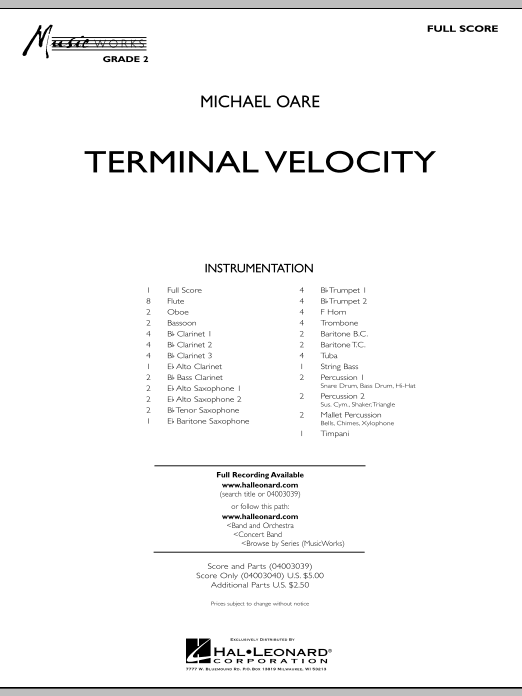

Terminal Velocity: Concert Band Conductor Score & Parts
By Michael Oare
Grade: 2
Item: 35-PK00180555
$60.00
Pickup currently not available
Buy Extra Parts (Digital PDF Download)
Parts Added to Cart!
Description
A term used in physics, "terminal velocity" describes the point at which a falling object ceases to accelerate but continues to fall at a constant velocity. Inspired by the exhilaration of sky diving, this is an exciting and dynamic work for young bands, and fittingly composed all in one constant tempo. Dur: 2:20


Terminal Velocity: Concert Band Conductor Score & Parts isn't in MakeMusic Cloud just yet...but it could be. Let us know you'd like to see it, and you'll help shape what comes next. In the meantime, start a free trial and dive into thousands of interactive titles your students can play along with today.
Request This Title
Tell us you want it.
Start Your Free Trial
Explore everything that's ready to play right now.
Sample Audio
No sample audio found.
Sample Video
No sample videos found.
Additional Details
Publisher:
Hal Leonard
SKU:
35-PK00180555
More about this title
About the Composer: Michael Oare

Michael Oare combines three decades of classroom experience with a prolific compositional voice shaped by direct work with young musicians. After earning degrees in composition and music education from Old Dominion University, he spent 33 years directing bands at Great Bridge Middle School in Chesapeake, Virginia, where his ensembles achieved an extraordinary record of superior ratings in state assessments. Two of his works appear in GIA Publications' prestigious Teaching Music Through Performance series, and he continues to serve as conductor of the Bay Youth Orchestras of Virginia Concert Band.
Oare's recognition includes the 2016 Chesapeake Public Schools Middle School Teacher of the Year award, two citations of excellence from the National Band Association, and multiple listings in Who's Who Among America's Teachers. He maintains active involvement in state and national music organizations, holds ASCAP membership, and performs with the Virginia Wind Symphony. His compositions reflect a deep understanding of what young musicians need: music that challenges without overwhelming, engages their musicality, and rewards careful preparation.
Why we love this
Oare captures something essential about kinetic energy and momentum in this piece. The constant tempo creates a musical architecture that feels inevitable and propulsive rather than rushed, giving young players a clear structural anchor while the orchestration and dynamic contours do all the work of creating excitement. It's the kind of writing that builds student confidence because the harmonic language and part writing are transparent enough for Grade 2 players to hear themselves succeed.
What to expect
The piece channels the rush of acceleration without the chaos; imagine the moment of decision before the jump, held in a single sustained velocity. The orchestration pulses with constant forward energy, suggesting motion and purpose while the unified tempo creates an almost trance-like quality, hypnotic rather than frantic. It's exhilarating in its restraint.
Who it's for
Grade 2 concert bands preparing for festivals and contests will find a modern piece with genuine compositional substance. This works particularly well for ensembles looking to program something contemporary that doesn't sacrifice musical integrity for accessibility, and for directors who want their students experiencing the mechanics of momentum and architectural unity.
How to get the most out of it
- Resist the urge to accelerate. The piece generates its own forward motion through rhythmic drive and orchestration; a steady tempo actually heightens the sense of velocity.
- Balance the low reeds and low brass carefully. Since the harmonic momentum depends on these voices, make sure they're articulated and voiced with clarity, not buried under the upper parts.
- Shape dynamic changes as smooth transitions rather than sudden shifts. The constant tempo works best when dynamics do the emotional lifting.
- Mark breath points strategically in your parts. At Grade 2, students need breathing room, so conductor cues for ensemble breath will prevent phrases from feeling cramped.
How to use it
Open a concert with this piece to establish energy and confidence, or use it as a strategic closer before a heavier work when you want the audience engaged and the band riding momentum. It also serves well as a contest piece for bands seeking Grade 2 literature that demonstrates musical maturity and control rather than flash.
Skills your students will build
- Maintaining consistent tempo and internal pulse across changing orchestration
- Executing clean articulation in rapid note passages
- Balancing harmonic voices to support forward motion
- Interpreting dynamic shaping that reinforces structure
- Listening across the ensemble to achieve unified phrasing